Previous Chapter ... ... Next Chapter
On a basic level, force is force. Thus, if we can apply the correct stress to the muscles and nervous system through various exercises we can sec increases in both strength and mass.
Rather than adding weight to the body, bodyweight strength programs provide structured progressions through which the training stimulus on the muscles can be increased without increases in body mass. This is done through decreasing leverage
Leverage is a mechanical1 advantage gained by using a lever. In this case, we are decreasing the leverage which means we are going to decrease the mechanical advantage that our bodies have during exercise. By doing this, it effectively increases the forces that the muscles need to apply to obtain certain positions or movements. This is how astounding strength can be built without the use of external weight.
Decreasing leverage in exercise is primarily employed through two different methods: changing the body position and changing the muscle length.
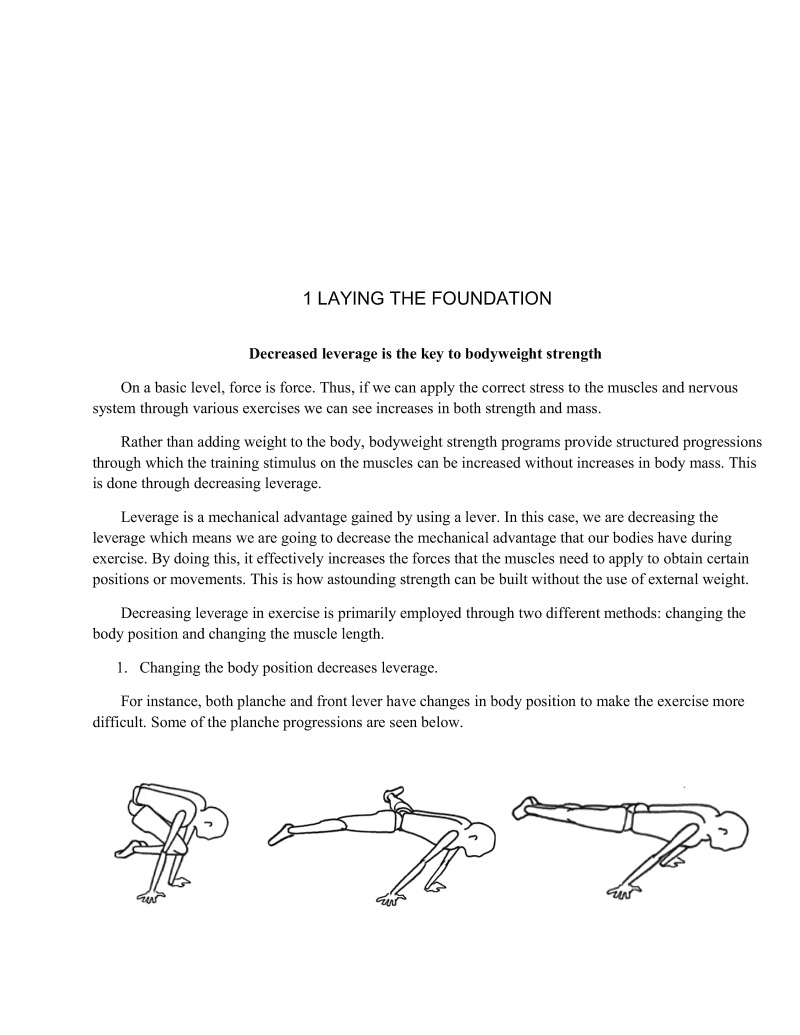
For instance, both planche and front lever have changes in body position to make the exercise more difficult. Some of the planche progressions are seen below.
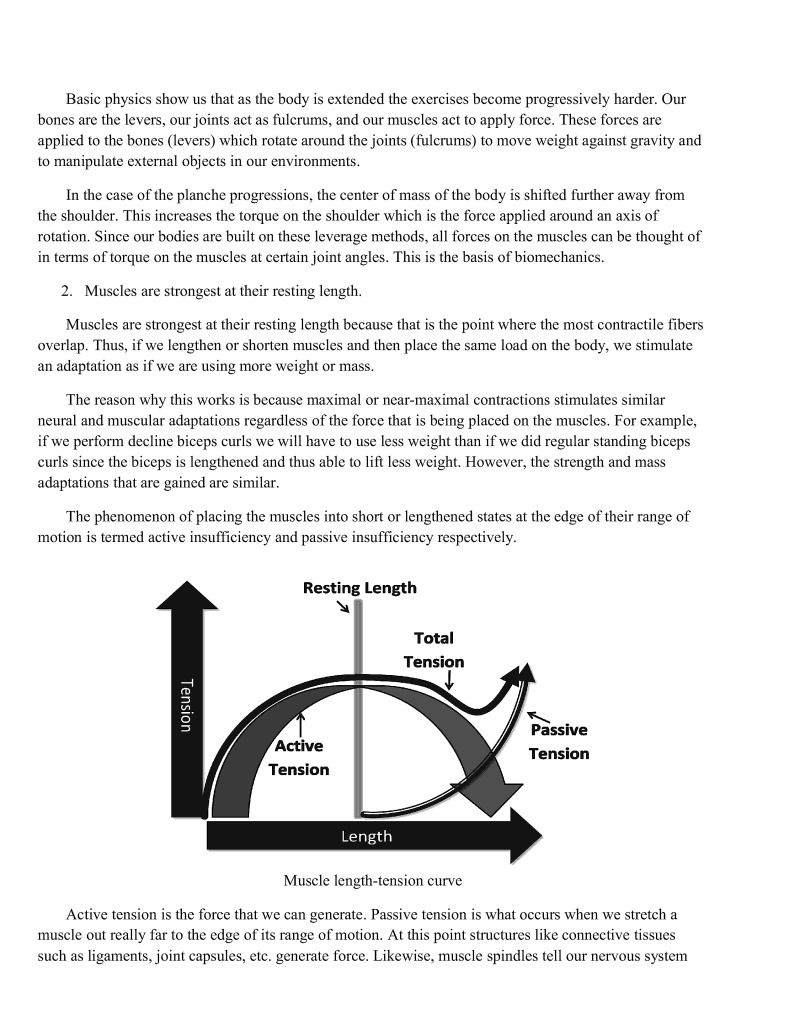
Basic physics show us that as the body is extended the exercises become progressively harder. Our bones are the levers, our joints act as fulcrums, and our muscles act to apply force. These forces are applied to the bones (levers) which rotate around the joints (fulcrums) to move weight against gravity and to manipulate external objects in our environments.
In the case of the planche progressions, the center of mass of the body is shifted further away from the shoulder. This increases the torque on the shoulder which is the force applied around an axis of rotation. Since our bodies are built on these leverage methods, all forces on the muscles can be thought of in terms of torque on the muscles at certain joint angles. This is the basis of biomechanics.
Muscles are strongest at their resting length because that is the point where the most contractile fibers overlap. Thus, if we lengthen or shorten muscles and then place the same load on the body, we stimulate an adaptation as if we are using more weight or mass
The reason why this works is because maximal or near-maximal contractions stimulates similar neural and muscular adaptations regardless of the force that is being placed on the muscles. For example, if we perform decline biceps curls we will have to use less weight than if we did regular standing biceps curls since the biceps is lengthened and thus able to 1ft less weight. However, the strength and mass adaptations that are gained are similar.
The phenomenon of placing the muscles to short or lengthened states at the edge of their range of motion is termed active insufficiency and passive insufficiency respectively.
Active tension is the force that we can generate. Passive tension is what occurs when we stretch a muscle out really far to the edge of its range of motion. At this point structures like connective tissues such as ligaments, joint capsules, etc. generate force. Likewise, muscle spindles tell our nervous system
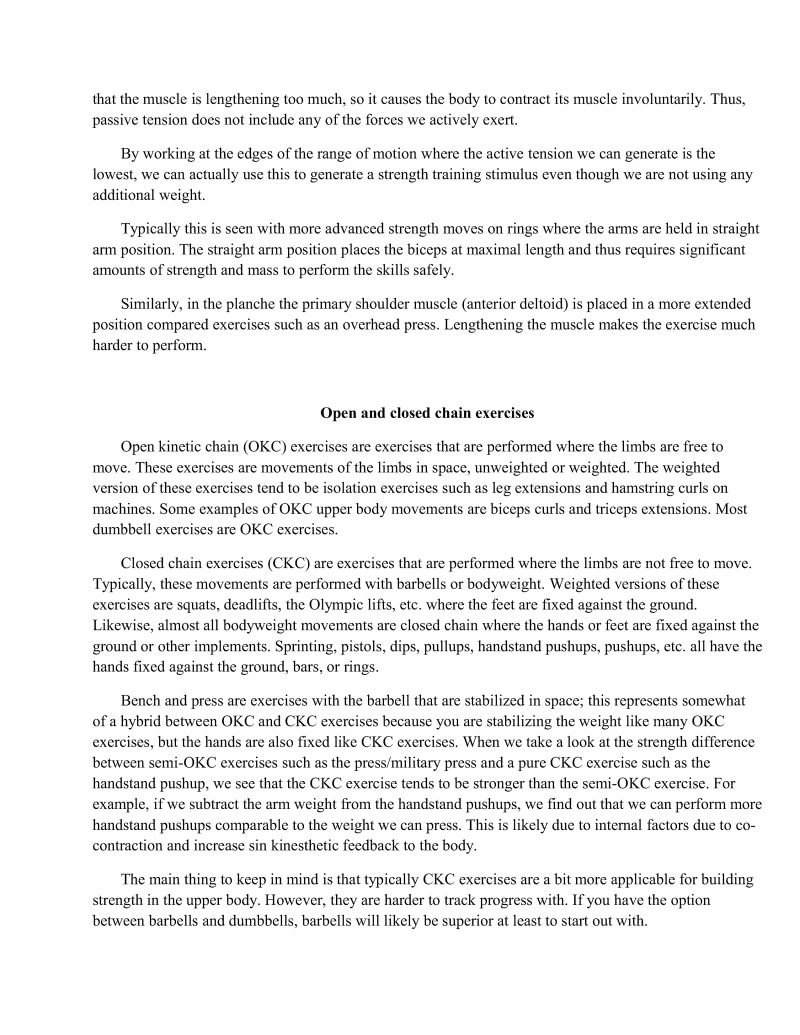
that the muscle is lengthening too much, so it causes the body to contract its muscle involuntarily. Thus, passive tension does not include any of the forces we actively exert.
By working at the edges of the range of motion where the active tension we can generate is the lowest, we can actually use this to generate a strength training stimulus even though we are not using any additional weight.
Typically this is seen with more advanced strength moves on rings where the arms are held in straight arm position. The straight arm position places the biceps at maximal length and thus requires significant amounts of strength and mass to perform the skills safely.
Similarly, in the planche the primary shoulder muscle (anterior deltoid) is placed in a more extended position compared exercises such as an overhead press. Lengthening the muscle makes the exercise much harder to perform.
Open kinetic chain (OKC) exercises are exercises that are performed where the limbs are free to move. These exercises are movements of the limbs in space, unweighted or weighted. The weighted version of these exercises tend to be isolation exercises such as leg extensions and hamstring curls on machines. Some examples of OKC upper body movements are biceps curls and triceps extensions. Most dumbbell exercises are OKC exercises.
Closed chain exercises (CKC) are exercises that are performed where the limbs are not free to move. Typically, these movements are performed with barbells or bodyweight, Weighted versions of these exercises are squats, deadlifts, the Olympic lifts, etc. where the feet are fixed against the ground.
Likewise, almost all bodyweight movements are closed chain where the hands or feet are fixed against the ground or other implements. Sprinting, pistols, dips, pullups, handstand pushups, pushups, etc. all have the hands fixed against the ground, bars, or rings.
Bench and press are exercises with the barbell that are stabilized in space; this represents somewhat of a hybrid between OKC and CKC exercises because you are stabilizing the weight like many OKC exercises, but the hands are also fixed like CKC exercises. When we take a look at the strength difference between semi-OKC exercises such as the press/military press and a pure CKC exercise such as the handstand pushup, we see that the CKC exercise tends to be stronger than the semi-OKC exercise. For example, if we subtract the arm weight from the handstand pushups, we find out that we can perform more handstand pushups comparable to the weight we can press. This is likely due to internal factors due to co- contraction and increases in kinesthetic feedback to the body.
The main thing to keep in mind is that typically CKC exercises are a bit more applicable for building strength in the upper body. However, they are harder to track progress with. If you have the option between barbells and dumbbells, barbells will likely be superior at least to start out with.
If your goal is hypertrophy, typically CKC and semi-CKC exercises work best. This means compound barbell exercises in most cases such as the squat, deadlift, bench press, etc. Also, the opposite occurs in some comparisons: the press will be superior to the handstand pushup. Since there is comparatively less body feedback in the press compared to the HSPU, there is less neural strength generated with the press. Thus, to gain strength the body must compensate with hypertrophy (increase in cross sectional area) of the muscle.
Thus, if your ultimate goal is pure hypertrophy it is generally a good idea to perform mostly barbell type exercises. This is not to say you cannot gain an impressive physique with bodyweight exercises because you can (e.g. gymnasts' physiques). It will just take longer. Thus, from a purely aesthetics standpoint you will want to be doing mostly barbell exercises.
For rehabilitation, we will primarily use OKC exercises because they are very easy to isolate specific weaknesses, target specific structures that need to be strengthened, or improve certain movement patterns. Eventually, the goal of therapy is to work our way back into gross motor CKC movements.
For example, an ankle sprain will start with more OKC exercises to help strengthen the muscles in the leg and keep them from atrophying. However, as we improve strength, range of motion, etc. we will start 10 target more gross movement patterns such as squats, running, etc. to strengthen the ankle for athletic movements. Likewise, with something like elbow tendonitis you start out with isolation exercises to rehab it back, and then to start building more strength and function based movement you will go back to pullups or other compound exercises. We will talk more about this in the injury sections.
In summary, closed chain exercises emphasize that the body stabilize itself through the core and extremities because of its interaction with the ground, parallettes, or rings. This means that bodyweight exercises tend to rely more on progressions rather than adding weight. They are extremely good in both the development of strength, proprioception, and kinesthetic awareness. When you can add weight to them such as with a weighted vest it makes progressions much easier to handle. We will discuss multiple ways 10 do this later in the sample programming section.
The benefit of more open kinetic chain exercises is that they can be regulated easier with weights. This is especially the case if there is an injury or other weakness where focused exercise may be beneficial to certain muscles, tendons, or other structures.
Al these different movements are useful in their different contexts. I assume that if you are reading this you have some interest in bodyweight strength including the various isometric hold positions that gymnastics is known for. Additionally, most people have some aesthetic goals such as looking good naked. If these are your goals then this book is a good fit for you.
We learned that decreased leverage is the key to gaining strength with bodyweight exercises. Decreasing the leverage during exercises occurs through two different methods, namely:
Additionally, OKC and CKC exercises are useful for different purposes.
CKC movements are typically better for generating strength and muscle mass. Specifically, CKC bodyweight movements are better at generating strength. CKC barbell exercises are better at generating hypertrophy. They do overlap some.
OKC exercises are good for targeting specific weaknesses or rehabbing injuries
Previous Chapter ... ... Next Chapter