|
Beyond the Grip of Realism
A Fistful of
Action-Movie Advantages for GURPS
By S. John Ross
Copyright ©1997,
1999 | Version 1.2
"I am ready man, check it out, I
am the ultimate badass. State-Of-
The-Bad-Ass-Art. You do not want to fuck with me. Check it out!
Hey Ripley, don't worry. Me and my squad of ultimate badasses
will protect you."
- from Aliens.
He was wrong. The advantages that follow are designed for cinematic campaigns. They
work best in adventures where Our Heroes are above the merely realistic,
and granted a blind eye from the Grim Reaper to indulge in heroic carnage
- flipping cars, crashing airplanes, leaping through windows 300 feet above
the ground as the terrorist bomb fills the screen with flames. GMs running
more sober adventures should forbid these rules entirely, or allow them
selectively.
In completely cinematic, pumping-blood-and-burning-cordite games (or
in four-color GURPS Supers), many of these advantages might
be given out as "campaign perks" not included in the normal price
of characters. This is especially true of the Car Crawler, Cinematic Ammo,
The Leap, and Second Wind advantages, which form a kind of "standard
package" for modern action films and comic books.
Beneficial Enemy; Variable
This is the Enemy Advantage. Somebody is out to get you, but they are
destined to fail. Whenever they try, it's an opportunity for you to look
good for the camera.
This works exactly like the Enemy disad, except you always -- always
win. Beneficial Enemies use any villainous tactics appropriate to the genre
(kidnapping dependents, holding cities hostage, and so on). They aren't
humorous unless the genre is; they're dead serious, and have no idea the
deck is stacked against them. They will typically show up at opportune
moments to make you look good in front of potential employers, friends,
or romantic interests.
In all other ways, treat this as a normal Enemy. Each session, the GM
checks for appearance, and the enemy will appear at a time in the adventure
best suited to make your character look great. Point cost is equal to the
value of a normal Enemy. A 100-point Beneficial Enemy would cost 10 points
if he appeared on a 9 or less.
The bigger the villain, the better you look. After trouncing the foe,
you get a temporary +2 to reactions for each 5-point base value of the
advantage; taking care of that 100-pointer would be worth a +4. This bonus
applies only to characters who haven't known you for a long time.
Boomer-Bullets; 5 points/level
Once per session (per level of this advantage), you can declare that
any bullet you've successfully fired at a vehicle hits a vital fuel line,
sparks a fume, cracks a capacitor bank, or otherwise triggers a devastating
explosion. The vehicle is destroyed, and any nameless NPCs inside (generic
thugs, faceless drivers, and so on), are automatically killed. Signifigant
NPCs will somehow survive unless the GM rules otherwise. Any PCs near or
in the blast must fend for themselves!
Your Boomer-Bullets can also ignite heavy machinery, barrels of fuel,
or anything else that the GM rules is volatile. In TL8+ campaigns, this
advantage also applies to shots from beam weapons. The GM should feel free
to prohibit the use boomer-bullet shots in honest sporting competition,
such as an arena battle in GURPS Autoduel.
Car-Crawler; 5 points
Any time you are required to make a DX, Acrobatics, Climbing or Jumping
roll to safely leap onto or off of a moving vehicle, or simply to hang
on to one, you will fail only on a Critical Failure, and may always roll,
regardless of how ludicrously high the penalties are. This advantage doesn't
protect you from the effects of failure in any way, and some effects of
success can be dangerous, especially at high speeds.
Cinematic Ammo; 2/5/10 points
You do not follow the normal ammunition rules (including Power Cells).
This advantage comes in three varieties, any of which may be combined:
Safe Reload (2 points): Anytime you run out of ammo during a
gunfight, you cease to be a valid target until you have a chance to reload
your weapon. You must reload as quickly as possible (using Fast-Draw and
Speed-Load skills if you have them), but no hostile action can be taken
towards you while you're loading up (more often than not, the opposition
will take the time to reload their weapons, since they can't aim or fire
at you).
Guns Everywhere (5 points): Whenever you run out of ammo in a
gunfight, roll one die. On a 1-5, there is another gun at hand (lying on
a nearby table, for instance) which is at least half-full of ammo (more
at the GM's whim); a Ready manuever is all that's needed to be armed again
(dropping your current weapon is a Free Move, as always). The guns come
from a variety of sources -- downed foes from earlier in the scene, your
own prepared stashes, etc., as appropriate. They are most often pistols
or shotguns (SMGs in some genres) -- the GM may choose or determine randomly.
Cowboy Ammo (10 points): You never need to keep track of ammo;
your guns  almost
never run out of bullets. This advantage applies to any weapon that normally
has multiple shots (it doesn't apply to single- shot weapons like many
holdout pistols, anti-tank weapons, or Dino Lasers, but it does apply to
all shotguns, including breech-loaders). Whenever you roll a Critical Failure
on a shot, however, there is a 50/50 chance that you are out of ammo, rather
than the normal result. This advantage doesn't offer special protection
from disadvantages that might result in lack of ammo, such as Unluckiness
or Absent-Minded. almost
never run out of bullets. This advantage applies to any weapon that normally
has multiple shots (it doesn't apply to single- shot weapons like many
holdout pistols, anti-tank weapons, or Dino Lasers, but it does apply to
all shotguns, including breech-loaders). Whenever you roll a Critical Failure
on a shot, however, there is a 50/50 chance that you are out of ammo, rather
than the normal result. This advantage doesn't offer special protection
from disadvantages that might result in lack of ammo, such as Unluckiness
or Absent-Minded.
Cinematic Blindness; 15 points
You can't see -- but who needs it? This is an unrealistic version of
blindness, of the sort found in martial-arts movies featuring Blind Elderly
Masters, and in films like Yellowbeard and Scent of a Woman.
The Drawbacks: Colors and details don't exist. Printed images
might as well be blank. Light is meaningless (although you can detect "warm"
light on your skin). Unlike a normal Blind character, you pay full cost
for acute senses. You still get the +1 reaction bonus in civilized societies,
though.
One-Hex Radar: Within your reach (which can be extended by a
cane or melee weapon), your senses of smell, hearing, and touch almost
entirely make up for your lack of sight. At this range, the general shape
and movement of everything is known to you. Stealth is useless against
you within your reach, and you automatically recognize, by touch, any object
or person you've touched before. Unencumbered by reliance on sight, you
learn any melee skill at +2 to your DX.
Normal Sense Rolls: You can roll against Smell/Taste to recognize
the distinctive scent of any person or animal (including lingering scents),
or to identify any familiar brand of shampoo, shaving cream, perfume, and
so on. With a Hearing roll, you can single out any conversation in a crowd
and listen to it to the exclusion of others, or recognize anyone you've
heard speak before.
Difficult Sense Rolls: With a Roll against Smell/Taste at -6,
you can accurately determine someone's mood or hair color, or get a general
idea of where they've been in the past two hours (they must pass within
your reach). With Hearing-6, you can identify bearded men, the style of
somebody's clothing, or recognize people by the distinctive sound of their
movement. You can also guess at how physically attractive a person would
be to the sighted, by considering their voice and demeanor, among other
clues.
Each new insight requires a separate roll. The GM rolls in secret; you
might be wrong, and you have no way of knowing...
Beyond your reach: You can guess at the outline of a room, with
about a 5O% margin of error for distances. You may make ranged attacks
against any living or moving target (tracking them by sound), but range
penalties are doubled. Immobile, inanimate targets may also be attacked,
but you take a further -10 to skill unless a sound indicates their location.
When you are attacked with a ranged attack, you get your normal Active
Defenses if you make a Hearing roll. If not, you may only use Passive Defense.
Deadly Karma; 15 points/level
Once per game session (per level of this advantage), you can change
any Success Roll made by your character, or against your character (such
as an enemy attack) into a Critical Success or Critical Failure.
For every time you invoke this power, the GM will turn a future Success
Roll against you in the same fashion (it need not be the same type of roll).
The GM may not kill your character outright with this (it's more deadly
to your foes than to you!), but should otherwise reserve the "karmic
backlash" as maliciously as possible to do harm to your character.
The GM may reserve backlash criticals between sessions, if he wishes.
 Fistfighter;
10 points Fistfighter;
10 points
Whenever you are one-on-one with a foe (nameless thug or Feature Villain
-- it doesn't matter), you can eliminate the possibility of a gunfight
or blade-fight by simply putting up your fists in invitation (or taking
a stylized stance, depending on how you fight). You don't have to say anything;
just the gesture is enough. Your foe must make an IQ roll, at a penalty
equal to triple any reaction bonuses you have (penalties are ignored).
If he fails, he sheathes or holsters his weapon and raises his own fists,
and the scene becomes a punch-and- kick match. If he critically fails (not
uncommon for nameless thugs), he sets his weapon down on a nearby table,
bartop, etc., rather than holstering or sheathing it. You, of course, can
maneuver to grab it during the fight.
This only works mano a mano; if you face a group of armed soldiers,
you can't coax them all into fighting you with their hands unless the GM
rules that they are truly insipid. However, an entire group of PCs with
this advantage could have that affect on an NPC group of equal or lesser
size!
If any NPC tries the "fistfight invitation" on you, you must
roll at Will-4 to resist! The same one-on-one conditions apply.
Immune to a Poison; 5 Points
There is a single drug or poison which you have deliberately built up
an immunity to. The poison can be anything, but the choice is subject to
GM approval. Increased tolerance to alcohol is covered in GURPS Callahan's
Crosstime Saloon, and is independent of this advantage. Each additional
poison costs 1 point. If none of the poisons taken are lethal, reduce overall
cost by 2.
The Leap; 5 points
You cannot be killed in an explosion unless you are trapped with it
(in a sealed bank vault, for example, or literally surrounded by multiple
large explosions), or you deliberately caused it. As long as there is a
window, balcony, cliffside, or something else to leap over or through,
you can throw up your arms and "ride" an explosive shockwave
to safety (usually against a background of expensive pyrotechnics - you're
"thrown clear of the blast").  You'll
fall either a short distance, or a long distance ending in something soft.
You take 1d-3 falling damage whenever you use this advantage (Toughness
applies; see sidebar, p.B131, for location), but are otherwise immune to
injury for the duration of the explosion. You'll
fall either a short distance, or a long distance ending in something soft.
You take 1d-3 falling damage whenever you use this advantage (Toughness
applies; see sidebar, p.B131, for location), but are otherwise immune to
injury for the duration of the explosion.
Luck Type II; 3 points/level
For every level of this advantage you have, roll a d6 at the beginning
of each game and record the result. These are "luck rolls" which
may be substituted for die-rolls once the game begins. As each luck roll
is used, it is erased. Luck rolls may be used to replace any required roll
of the dice, provided at least one die remains random (exception:
damage rolls). Luck rolls may not be saved between sessions.
For example, if you have three levels of Type II Luck and roll a 2,
a 3, and a 1 at the beginning of the game, and are then called upon to
make a difficult skill roll, you could (instead of rolling 3d against your
skill), roll 1d and use the 2 and the 1 to dictate the result of the other
two dice! The 2 and 1 would then be erased and used up. You could not use
the 2, 3 AND the 1, because at least one die must be random.
Retroactive Type II Luck is also available, for 5 points/level. This
advantage is identical to Type II Luck, except that you may roll the dice
first, and then decide whether to "spend" any of your luck rolls
to alter the roll. One of the dice rolled must remain unchanged, but the
choice is yours.
Type II Luck may be used to affect any die-roll that normal Luck can
affect.
Pacifist Weapon Master; 20 points
Only total (-30 points) Pacifists may take this advantage. A single
Combat/Weapon skill of your choice is doubled (tripled if the skill is
for ranged attacks). When you use the skill, penalties for visibility,
partial concealment, or speed are ignored. This includes total darkness
and Invisibility. Related Fast-Draw and Speed Load skills are learned at
+5. Size and Range still applies (if you are in an Old West campaign, you
can shoot off belt-buckles without harming the wearer).
If the skill is used in melee (including defensive skills like Shield
and Cloak), you get an extra attack or parry or block (as appropriate or
needed) every turn for every 5 full levels of skill above 20 (using final,
multiplied skill). You may also parry or block for others, if the attacking
weapon is within reach!
If you injure an intelligent creature (directly or indirectly), you
will suffer a nervous breakdown (use the rules under Cannot Kill Pacifism).
During the breakdown, Will rolls will be required to even touch a weapon,
let alone use it. If you are responsible for a death, triple the duration!
Rush of Pain; 20 points
You may not have either High or Low Pain Threshold. You feel pain, but
it gives you an intense rush of adrenaline! You are immune to Stun from
injury. You gain no special bonus to resist torture.
The Shock rules (p.B126) are reversed for you -- and then some. If you
are hit and injured, you will have a bonus on your next turn, rather than
a penalty! The bonus is equal to the amount of damage taken, and may be
divided in any way between your (combat-oriented) Success Rolls, and damage
rolls for hand-weapons, punches, or kicks (or more exotic body-attacks,
for nonhumans). It may not be applied to Defense Rolls.
Example: Olaf the Hirsute is struck by an axe for a total of
7 points damage, which takes him to -2 HT (he had already been wounded
earlier. On his turn, he has a +7 bonus that he can divide up any way he
sees fit. His first order of business is to make a HT roll to stay concious,
so he takes +2 to his HT to make sure he does. He then attacks the offending
axeman, taking +2 to his attack roll. If he hits, he still has +3 left
over to apply to damage! If he had wanted, he could have saved the entire
+7 for damage -- counting on lucky rolls to make sure he stayed conscious
and hit his foe.
The bonuses may not be saved between turns -- they must be used on your
next turn or they are lost.
Safety Bullets; 5 points
Whenever you make a ranged attack, innocent bystanders are ignored.
They do not provide cover for your target, and cannot be hit by missed
shots unless you critically fail your attack (incidental explosions can
still frag them, though). Other Player Characters (and your foes!) receive
no special protection.
Second Wind; 75 Points
You can be seriously injured, even killed, but when the scene is over,
you're better off. You might even rise from the rubble, brush yourself
off, and walk away.
You take your lumps normally until the scene ends ("the scene"
is left for the Game Master to define according the needs of the plot).
In the aftermath, divide the damage you took by a factor of 1d+1, rounding
in your favor. History is rewritten. If the die-roll comes up a total of
3, that 11 points of damage the spear did blowing through your torso becomes
a more palatable 3 points: the difference between minor injury and short-term
coma!
This isn't magical healing or a super-power -- those extra 8 points
of damage didn't really happen. It just looked like it. You are free to
distribute this "healing" any way you like, if the GM requires
that you keep track of individual wounds (for the Accumulated Wounds option,
or for injuries that crippled a limb). Note that crippling wounds "undone"
in this way are still considered "temporary" (p.B129) unless
the character can make an immediate HT roll.
Note: An unconscious character is still unconscious if he's at
zero hits or less. A dead character is still dead if the "second wind"
doesn't bring him back above the point which he failed his HT-based "death
check."
Stunt Driver/Stunt Pilot; 15 points
You cannot be killed in a vehicular crash as long as you're controlling
the vehicle. You can get unconscious and bloody, but even that's unlikely,
since you (but not the vehicle) takes half damage from impacts or rolls.
If using the rules from GURPS Vehicles, any vehicle you're operating has
twice the Maneuverability Rating and Stability Rating that it realistically
should. If using the Bleeding rules (p.B130), you can't bleed to death
from injuries sustained in a vehicular crash, unless you are hemophiliac.
This advantage comes in two forms for TL6+ campaigns: Stunt Driver (which
applies to all ground and water-surface vehicles), and Stunt Pilot (for
aircraft and spacecraft). Each costs 15 points. A low-tech version ("Stunt
Rider") would have similar effects for equestrians. Other effect of
the advantage:
Races and Chases: You receive a +3 bonus to any Contest of Skills
in a chase scene or race. All vehicles being equal, you don't often lose!
And even if you're in the slow vehicle, you always have a chance.
Stunts: You can, by making an ordinary skill roll against the
appropriate Vehicle skill, do all sorts of cinematic stunts (ride a cycle
safely down an escalator, angle a jet-fighter between two skyscrapers,
or anything the GM and players agree is entertaining). Ignore modifiers
and the laws of physics -- just a single skill roll and away you go (it's
all special effects anyway).
Ramps: You can use nearly anything as if it were a smooth, prepared
ramp. If you're driving a car or truck, any earth-embankment will do the
trick (and they'll almost always be handy), and you'll have the upper hand
on suddenly-parting drawbridges. If you're on a motorcyle, then cars make
good ramps (from the front) along with stairs, piles of trash, office furniture,
and stacked firewood. Furthermore, you'll always survive a deliberate jump
completely unharmed, even if your vehicle doesn't.
High-G: You are immune to "blackout" and "redout"
effects from high-g manuevers. This is mostly important to pilots, but
can matter in ultra-tech ground-racing, too.
High Vehicle Mortality: The drawback of this advantage is that
you go through a lot of vehicles, both your own and those of your pursuers.
If you run an enemy vehicle off the road, for instance, it's likely to
explode for no good reason other than "the special effects budget
allowed for it." When your own vehicle finally goes (and it will,
eventually), it's spectacular, and another one is always available soon
after to borrow or steal.
Truly Badass; 75 points
You are the shape emerging from the flaming wreck, the spectre of justice,
the silent killer, the daring pilot, the suave agent. You're a badass,
and every ounce of confidence is justified.
This advantage represents the many perks of being a cinematically- competent
individual, and falls somewhere between a special kind of Luck and a special
kind of Charisma. The GM should require that any character purchasing the
Truly Badass advantage be able to back it up with real ability -- the Truly
Badass are at the top of their field: healthy, assured, and capable of
getting the job done (whatever the job might be).
Important to many facets of the truly badass is the "Scrub"
-- any character with 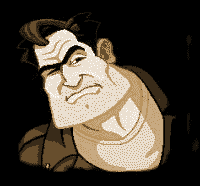 no
real identity, unworthy as foes. Nameless thugs are scrubs. Generic congressmen
wandering through a crowd scene are scrubs. Almost all security guards
are scrubs. If the GM has assigned the character a motive that extends
beyond a single scene, he probably isn't a scrub. no
real identity, unworthy as foes. Nameless thugs are scrubs. Generic congressmen
wandering through a crowd scene are scrubs. Almost all security guards
are scrubs. If the GM has assigned the character a motive that extends
beyond a single scene, he probably isn't a scrub.
The many facets of the Truly Badass:
If it isn't important, you can just kill it: That's without a
die- roll of any kind. By taking a one-second Attack maneuver, any Scrub
becomes dead. Or they can become unconscious or maimed, if you feel like
it. They must be within reach (or yards equal to your DX, for ranged weapons).
Characters or foes of signifigance (GMs discretion) are immune to this.
If you have multiple attacks you can make multiple kills.
If it's weaker than you, it's scared: Crowds of Scrubs will part
to let you pass. Furthermore, they must make a Will roll in order to attack
you. When they do attack you, rules such as Buck Fever (p.CII65) are appropriate,
if the GM enjoys them.
If it's recognizable, you recognize it: If you have Driving skill,
you can identify a model of sports car by the purr of the engine. If you
have Guns skill, you can identify a model of pistol by the sound of the
safety releasing. If you have Savoir-Faire skill, you know an Armani on
sight, and so on. This requires an IQ roll.
If you want to be there, you are: In an action scene, when nobody
is looking, you seem to move like a ghost, appearing out of nowhere. You
may use a Move maneuver to get anywhere in a single turn (into an air-vent,
on top of an elevator, beneath a stairway), silent and undetected, provided
it is within [Move] yards, and you are unobserved. No die-roll is needed
(see the opening scenes of The Professional for this).
If you want to be noticed, you will be: When you decide to be
conspicuous, you are. Crowded rooms will hush slightly when you
enter, and people will pay attention. Nobody will forget you.
If it's mechanical, it likes you: Your motorcycle can explode,
but it never breaks down. Your gun can run out of ammo, but it never jams.
Your laptop can be fragged by an antitank weapon fired through the window,
but you don't experience irritating system-crashes. You take great care
of your equipment, and it never fails you in any mundane way. This doesn't
protect you from the failures of experimental equipment.
If you play, you win: You can never lose a Quick Contest with
a scrub -- the dice need not be rolled. You just win. Likewise, any skill
roll made against a scrub will  succeed
-- you will automatically Fast-Talk them, seduce them, Intimidate them,
and so on. succeed
-- you will automatically Fast-Talk them, seduce them, Intimidate them,
and so on.
Note that while this advantage is useful for sweeping aside the rabble
(and speeding play), it should be used to enhance roleplaying, not to sidestep
it. Saying "I kill the twerp with the Beretta pointed at me"
isn't enough; the player must always describe
his Badass exploits for the amusement of those at the gaming table.
"I flip the Beretta's muzzle back into his gawping mouth and
squeeze his hand on the trigger" is much more amusing.
For 50 points, a character can be merely "Badass." He may
choose any three of the above traits to comprise the advantage. Both Badass
and Truly Badass characters are automatically immune to things like the
flu, getting their shirts stuck in their fly, and other minor problems
of the mundane world, as a matter of style.
Up to the Challenge; 50 points
You are an action hero, and action heroes can handle any kind of action!
You might not be able to pilot a Jet-Ski for recreation, but if you need
to chase an enemy across a lake, you'll handle one like a pro. If a conflict-action
scene (including chase scenes and sports conflicts) requires a physical
Animal, Athletic, Combat/Weapon, or Vehicle skill that you lack, you gain
it for the duration of the scene at a level equal to your DX (IQ-based
gun-bonuses and other special modifiers are ignored).
At the end of the adventure, you may put one of your earned Character
Points into any skill this advantage granted during play. Optionally, the
GM may require you to. From then on, you'll really have the skill, and
all normal rules for it apply. This advantage is especially appropriate
for action heroes with long, serialized careers (James Bond or Mack Bolan
types).
For a variant form of this advantge, click here.
Enemy Magnet; 5 points
You have an uncanny knack for earning the lethal emnity of villains.
Any Bad Guy (GMs discretion) that is ever harmed or inconvenienced by you
(even indirectly) will hate you for it, developing a savagely paranoid
view of you and and obsessive desire to pay you back, even if it means
being distracted to their own defeat... Thus, the rest of the party can
use you as valuable bait. A dangerous, double-edged advantage, best suited
to the very lucky, the very cocky, or the willingly-martyred.
Thanks to the faithful playtest crowd among the Lower Reprieve Generals.
Special thanks to Marty Franklin, a true swashbuckler (and afficionado
of atrociously schlocky films), and Clint Gaige, the "Action Movie
GM" of Fredericksburg, Virginia. Both provided the inspiration, comments,
and critiques that made these rules fly.
Thanks also to the (now long-deceased) io.com GURPS discussion
forum, for their comments on the Truly Badass advantage.
Original HTML conversion by Incanus;
go visit his page now!
Then return to the Blue Room. That's my home
page! Or head back to Gunmetal Blue. That's my
action GURPS page! Or read this
very same article in Italian, 'cause it's just too cool to be constrained
by a single language!
The cartoon guy? That's Ben, the star of Full Throttle,
a sadly out-of-print classic adventure game by Lucasarts. If you've played
the game, you know why I picked him to illustrate Truly Badass. Now go
play the game. You can still find it around if you hurry. Go. Shoo.
The girl? Oh, that's Amy Yip. She's in lots of cool Hong Kong films.
Most of them aren't really action movies. And, okay, she's not exactly
holding a gun or being a cop or hitting somebody. But it's a nice picture.
Go. Shoo.
|