As France and Germany struggled to become strong, two other empires were fighting to keep the land they had claimed for themselves.
Far south of Japan, six good-sized islands lie among a thick scattering of tinier ones. Today, this cluster of islands is called the Indonesian archipelago (group of islands). But a hundred years ago, the islands were known as the “Dutch East Indies.”
Why were these islands in southeast Asia called “Dutch”? Two hundred years earlier, merchants from the Netherlands formed a trading company to build trading posts in the east, so that Dutch ships could land and buy cinnamon, nutmeg, and pepper. Like the British East India Company, the United Dutch East India Company built some trading posts in India. But most of the Dutch trading posts were built further east, on the islands called the “East Indies.”
Before long, the government of the Netherlands took over the control of the ports from the United Dutch East India Company. And at the same time, the Dutch government also took control of most of the East Indies. The East Indies would become part of the Dutch Empire.
The Dutch also wanted to claim the island of Sumatra, which lay north of the East Indies. But the British also wanted Sumatra. Great Britain had already seized Singapore, the city that lay on the very southern tip of the peninsula that jutted down from the mainland of Asia, almost touching Sumatra. If the Dutch were in Sumatra, they would be far too close to British territory!
In 1824 the two countries came to an agreement. The Dutch would promise never to attack Singapore, and they would give the British all of the Dutch ports and settlements in India. In return, the Dutch could have Sumatra as their own.
But there was a catch: the Dutch had to allow the kingdom of Acheh, on the northern end of Sumatra, to stay independent. That way, Acheh would be like a “neutral zone” (an area that neither country could claim) between the British in Singapore and the Dutch in Sumatra.
At first, this arrangement seemed to work. The East Indies poured money into Dutch pockets. The islands were rich in all sorts of wonderful things: gold, rubies and sapphires, coal for running steam engines. The warm damp fields were perfect for growing coffee, tea, and rubber plants. Under Dutch rule, the farmers of the East Indies had to set apart one fifth of their land to grow crops for the Dutch. And they had to spend three days a week working on this land, rather than on their own. The Dutch knew that farmers would be reluctant to spend so much time working for their foreign rulers. So they promised mayors and chiefs in every part of the East Indies part of the profit from these “official” crops.
Many of the local officials saw a chance to get rich. They agreed—and even forced their people to work harder than the Dutch asked. In some communities, the farmers worked on the Dutch land for two hundred days every year! The chiefs and mayors grew rich, the Dutch had more money than they knew what to do with—and the farmers who were laboring their lives away grew angrier and angrier.
Small revolts broke out here and there. Soon the government of the Netherlands realized that the little independent kingdom of Acheh was encouraging these rebellions. One Dutch official fumed, “Acheh is nothing but a pirate’s den!”
But the Dutch didn’t want to anger the huge British Empire by attacking Acheh. So in 1871, the Dutch negotiated another treaty with Britain, called the Sumatra Treaty. In the treaty, Britain gave the Dutch permission to take over Acheh as well.
In 1873 the Dutch invaded Acheh with three thousand men. They didn’t realize that the fighting would go on for more than thirty years.
The people of Acheh refused to yield. Muslim leaders, army captains, city chiefs, and even women fought fiercely to keep the Dutch from conquering their country. A young woman named Tjoet Njak Dien became one of Acheh’s fiercest warriors. Her father and her husband were both soldiers in Acheh’s army. When the Dutch seized Acheh’s capital city, Dien, her father and her husband fled into the jungles. There, they began a guerrilla war (a war fought from hiding, rather than with an organized army on regular battlefields). When her husband and her father were killed, Dien took over the job of guerilla commander. She married another guerilla leader. They fought side by side. In the middle of the war, Dien gave birth to a baby girl—and carried her into battle too.
Dien and her husband knew that in order to resist the Dutch, the guerillas needed better weapons and more ammunition. So together, they formed a plan. Both of them came out of hiding, found a camp of Dutch soldiers, and walked right into the middle of it. “We want to surrender!” they said. “We were wrong to fight against you. Please, let us help you in your war against our rebellious countrymen.”
The Dutch were so pleased by this “surrender” that they gave Dien’s husband a medal, and put him in command of an entire army unit. The people of Acheh were horrified. Dien and her husband seemed to be traitors to their country. But the two were carefully studying Dutch strategy, learning to use Dutch weapons, and listening carefully to Dutch plans. One by one, they recruited Achenese soldiers into the Dutch unit. But these soldiers were really freedom fighters, guerillas from the jungle who were only pretending to be loyal to the Dutch.
As soon as there were enough Achenese in the unit, Dien’s husband led his unit off to battle—and never returned! He took all of the guns, ammunition, and cannon with him, and gave them to the Achenese. With the help of these new supplies, the guerrilla fighters managed to drive the Dutch soldiers back.
But even so, the war dragged on for years and years and years. For twenty-four years, the husband and wife fought on. Finally, Dien’s husband was killed. By now, Dien was fifty-one years old and had spent most of her life fighting in the jungle. She was beginning to weaken from illness. She had lost most of her eyesight, and now she had lost her husband. But she refused to give in.
In 1901, after almost thirty years of war, Dien was captured by the Dutch. They sent her to live under guard, far away from her home. Even in exile, she came to be known as Ibu Perbu: The Queen.
Two years later, in 1903, the Dutch finally gained control over Acheh. But the long war had been so expensive that the Dutch government had been forced to spend all the money it had made from the East Indies.
______________________________________
Note: This country’s name is now spelled Aceh, but in the nineteenth
century, it was known as Acheh.
It was a cold, dark morning in the Russian city of St. Petersburg. The wind howled over the crowded roofs, whisking snow from the wooden tiles and whirling it along the icy cobbled streets. It was ten degrees below zero—cold enough to freeze the fingers and toes of the British ambassador (an official messenger or representative that one country sends another). But the ambassador was waiting in the audience room of the Winter Palace, where a huge fire had been built in the cavernous hearth. The fire had warmed the room until it was almost uncomfortably hot.
The ambassador heard a cough from the door. He stood up. The czar of Russia was hobbling towards him, an attendant on each side.
The czar, Nicholas I, settled himself carefully in a chair near the fire. He had been sick with a high fever for several days, but he had decided to get up out of bed to greet the ambassador.
For a little while, the two men talked of small matters. But Nicholas I had something more serious in mind. He leaned forward.
“We have a sick man on our hands,” he said.
For a moment, the British ambassador was puzzled. Was the czar speaking of himself?
“A sick man,” the czar repeated, “a man gravely ill. It will be a great misfortune if one of these days he slips through our hands, especially before the necessary arrangements are made.”
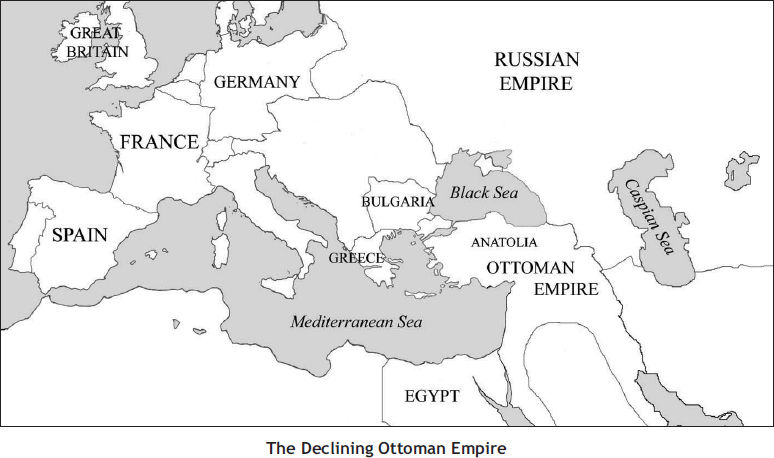
Now the ambassador understood. The czar was speaking of the Ottoman Empire—the sprawling country just south of Russia, that stretched from the Tigris and Euphrates Rivers, all the way across Asia Minor, into the Greek peninsula. The Russians wanted to take part of the Ottoman Empire for itself. And they hoped that Britain would be their ally, not their enemy, as they made the “necessary arrangements” to conquer the Turks.
Why did the czar call the Ottoman Empire a “sick man”? For many years, the Ottoman Turks had been growing weaker and poorer. The sultans who ruled over the Ottoman Turks had spent so much money that they had to borrow money from other countries just to pay the soldiers in the Turkish army. And although the sultan still claimed to rule over a vast empire, at least three parts of that empire had started to ignore the sultan. The people who lived in the mountainous land north of Greece, which the Turks called the “Balkans” (the Turkish word for “mountain”), were doing exactly what they pleased. So were the people of Anatolia, right in the middle of Asia Minor. And so were the Lebanese, on the eastern coast of the Mediterranean.
The Ottoman Empire was certainly sick! And the British ambassador knew exactly what the czar was saying—that it was time to take over the Ottomans. But he also knew that Russia would grow larger and stronger if it added Ottoman land to its own territory. His job was to tell Russia what the British government would think of this idea; and Great Britain didn’t want Russia to grow larger.
The ambassador smiled at the czar. “A sick man should be taken care of by a physician,” he said. “He should be helped to recover—not have his limbs amputated by a surgeon!”
After this, Nicholas I knew that Great Britain would not help the Russians fight against the Turks. As a matter of fact, Great Britain was more likely to fight against Russia. Do you remember reading about the Crimean War? In 1853, the Russians had marched south into Ottoman territory, hoping to claim some of it for their own. But the British and the French had forced Russia to give up all of the land it took from the Turks. Neither country wanted Russia to get any bigger—or any more powerful.
But the Russians had not given up the idea of attacking the Ottoman Empire, the “sick man of Europe,” again.
In 1876, Russia got its chance.
The sultan of the Ottomans, a big, cheerful man named Abdul Aziz who enjoyed parties and good eating, was having trouble with Bulgaria. Bulgaria lay just south of the Russian border, on the western coast of the Black Sea. It had been part of the Ottoman Empire for more than four hundred years, but the Bulgarian people had never been content with their Ottoman overlords. They called the Ottoman rule “the Turkish yoke.”
Now, young revolutionaries in Bulgaria were busy preaching that Bulgaria should be independent. The Young Bulgarians, like the Young Italians who fought with Garibaldi, wanted their country to be free from the Turks. Instead, they wanted Bulgaria to have a modern constitution, like the constitution of the American states.
In April 1876, the Bulgarian revolutionaries picked up weapons and rebelled against the Turks. But these revolutionaries weren’t as well organized as the revolutionaries of Italy. They were scattered all over Bulgaria in little groups. Abdul Aziz and his officials didn’t hesitate. They ordered the Turkish army to march into Bulgaria, kill the revolutionaries—and kill anyone who had helped them.
The soldiers obeyed their orders. Many Bulgarians who didn’t even know the revolutionaries were murdered. Sixty villages were wiped out. By the time the army had finished putting down the April Uprising, almost twelve thousand Bulgarians were dead.
The rest of Europe was shocked by this bloodshed! Over in Germany, Bismarck told the German people that the Turks should no longer be treated as part of Europe. In Italy, Giuseppe Garibaldi condemned the sultan for his cruelty. The prime minister of Britain announced that European countries should rise up together and drive the Turks out of Bulgaria.
Meanwhile, Abdul Aziz was in trouble. His own people had turned against him. On May 30, a little more than a month after the bloodshed in Bulgaria, Turkish rebels marched into the palace in the middle of the night. Abdul Aziz ran out of his room in his huge nightshirt, waving a sword! But when he realized that he was outnumbered, he agreed to give up his throne.
Four days later, Abdul Aziz was dead. His doctor said that he had committed suicide—but a British doctor who saw Aziz’s body said that he had been murdered.
The Ottomans needed a new sultan. So they chose Murad V, the nephew of Aziz. Murad had never been either clever or brave. When he heard about Abdul Aziz’s death, he fainted, and then spent two days throwing up. Afterwards he sat on his new throne for hours, rubbing his chin with his right hand. Before long, it became clear that Murad V had lost his wits.
So after just ninety-three days, the Turks sent Murad V away for a long rest.
Murad’s brother, Abdulhamid II, became the new sultan of the Ottoman Empire. He knew that the empire was bankrupt, filled with rebellion, and threatened by the other countries of Europe. He did his best to make the “sick man of Europe” better. He announced that the empire would have a constitution, like the modern Western countries. The Ottoman Turks would even have an assembly that would meet together to make laws.
Abdulhamid worked hard for his country. Even the British ambassador praised him, calling him a man with “kindliness of disposition and enlightened views.” But even Abdulhamid could not keep the Russians away. Russia had long wanted Ottoman land—and now the Russian army had the perfect excuse to invade. The czar pointed out that when the Turkish army had wiped out Bulgarian villages, Muslim soldiers had killed many Bulgarian Christians, and that the Christians of Russia were obliged to help protect their fellow believers. The Russian army began to march south towards the Ottoman borders. Thousands of Bulgarians flooded to join them and to fight against their Ottoman oppressors. Four months after fighting began, the Russians had taken away much of the Ottoman land, and were getting close to Istanbul itself.
By January of 1878, the Ottoman forces had begun to crumble. By March, it was clear that Russia had won the war. Abdulhamid was forced to sign a treaty that would give Bulgaria its independence. Russia took part of Anatolia (the area we sometimes call “Asia Minor”) for itself. Under the treaty, the Ottoman Empire lost half of its territory!
Abdulhamid still sat on the Ottoman throne. But the sick man of Europe had had most of his limbs amputated, just as the Russians wanted. The Ottoman Empire would never again be a world power.