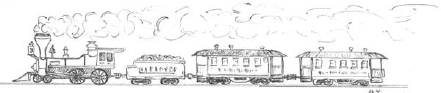
On a warm spring morning in Utah, a crowd of men and women milled around two vast train engines, sitting nose to nose on a brand-new railroad track. But they weren’t worried about the engines crashing. These two engines, nicknamed “Jupiter” and “Engine 119,” had been driven towards each other on the same track, one from the east and one from the west. They met each other at Promontory Summit, Utah, on May 10, 1869, and stood facing each other over a gap in the track. A single piece of track was missing—the piece that would finish the first railroad track to run all the way across the entire United States.
Two railroad officials stepped forward to help lay the last railroad tie. It was a special tie, made of polished California laurelwood, with four holes drilled in it for the last four spikes: a golden spike made by the railroad company, two silver spikes donated by the states of Arizona and Nevada, and a last gold spike sent by a newspaper in San Francisco, California.
The officials slipped the four spikes through four holes in the laurelwood tie, and tapped them in with a special silver hammer. But the laurelwood tie wouldn’t stand up to the weight of a train, so immediately the special tie and spikes were taken out and sent to a museum. A regular old pine railroad tie was put in its place. The two officials took turns swinging a real hammer at the last iron spike. The first official took a huge swing—and hit the tie, missing the spike altogether. Then the second official took a swing and missed both the spike and the tie! An experienced rail worker had to pick up the hammer and knock the spike in instead.
The railroad across the United States was finished. For seven years, twenty thousand men from as far away as China had been building for twelve hours a day, blasting passes through mountains with dynamite and stretching bridges across rivers and valleys. Now the railroad ran unbroken from coast to coast. Before the railroad was built, a businessman from New York who wanted to travel to California had to take a month-long journey by stagecoach, or sail in a steamship all the way around the coast of South America. Now he could reach the opposite coast in just five days!
Soon more and more railroads were built across the west. Trains carried people to cities where they might never have settled. Companies made tremendous amounts of money from shipping grain, cattle, coal, and other loads to far-away places of the United States. Railroad tracks crisscrossed the wild prairie lands.
And railroads also changed the way people kept time.
For as long as anyone could remember, cities all over the world set their own clocks by looking at the sun. When the sun was at its highest point in the sky, it was noon. But because the surface of the earth curves, noon for a city on the East Coast comes sooner than noon for a city a little further west. In 1869, when clocks in New York City read twelve o’clock noon, clocks in Boston read 12:12. And in a city in California, it might be 8:32 a.m.—or 8:47. How could trains, moving quickly across the hundreds of miles between cities, ever be able to tell passengers when they would arrive?
Ten years after the last spike was driven at Promontory Summit, a Canadian railroad engineer named Sir Sandford Fleming suggested that it might be a good idea to divide the world into twenty-four time zones. Each one of the zones would stretch from the North Pole down to the South Pole, like a thin slice of an apple. In each time zone, clocks would be set to the same time. Now, Boston and New York would reach noon at exactly the same moment. And when you travelled from one time zone to the next, you would move exactly one hour ahead or behind. Noon in Virginia would always be exactly nine a.m. in every city in California—not 9:13 or 9:21.
Railroad engineers welcomed Fleming’s idea. On November 18, 1883, cities all across the United States reset their clocks to match the new time zones. Time had become *standardized—*kept according to the same rules across the whole United States (and, eventually, across the whole world).
Railroads and time zones began to change the way people in the American west thought about the world.
The world no longer seemed quite as large as it once had. Making and selling goods to as many people as possible was becoming easier and easier. Local towns and small villages were changing, thanks to the ideas and inventions that came to them from large cities. And it seemed simpler than ever to come up with inventions that would make life better and better. The United States, along with the other countries of the West, was becoming modern.
One more invention joined with railroads and time zones to make the world more modern. In 1879, the scientist Thomas Edison unveiled his new creation: a light powered by electricity.
Edison had tried for years to come up with a way to use electrical currents to light up homes and businesses after dark. He and his assistants had tried three thousand different designs! Edison was so obsessed with his experiments that, on his wedding day, he forgot he had gotten married and went to his lab—leaving his new wife at home alone.
Finally Edison managed to seal a filament (a strand that could be made to glow with electrical energy) into an airtight glass bulb. As long as no air reached the filament, it wouldn’t burn up. It would just shine with power.
Edison’s first “light bulbs” only lasted for a few hours. But Edison kept on testing different kinds of filaments—thousands of them. He tried hickory wood, cedar wood, flax stalks, bay wood, and boxwood. He sent off to tropical lands for new and different kinds of wood. At last Edison’s bulbs would stay lit for fifteen hundred hours before the filament burned out.
Next, Edison and his lab helpers worked on developing a whole system to run these lights: wires, cable, generators, light sockets, and everything else needed to light up a whole building—or a whole city. At first, Americans were suspicious of these new lights. When the storekeeper John Wanamaker decided to put electric lights into his huge Philadelphia store, shoppers wouldn’t go through the doors. They were sure that the bulbs would go off like little bombs at any moment! But the bulbs didn’t explode, and soon more and more stores, factories, and even homes were using electric lights.
The human invention of the railroad had conquered space; now, it didn’t matter if a company was hundreds of miles away from the people who bought its goods. The human invention of time zones seemed to have conquered the challenge of time; now, people set their clocks according to time zones, not according to the sun. And electric lights had conquered the dark. Dusk was no longer the end of the working day. Now, men could go on laboring, long after sunset!
With the help of railroads, time zones, and electric lights, the United States was moving towards modern times. The country of Japan was beginning the same journey.
In 1854, fifteen years before the engines met at Promontory Summit, Matthew Perry had convinced Japan to open its ports to American trade. But many Japanese were unhappy that the shogun had allowed his officials to sign the trade treaty. The treaty gave the United States plenty of privileges in Japan—but it didn’t do much for the Japanese. Four years later, when a Japanese official signed another agreement allowing Americans to settle down and live in Japan, a group of samurai ambushed him and cut his head off as punishment.
But although the Japanese didn’t want the United States to take advantage of Japan, most Japanese also knew that Japan could no longer stay isolated from the West. It seemed that the Tokugawa shogunate, which had ruled Japan for over 250 years, just couldn’t manage to deal with the problems of a modern Japan.
Twelve years after the treaty was signed, the Tokugawa shogun died. A young man of twenty-nine, Tokugawa Yoshinobu, became shogun in his place. He could see that the power of the shogunate was tottering. At once, he started to make changes. He tried to strengthen Japan’s navy, and promised that he would throw all foreigners out of Japan. But it was too late for the shogunate. Rebellious daimyo (Japanese noblemen) had already gathered, demanding that Yoshinobu resign and end the Tokugawa shogunate for good.
Yoshinobu could see that a civil war would only weaken Japan, and make his country even less able to stand up to the United States and the other countries of the West. So in 1868, he agreed to resign. He was marched off to his house and put under guard. In his place, the daimyo put the seventeen-year-old emperor on the throne of Japan—the emperor who had been completely powerless as long as the shoguns governed in Japan. Edo, the city where the shoguns had once ruled, was renamed Tokyo and became the emperor’s imperial city.
For a year, Japanese loyal to the shogunate fought with Japanese who were loyal to the emperor. Finally the last army of shogunate loyalists—over twenty thousand men—were driven back into a castle and surrounded by thirty thousand of the emperor’s troops. Then the emperor’s army destroyed the castle with guns and cannon that they had bought from the West.
Now a new time had begun in Japan. The daimyo who had helped the emperor regain his throne called it the “Meiji Restoration,” because they insisted that the traditional imperial rule of the emperor was being “restored.” But in reality, the emperor had no more power than before. Now Japan was ruled by the educated daimyo who surrounded him and told him what to do.
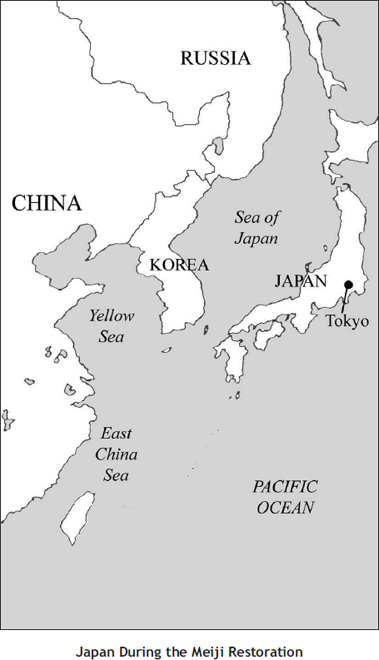
These daimyo wanted to know the ways of the West so that Japan could stand as an equal to any Western nation. So they sent young men to Europe to go to school. They hired French experts to come to Japan, build a dockyard, and teach the Japanese to build ships and repair them. American miners were hired to show the Japanese how to dig coal mines. British factory experts were brought in to build a spinning factory and to train spinners. By 1872, all Japanese were told that they needed to wear Western clothes, not Japanese robes, at all official ceremonies and meetings.
And an even more startling change came next. Less than ten years after the end of the shogunate, in 1876, the samurai were told that they could no longer carry swords in public at all. At this, they revolted.
The samurai knew that giving up their swords meant that their whole way of life was ending. For centuries, Japan had been a feudal society—a society in which each person served someone else in return for privileges and favors. The shogun promised to protect the noblemen of Japan, the daimyo, and granted them land to live on; in return, the daimyo promised to provide the shogun with food and all his needs. Then the daimyo gave castles to the samurai, the warriors; in return, the samurai fought to protect them. The samurai were the only Japanese men who had this special job of protecting the daimyo, and so they were the only men allowed to carry swords.
But now there was no shogun. Instead, Japan had an emperor—and now, a new army. This army would be made up of conscripts (men ordered to serve in the army, in exchange for money), not samurai. Like armies in Western countries, soldiers in Japan were now supposed to fight in return for a salary, not because they owed a feudal obligation to a nobleman!
The samurai didn’t want to lose their power—or their right to live in the castles of the daimyo. So when they were told they could no longer wear their swords, they gathered together in a samurai army to fight against this new army of peasants with guns. They were led by a samurai warrior famous for his strength, Saigo Takamori.
The new army of conscripts was called out to face the samurai. But the peasants with guns were more powerful than the trained Japanese warriors with their swords. Rank on rank of samurai fell as the guns boomed. When he saw that the samurai were doomed, Saigo Takamori killed himself. His rebellion, the Satsuma Revolt, had lasted less than a year.
By 1884, Japan had a new constitution. It had been written by a Japanese statesman who admired Bismarck so much that he had travelled to the new German state to see how it was run. The constitution that he wrote made Japan’s government much like the German government. Japan’s emperor was the “head of state” in Japan, just as Wilhelm II was the king of the German state, but a “cabinet” (a group of advisors, such as a prime minister) actually made policies for the country. Japan would also have two assemblies, made up of educated and intelligent Japanese representatives. These assemblies would pass laws for Japan.
Does this sound familiar? It should. Japan was beginning to adopt the form of government used in the West. Even though this time in Japan’s history is known as the Meiji Restoration, the power of the emperor wasn’t really “restored” at all. The emperor was little more than a symbol—a symbol of faithfulness and loyalty to Japan.