Like Great Britain, France was an empire that ruled colonies across the world. But France had not always been an empire. As a matter of fact, by the year 1871, France had been a monarchy once, an empire twice, and a republic three different times! And the two empires and three republics had all come within a hundred years of each other.
Before we visit the French Empire, let’s look back at this unstable history. Until the year 1789, France was a monarchy, governed by kings who belonged to the royal Bourbon family—and who claimed that God gave them the right to rule exactly as they pleased. But the French wanted to be a republic, like the brand-new United States of America. They wanted to elect their own leaders, not submit to the tyranny of kings.
So in 1789, the French revolted. During the French Revolution, the king was executed (along with thousands of aristocrats), and France became a republic for the first time. But the first French Republic was filled with bloodshed, unhappiness, and unrest. When an army general named Napoleon Bonaparte seized control of the government and had himself crowned Emperor, the First Republic of France ended. But many French were simply grateful that someone was willing to bring order to the chaos of France! Now Napoleon had become Emperor Napoleon I, and the First French Empire had began.
After Napoleon, two kings from the Bourbon family reclaimed the throne of France and continued to rule over the First French Empire. But the second of these kings, Charles X, returned to the old bad ways of ruling France. He refused to listen to the wishes of the people of France, and did as he pleased. He even told newspapers what they could and couldn’t publish.
Once again, the French revolted! This revolution was known as the Three Glorious Days, or Les Trois Glorieuses, because it only lasted from July 27 to July 29, 1830. In Paris, indignant Frenchmen turned over wagons and carts in the streets and piled paving stones, small trees, and iron railings ripped from the fronts of houses over them to make huge barricades. They hid behind these barricades, shooting at the French army, which was trying to clear the barricades away and arrest the rebels. Charles X was forced to flee to England!
But the revolutionaries disagreed about who should take Charles’ place. Many Frenchmen, like the Marquis de Lafayette, wanted France to be a republic again. Lafayette had helped the American colonists fight for their own independence from the British king. Now he wanted to see France free from kings as well.
But another, stronger group of Frenchmen wanted France to become a constitutional monarchy, like Great Britain. France would still have a king, but this king would have to obey a written set of laws, instead of doing whatever he pleased.
Finally Lafayette decided to help end the revolution by agreeing to a constitutional monarchy. He went before his followers, wearing the flag of the French kings around his shoulders like a shawl, and convinced them to join with the other revolutionaries to put a king back on the French throne.
So one of the republican leaders, Louis-Philippe, became the new king of France. Louis-Philippe wasn’t supposed to be an absolute ruler, like the Bourbon kings. Instead, he was called the “Citizen King,” because he was supposed to act only by the wishes of the people. “He reigns,” one of his supporters explained, “but he does not govern.”
The First Empire still existed, but now Louis-Philippe, the Citizen King, was at its head. But all the time that Louis-Philippe reigned, the French revolutionaries who had wanted a republic kept on complaining, writing, and speaking about the dangers of a king. Two revolutionaries even tried to assassinate him by planting a gunpowder bomb on the street where an official parade was due to pass by. When the bomb exploded, the courtiers and soldiers around it were killed—but Louis-Philippe survived.
After eighteen years of Louis-Philippe’s reign, his enemies planned a huge gathering in Paris. They hoped that the crowd would decide to throw the Citizen King out, and bring a republic back to France. When Louis-Philippe saw the enormous mass gathering, he ordered that the gathering be cancelled and sent the French army out to disperse the meeting.
The crowd that had gathered was furious! Once more, their king was trying to use force against them, in order to get his own way. They stormed the palace gates and broke in, flooding through halls, smashing royal dishes, pulling all of the gold coating off the furniture, and taking turns sitting on the royal throne. Louis-Philippe jumped into a horse-drawn carriage and drove out of Paris. When he was stopped, he announced that his name was Mr. Smith. He got out of the city, and, like Charles X before him, sailed for England.
The year was 1848. The Citizen King was gone, and so was the First Empire. Now the Second Republic would begin.
The leaders of the Second Republic started out by writing a new constitution—one that looked very much like the American constitution. It said that every man in France would be allowed to vote for a president, and also for representatives who would gather together in an assembly and make laws. The president would only be able to govern for four years. That way, no one man could gain too much power in France.
But when the first elections for president were held, something very alarming happened. The winner of the election turned out to be Louis-Napoleon Bonaparte, the nephew of the first French emperor, Napoleon himself!
Was the Emperor Napoleon’s nephew the right man to be president of a French republic? Many people were skeptical—but Louis-Napoleon had gotten millions more votes than any other candidate. So he was sworn in as president of the Second French Republic.
But Louis-Napoleon couldn’t convince the elected assembly of France to do what he wanted. The assembly wouldn’t give him all the money he wanted. And they wouldn’t agree to let him run for president a second time.
On December 2, 1851, Louis-Napoleon made his move. He arrested seventy French leaders who had disagreed with his plans. He then announced that France had a new constitution (which he had helped write). This constitution took power away from the assembly, gave it to the president, and made Louis-Napoleon president for ten more years. When the people of Paris objected, Louis-Napoleon brought out the army and arrested thousands and thousands of protestors. A year later, he had himself declared Napoleon III, the Emperor of France.
The Second Republic had lasted only five years. Now the Second Empire had begun.
Napoleon III was not a royal-looking man. Like his famous uncle, he was very short; his beautiful wife Eugenie was much taller than he was. He wore huge, long mustaches, and a tiny little chin beard called an “imperial.” But despite his looks, Napoleon III was determined to behave like an emperor. He travelled to Great Britain and promised Queen Victoria that he would help the British fight the Crimean War against Russia. And after France and England triumphed in the Crimea, Napoleon III declared war on Prussia, the country just to his east.
Napoleon had worked hard to make the French army strong—but he didn’t realize how quickly the Prussians would react to his declaration of war. Prussian armies stormed into France even before the French army could organize itself for battle. Napoleon himself had been ill with painful stones (calcium deposits) in his kidneys and bladder. Aching and sore, he rode out to the east, towards the approaching Prussian army.
Napoleon III and his soldiers met the Prussians in the city of Sedan, in northeast France, on September 1. Napoleon soon realized that his army was outmatched. He threw himself into the center of the fighting, hoping to be killed in battle. But on September 2, he was taken prisoner along with almost one hundred thousand of his soldiers.
Messengers quickly took the news to Paris. On September 4, the people of Paris heard that their emperor had been captured. They celebrated! Finally, France could be a republic again. The Second Empire had ended, and the Third Republic could begin.
The leaders of the Third Republic made peace with Prussia, which released the sick, powerless Napoleon III. He, too, went to live in England. He hoped that he might be able to collect an army, land on the shores of France, and reclaim his throne.
But instead he died, old and sick, without ever returning to France. From 1870 on, France remained a republic. Napoleon III was the very last emperor of France.
Just as France was becoming a republic, Prussia was becoming a kingdom.
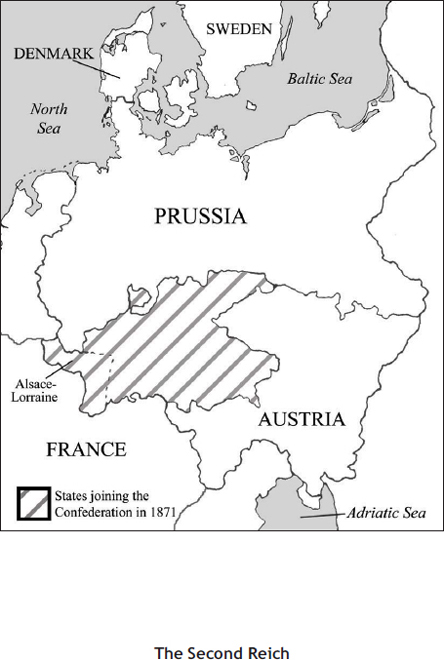
Prussia was a German state—but not part of “Germany.” In 1870 there was no such country as “Germany.” Instead, thirty-eight different German-speaking states lay across the land east of France. These states were joined together into a loose group called a confederation.
You’ve already heard the word “confederation.” Remember, in the American Civil War, the Southern states left the Union to form a confederacy. In a confederacy, the states agree together to elect officials who will be in charge of dealing with foreign countries and other matters that affect all of the states. But each state stays independent, with its own government and its own identity.
Prussia belonged to the German Confederation. It was just one German state among many. But in 1847, a square-shouldered man with a determined jaw was elected to the Prussian assembly. His name was Otto von Bismarck, and he was determined to make Prussia the ruling state of the confederation.
Otto von Bismarck served in the Prussian government for fifteen years. For those fifteen years, he nursed his wish to make Prussia great. He wanted the German confederation to become a single German country, led by a powerful Prussian king and protected by an invincible Prussian army.
But the king of Prussia was far from strong. As a matter of fact, he had had a stroke—and could no longer speak or see.
In 1861 the sick king died. His brother Wilhelm became king, or kaiser, in his place. Wilhelm appointed Otto von Bismarck to be his chancellor (prime minister). Now that he was chancellor, Bismarck set about making Prussia the leader of the German states. If this meant war, Prussia would fight! In a stirring speech to the Prussian assembly, Bismarck announced that Prussia would become the strongest of the German states not “by speeches and majority votes, but by blood and iron.” This speech earned Bismarck the nickname of the “Iron Chancellor.”
Soon it became clear that the Iron Chancellor had more power than the king of Prussia. Wilhelm was a polite, sensible man, a good soldier, and a careful king. But he was not as bold as Bismarck. More than once, when the king and the chancellor disagreed, Bismarck threatened to quit—and Wilhelm quickly agreed to follow Bismarck’s wishes. Bismarck’s leadership became known as the “chancellor dictatorship.”
Under Bismarck’s “dictatorship,” Prussia fought two wars before turning to attack France. In 1864, Prussia joined with the large German state of Austria and attacked Denmark, capturing the southern part of Denmark’s kingdom. Prussia then insisted on controlling this newly captured land. When Austria objected, Prussia turned and attacked Austria as well!
The Prussian army was victorious. At the end of the short, violent war, Bismarck announced that Prussia would now form a new confederation of German states—a North German Confederation that didn’t include the state of Austria. Prussia wanted no other state competing to lead the Confederation.
Then Prussia turned to confront Napoleon III and France. When Napoleon III was forced to surrender, Prussia claimed the northeast corner of France, an area called Alsace-Lorraine, as its own. And four more German kingdoms offered to join the triumphant Prussia in the North German Confederation.
In 1871, the year after the war with France, Otto von Bismarck convinced the other German states in the confederation to declare Wilhelm of Prussia the “German Emperor.” The states agreed—with some reluctance. They wouldn’t allow Wilhelm to call himself the “Emperor of Germany,” because none of the German states wanted to belong to a country called “Germany.” Each state wanted to keep its own princes, dukes, and assemblies. But they allowed Wilhelm to take the title “German Emperor”—which meant that he was the most important of all other German rulers. And the Confederation became known as a kingdom, or Reich.
At last, Prussia was the strongest state in a German kingdom. This kingdom was known as the “Second Reich.” Germans liked to think that they were the heirs of the Holy Roman Empire, which they called the “First Reich.” Of course, the Holy Roman Empire had not been a Prussian-led kingdom. But by claiming that their new German kingdom was a successor to the Holy Roman Empire, Bismarck and the Prussians implied that Wilhelm was the successor to the Holy Roman Emperor!
But Otto von Bismarck, not Wilhelm, was the most powerful man in the Second Reich. Wilhelm made Bismarck the royal chancellor, which meant that Bismarck appointed government officials and decided how the Second Reich would act towards the other countries in Europe. And the Reich’s actions were most often warlike. “Better pointed bullets than pointed speeches,” Bismarck once remarked.
Bismarck’s dedication to war was very Prussian. Other German states were more interested in art, or in science, or in learning. But the noblemen of Prussia had always been more interested in war. As a matter of fact, Prussia spent five-sixths of its money on its army!
The whole kingdom of Germany was becoming more and more Prussian. Wilhelm’s son Friedrich (who happened to be married to Queen Victoria’s oldest daughter) was disturbed by the overwhelming Prussian influence on the German states. He wrote in his diary:
In this nation of thinkers and philosophers, poets and artists, idealists and enthusiasts, the world will recognize nothing but a people of conquerors and destroyers. … [The Germans are] the foremost people of the world in civilization, yet at the moment … we are neither loved nor respected, but only feared. We are deemed capable of every wickedness, and the distrust felt for us grows ever more and more pronounced. … Bismarck has made us great and powerful, but he has robbed us of our friends, the sympathies of the world, and our conscience.1.
If Friedrich had inherited the German throne after his father, perhaps the German Empire would have become a little less “Prussian.” But as his father grew older, Friedrich began to grow ill. He had cancer, but he was never properly treated. When Wilhelm died, Friedrich became emperor. He was emperor for less than a hundred days before he too died.
His son, Wilhelm II, became the third German emperor. Wilhelm II was a violent, quarrelsome, quick-tempered bully. He wanted the Second Reich to conquer other lands, to claim colonies around the world, and to have a navy even larger than Great Britain’s huge and powerful fleet. Wilhelm II soon decided that even Bismarck was too cautious and careful. Two years after inheriting the throne, Wilhelm II forced Bismarck to resign.
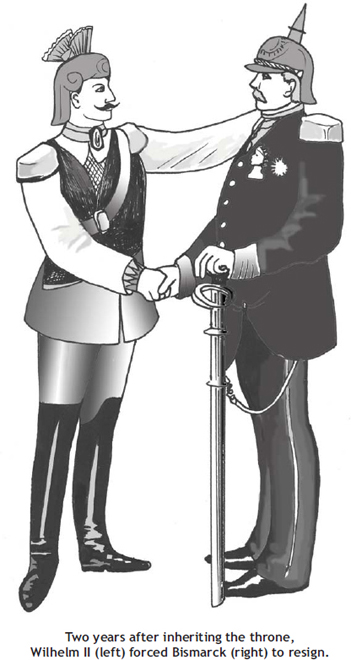
The Second Reich was set on a path of war and destruction. But it would follow this path without the man who had helped to make it into a kingdom. Bismarck went to live in a small German town, where he spent his time writing out his memories of his years of service to Prussia. He died eight years later, before he could see the collapse of the Second Reich—a collapse that would shake the whole world.
______________________________________________
1. Friedrich II of Prussia’s diary,
reprinted and translated in The Age of Bismarck: Documents and
Interpretations, ed. Theodore Hamerow (HarperCollins, 1973).