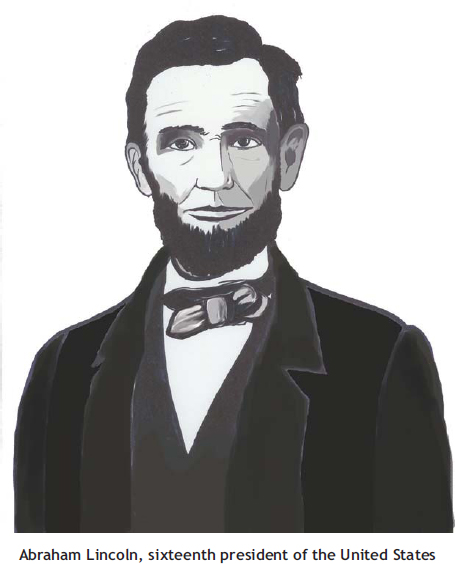
On a cold April night in 1861, only a month after Victor Emmanuel was crowned king of Italy, the president of the United States sat in the White House, reading the handwritten page that lay before him. I, Abraham Lincoln, president of the United States … hereby do call forth, the militia of the several States of the Union … seventy-five thousand …
He sighed, rubbing a weary hand across his face. The next morning, this proclamation would be published in newspapers across the country. And seventy-five thousand American men would pick up guns and bayonets, and set out to fight against their neighbors.
But Abraham Lincoln felt that he had no choice.
Two months earlier, seven of the United States—South Carolina, Mississippi, Florida, Alabama, Georgia, Louisiana, and Texas—had announced that they would no longer belong to the United States. Instead, they would form their own country, the Confederate States of America.
The Confederate States demanded that United States soldiers who were stationed at Fort Sumter, a military base in South Carolina, leave and turn the fort over to Confederate soldiers. But the United States refused to give up Fort Sumter.
Two days earlier, in the still dark just before sunrise, Confederate soldiers had begun to fire round after round of cannonballs and shot at the walls of Fort Sumter. After a full two days of firing, the besieged U.S. commander inside the fort had finally hauled down the American flag. Now, the flag of the Confederate States flew over Fort Sumter’s walls.
Abraham Lincoln had to decide how the United States would respond. He chose to fight. The United States would use force to bring the seven rebel states back into the U.S.
The next morning, Lincoln published his proclamation. People all over the United States gathered together, cheering, making speeches, and singing The Star-Spangled Banner. But not every state was pleased that Lincoln was going to war. Two days later, Virginia joined the Confederate States. A month later, three more states—Arkansas, Tennessee, and North Carolina—left the United States for the Confederacy as well. And along the border between North and South, the states of Kentucky, Missouri, West Virginia, Maryland, and Delaware sent a message to the president. They would not join the Confederacy, but they refused to fight for the U.S. The governor of Missouri told Lincoln that the war against the South was “illegal, unconstitutional … inhuman and diabolical.” And the governor of Kentucky snapped, “Kentucky will furnish no troops for the wicked purpose of subduing her sister Southern States.”
The United States was less than a hundred years old—and already the country had broken apart into civil war.
Lincoln had been elected president the year before, in 1860. And in the United States of 1860, every state was allowed to decide for itself whether or not some people could hold others as slaves. Down in southern states such as South Carolina and Georgia, slavery was legal. Farmers made their living by growing huge fields of tobacco and cotton. And tobacco and cotton needed plenty of hands to weed, tend, and pick them. Farmers could only grow these crops if they had plenty of cheap help. Without slaves, the farms of the South would collapse.
In the northern states, slavery was illegal. But states such as New York, Pennsylvania, and Massachusetts didn’t have huge fields of crops that needed tending. They had factories, mills, and ironworks instead. “It’s easy for northerners to say that slavery should be against the law,” Southerners complained. “The north doesn’t need slaves to survive!”
For decades, southern and northern states argued about slavery. But the argument didn’t turn into war until new states began to join the U.S.A. The southern states wanted slavery to be legal in these new states, so that the northern states would be outnumbered. And the northern states wanted slavery to be illegal in the new states, so that slave-holding states wouldn’t overwhelm the rest of the U.S.
Even before he became president, Abraham Lincoln was firmly on the side of the north. When he was asked why he didn’t want new states to have slaves, Lincoln retorted, “If there was a bed newly made up, to which the children were to be taken, and it was proposed to take a batch of young snakes and put them there with them, I take it no man would say there was any question how I ought to decide.” Lincoln believed that slavery was as poisonous as a nest of snakes.
So as soon as Lincoln became president, the slave-holding states of the South began to get ready to leave the United States. When they finally left, or seceded, Lincoln declared war.
At first, both Lincoln and his generals thought that the war would be short. Government officials and their wives even went to the earliest battles of the war to watch, as though they were seeing a play. They were sure that the play would end with the blue-coated United States soldiers (called Union soldiers because they were fighting to keep the states unified) crushing the gray-uniformed Confederates.
But in just months, Lincoln realized that the war would not be won so easily. He tried inviting Giuseppe Garibaldi over from Italy to lead his army; after all, Garibaldi had just won an enormous victory against a fierce enemy! But Garibaldi decided to stay in Italy. Eventually, Ulysses S. Grant became Lincoln’s general instead.
In the South, the Virginia general Robert E. Lee led the Confederate soldiers into battle. Robert E. Lee didn’t approve of slavery, but when Virginia seceded, he had chosen to be loyal to his home state.
A year after the Civil War began, Abraham Lincoln announced that all slaves in the Confederacy would be declared free on January 1, 1863. This announcement was known as the “Emancipation Proclamation.” Of course, Lincoln had no power in the Confederacy—so his proclamation didn’t actually change anything for the slaves in the South. But by making this proclamation, Lincoln had announced to the whole world that the Civil War was no longer about keeping the United States together. Now, the war was being fought to end slavery.
Lincoln needed to assure the people of the U.S. that the war was important—because hundreds of thousands of men were suffering and dying. In the Battle of Gettysburg, in 1863, over fifty thousand men were wounded and killed in just three days of fighting. Hundreds of towns and cities were burned and destroyed, including the cities of Richmond, Virginia and Atlanta, Georgia.
On April 9, 1865, Robert E. Lee realized that his Confederate army was out of food and too weak to fight on. He agreed to surrender to Ulysses S. Grant in the little Virginia town of Appomattox. After four years of fighting, the war was over.
The Confederacy fell apart. The southern states were forced to rejoin the Union, without their slaves. But over five hundred thousand men had been killed—more than in any other war the United States has ever fought, even in the twentieth century. In the South, a whole generation had been wiped out.
The Civil War had saved the Union, but it had also changed the United States forever.
Just days after Robert E. Lee surrendered his forces to Ulysses S. Grant, Abraham Lincoln woke up late at night, gasping with fear. He sat up and looked around him. He was in his bedroom at the White House. The nightmare he’d woken from was just a dream. It wasn’t real.
But instead of feeling relief, Abraham Lincoln was haunted by dread. The dream had been so vivid! He had been wandering through the White House. Every room was empty; every hall was deserted. But he could hear wails and groans. “The silence was broken by … pitiful sobbing,” Lincoln told his wife, when she asked him why he was frightened. “But the mourners were invisible. I went from room to room; no living person was in sight, but the same mournful sounds of distress met me as I passed along.”
Finally, Lincoln dreamed that he arrived at the East Room of the White House. There he saw a coffin, resting on a stand, guarded by soldiers. But the face of the man who lay in the coffin was covered.
“Who is dead?” Lincoln asked. The nearest soldier answered “The president. He was killed by an assassin.” The crowd all around the coffin raised their voices in weeping. And then Lincoln woke up. “I slept no more that night,” he told a friend, the next day. “Although it was only a dream, I have been strangely annoyed by it ever since.”
But Lincoln tried to shake the dream away. Only a few days later, on April 14th, Lincoln spent the day meeting with his advisors, planning out how the defeated Confederate states should be brought back into the Union. It was Good Friday (the Friday just before Easter on the Christian calendar), and that same night he and his wife were supposed to go out and see a play.
Lincoln didn’t want to go. He was still disturbed by his dream, and his day of dealing with war matters had made him both weary and mournful. But people in Washington were celebrating the end of the war, and the newspapers had already announced that Lincoln would be at the play. The rest of the audience was looking forward to sharing the theater with the president.
So Lincoln decided to go. He and his wife rode a carriage through the dim, cool night to Ford’s Theatre. They arrived just before the play began, around nine o’clock in the evening, and walked to their box—a special private balcony where Lincoln could sit in a rocking chair and watch the play in comfort.
A police officer named John Parker had been assigned to stand at the door that led from the hallway into Lincoln’s box. He was supposed to keep anyone from coming through. But after half an hour or so, Parker got so interested in the play that he left his post, and wandered down to the main floor and sat with the audience! Abraham Lincoln’s box was unguarded.
Outside of it hid a man who hated Lincoln and the United States.
He was an actor named John Wilkes Booth. Although he had been born in Maryland, he thought of himself as a Southerner. Instead of fighting in the Civil War, he had gone on acting in plays. He felt guilty because he had not defended the South. So now he had formed a plan: He would redeem himself by fighting the greatest fight of all—against Lincoln, the enemy of the southern states.
Now, John Wilkes Booth crashed through the door of Lincoln’s box and fired a pistol directly at the president. Lincoln slumped down in his chair. Booth leaped up onto the side of the box, ready to jump down onto the stage below. He planned to dash across the stage and out the side door of the theatre. In the alley outside the door, he had left a horse, saddled and ready to ride away.
But a Union flag hung on the balcony’s side. Booth’s heel caught it. He twisted in the air and broke his leg as he landed.
Dragging his leg behind him, he limped from the stage and out the door and clambered onto his horse. He rode south into Virginia, expecting to be welcomed as a hero by Virginians. But although he stopped at several farms, the owners wanted nothing to do with him. Booth rode deeper and deeper into the Virginia countryside, his leg aching with each jolt of his horse’s hooves.
Back at the theater, a doctor was trying to revive Lincoln. But it was too late. Lincoln was still breathing, but he was unconscious. Early the next morning, he died without ever awakening again. His body was laid out in the East Room, where soldiers guarded it and crowds came to weep, just as in his dream.
Twelve days later, Union soldiers who had been searching the countryside for Booth finally found him. He was hiding in a barn in Virginia, on a farm near the Rappahanock River. The soldiers set the barn on fire to drive him out, and shot him as he came to the front door.
On the day he was shot, Lincoln had told another government official, “If we are wise and discreet we shall reanimate the States and get their governments in successful operation, with order prevailing and the Union re-established. … I hope there will be no persecution, no bloody work after the war is over. … Enough lives have been sacrificed.”
But although the war was over, it would be many years before the United States was healthy again. Lincoln’s assassination showed just how much hatred remained in the country. Many Southerners still hated the northern states. And even worse, many whites still hated blacks.
In December of 1865, eight months after Lincoln’s death, the United States passed the Thirteenth Amendment to the Constitution. This meant that the Constitution of the United States now included these words: “Neither slavery nor involuntary servitude, except as a punishment for crime whereof the party shall have been duly convicted, shall exist within the United States, or any place subject to their jurisdiction.” In other words, no one could be held prisoner and forced to work unless he had been convicted of a crime and sent to jail. And the states could no longer decide for themselves whether or not slavery should be legal. It was illegal in every state of the Union!
The years after the Civil War were called a time of “Reconstruction” for the southern United States. But not very much “rebuilding” went on. Although the Constitution said that slaves were to be freed, the government of the United States did not help these slaves to get any land where they could live. Nor did the slaves win any payment for the years they had spent working for their masters. Instead, the free blacks of the South, penniless, had to try to earn their own living, usually on farms owned by white farmers—farmers who were bitter that the United States had taken away their slaves. These free blacks were often treated just as badly as they had been during slavery.
Slavery had ended. But it would be many more years before African-Americans were given all of the freedoms and privileges of whites.