In 1991, America went to war with Iraq, in a war we now call the First Persian Gulf War. That war might not have happened if the Iran-Iraq War (the pointless war fought between 1980-1988) had not occurred.
Here’s how the story unfolded. During the war with Iran, Iraq borrowed money from several different countries so that it could buy weapons and pay its soldiers. After the Iran-Iraq war ended, Iraq was in debt to these countries—and didn’t have extra money to pay off those debts.
One of the countries that had lent money to Iraq was a little country called Kuwait. Kuwait, which lies between Iraq and Saudi Arabia, looks like a triangle with two wobbly edges. The long base of the triangle lies along the Persian Gulf.
Although Kuwait is a little country, just a little bit smaller than the state of New Jersey, it is a rich one—because one-tenth of all the known oil in the world lies beneath its desert sands. Kuwaiti citizens get free education, free care from doctors and hospitals, and don’t pay any income tax.
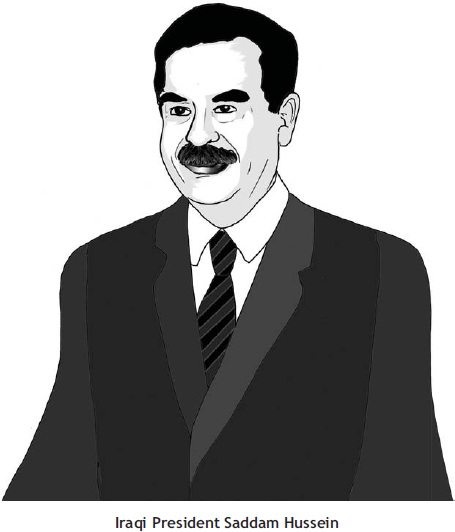
In August 1990, Iraqi soldiers obeyed Saddam Hussein’s orders to march into Kuwait and seize it. Hussein had several reasons for invading Kuwait. For one thing, Kuwait had insisted that Iraq pay its war debts—and Hussein couldn’t afford to. Hussein also claimed that Kuwait was taking oil from a patch of land on the Iraq-Kuwait border. He said that half of that oil should belong to Iraq! Furthermore, Hussein said that Kuwait was producing more oil than OPEC allowed, and that this was making the price of oil too low, which was like taking money away from the other countries that produced oil. And finally, Hussein said, Kuwait was actually part of Iraq anyway, and he was just reclaiming what belonged to him.
Those are a lot of different reasons.
Many of the soldiers marching into Kuwait had also fought in the Iran-Iraq war. They were experienced and tough, and Iraq had many more soldiers than Kuwait. They took over the small country easily. Less than a day after the Iraqi army had marched across Kuwait’s borders, Iraqi soldiers controlled almost all of Kuwait.
Immediately the United Nations sent Iraq a message: “You had no reason to invade Kuwait!” The UN announced that Saddam Hussein’s claim that Kuwait was part of Iraq was false, and that Iraq should withdraw from Kuwait by January 15, 1991.
January 15 came and went. Iraqi forces stayed in Kuwait.
Many nations in the UN, including the United States, worried that if Hussein stayed in Kuwait, he would not only control the oil that Western nations needed, but that he might next invade Saudi Arabia—and control even more oil.
So two days later, a group of soldiers from around the world attacked Iraq from the air. The attack was led by American soldiers, but Saudi Arabia, Afghanistan, Great Britain, and Egypt sent soldiers as well. In all, almost seven hundred thousand soldiers from twenty-eight countries joined in the war.
Factories and military bases all over Iraq were bombed. The city of Baghdad, Saddam Hussein’s capital, was bombed first. So were roads, so that troops couldn’t travel across the country. So were places where troops might get food and water.
The UN also announced that no country in the world could send anything to Iraq, except for food and medical supplies. No one was to buy from Iraq. Almost every country agreed to observe this embargo. As long as Iraqi soldiers were in Kuwait, Iraq would not be able to sell or buy anything from abroad.
But despite the bombing and the embargo, Hussein refused to withdraw his soldiers from Kuwait. So after five weeks, the UN agreed that soldiers should invade Kuwait by ground to drive the Iraqis out. By the end of February, soldiers from the different countries in the UN had managed to push the Iraqi solders back out of Kuwait. Iraq agreed to stop the fighting. On April 11, Iraq was forced to withdraw entirely from Kuwait and to destroy some of its weapons. Iraq’s leader, Saddam Hussein, also had to promise that he would never try to build nuclear weapons for his army.
The war was won. But despite the victory and the agreement, Kuwait was shattered. As they retreated, Iraqi soldiers had set the oil wells of Kuwait on fire. These oil wells pumped oil out of the ground in a steady black stream. When a stream of oil was lit, it burned like the wick of a kerosene lantern. The wells were turned into huge torches, hundreds of feet tall, that burned for weeks and weeks. More than seven hundred oil wells were set on fire in Kuwait. Around them, the sand grew so hot that it turned into glass.
It took nine months to put all of the fires out. And in the meantime, as the oil wells burned, poisonous smoke drifted over Kuwait, causing lung problems. All over Kuwait, people suffered from coughing, shortness of breath, and dizziness. The smoke turned day into night. Burning oil went up into the air, evaporated, and came back down as black rain. Pools of oil lay all over the ground. Some of the oil ponds were six feet deep. An oil fog drifted over leaves and grass. Sheep ate the grass and died. Oil clogged up fresh water wells. Oil fogs and black rain drifted as far north as Turkey, and as far east as Afghanistan.
Iraqi soldiers had also dumped eleven million barrels of oil into the Persian Gulf. A foot of oil lay on top of the water. All along the coast of Kuwait, birds and fish were dying from the oil in the water. Eventually, it would cost seven hundred million dollars to clean up the oil—and most of the oil still remained in the water.
The bombing in Iraq had done damage as well. By bombing roads and food and water supplies, the UN forces had put many civilians in danger of starving to death or dying from drinking dirty water. And many, many Iraqi people who had not taken part in the war did indeed die.
Some members of the UN wanted to press on further. They wanted to get rid of Saddam Hussein. They argued that Hussein was obviously going to keep on starting wars, no matter what. But many of the countries in the coalition, especially other Arab countries, wanted to end the war, now that Kuwait was free.
And so Saddam Hussein was left in power—for a little while.
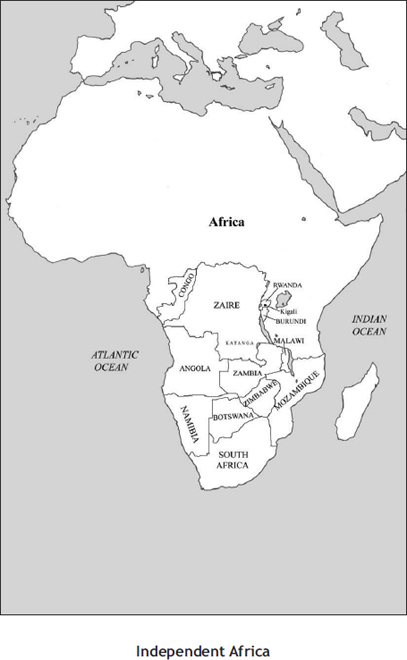
Between 1960 and 1975, one by one, African nations freed themselves from the last bits of colonial rule. We’ve already learned about the Union of South Africa, and about the Congo (Zaire) and Brazzaville becoming free from Belgium and France. If we told the story of every single African country that declared itself free from the colonial masters who once ruled it, we would need a whole different book. But if you look at a map of Africa, here’s what you will see: Between 1960 and 1964, almost every country in Africa became officially independent. The last countries to become free were Angola, on the western coast of Africa, and Mozambique on the east coast, which did not finally escape from Portugal’s control until 1975.
So instead of telling all of these stories, we will tell two short ones—one sad, and one hopeful. Both show the ways in which Africa was changed forever by its occupiers.
There have been many sad stories in the twentieth century, but this first story is one of the saddest. A few chapters ago, we read about the Belgian Congo, and its attempts to be independent. Just east of the Belgian Congo, now renamed Zaire, was a little Belgian colony called Ruanda-Urundi. In this mountainous area lived two different tribes. The first tribe, called the Batutsi, are tall and lighter-skinned. They make up only fifteen percent of the population. The second tribe, called the Bahutu, make up eighty-five percent of the population. They are much shorter, and darker skinned.
Even though there are so many more Bahutu, the Batutsi, or “Tutsi,” became rulers of the area for at least six hundred years. The Tutsi were the lords of the area; the Bahutu, or “Hutu,” served them, herded their cattle, and grew their food.
When the different countries of Africa began to ask for independence, Ruanda-Urundi also asked for independence from Belgium. The Belgians said that the country could only be independent if it organized a democratic government for itself and held elections.
So the Hutus, who were the majority, put together a political party, held elections, and claimed the right to govern their own country. And then they turned and attacked the Tutsis. For centuries, the Hutus had resented their Tutsi rulers. During Belgian rule, this hatred had grown stronger. Because the Belgians were white, they tended to give all the important jobs and political positions to the lighter-skinned Tutsis. This meant that the traditional Tutsi rule had grown even more oppressive.
Now that the Belgians were gone, all of that hatred came out. Hutus began to kill Tutsis. Many Tutsi fled into the south of Ruanda-Urundi. (Others ran to surrounding countries.)
Now, Ruanda-Urundi had Hutus in the north, and Tutsis in the south—and both tribes hated each other. The Belgians decided that, instead of trying to keep both peoples together in the same country, they would divide Ruanda-Urundi into two. The north would be Rwanda, where the Hutu would rule and would elect a Hutu president. The south would become a Tutsi monarchy, called Burundi.
That was in 1962.
Rwanda was now a republic governed by Hutus. But many Tutsi still considered it their rightful home. Tutsi who had been driven from Rwanda formed a political party in exile, called the Rwandan Patriotic Front. They wanted their country back.
In 1994, the Hutu president of Rwanda was killed in a plane crash. Immediately, some Hutus began to blame the crash on the Tutsis, saying that the Rwandan Patriotic Front had sabotaged the plane. All the hostility that had been temporarily bottled up by the division of the country into two suddenly boiled back over again. Hutus picked up weapons and begin to kill Tutsi neighbors who had lived beside them for years and years. Half a million Tutsi died at the hands of people they knew, who had lived near them, invited them for meals, played with their children and helped in their gardens.
In revenge, the Tutsi of the Rwandan Patriotic Front invaded Rwanda and began to drive the Hutu out of Rwanda. At least a million Hutu had to flee Rwanda and live in camps in Zaire. At the worst part of their flight, six hundred people were crossing over the border into Zaire every minute. With so many people in the camps, food and water were scarce; people died from hunger, thirst, and disease. Tens of thousands died.
The European occupation had made the hostility between the tribes worse, until it erupted into genocide.
Now for a story that is a little more hopeful, also from Africa. In South Africa, in the same year that the Hutu and Tutsi were battling with each other in the center of Africa, the first black South African president took office.
We’ve read about South Africa and apartheid. Apartheid—the practice of separating whites and nonwhites into different spaces, different buses, even different benches in waiting rooms—was designed to keep all of the power of a country in white hands. We read about the Unjust Laws, the apartheid laws that were established after World War II. We also read about the beginnings of resistance, how the African National Congress began to use Gandhi’s techniques of nonviolent resistance, and how this brought little change to South Africa for years and years and years.
As a matter of fact, the ANC finally decided that nonviolent protest wasn’t going to work. Instead, they began to set off bombs and make threats. This didn’t work either. ANC leaders, including one named Nelson Mandela, were arrested for their illegal acts and put into prison.
But the unrest in South Africa did begin to finally attract the attention of the rest of the world. The UN put an embargo on weapons, so that no one could sell guns or ammunition to South Africa. All around the world, people began to suggest that not buying things made in South Africa (a “boycott”; do you remember reading about this word in the chapter on Ireland?) would make South Africa poorer and force the government to reject apartheid.
In response, the South African government, led by P. W. Botha, declared that South Africa was in a state of emergency—and cracked down on the freedoms of black South Africans even more. Many were arrested. Newspapers were forbidden to write about the arrests, and South African TV stations couldn’t cover them.
But the outcry from the rest of the world did not stop. Desmond Tutu, an Anglican priest from South Africa, spoke out to the rest of the world, telling them about the evils of apartheid. In response, the United States refused to lend money to South Africa or to buy South African goods. So did other nations.
In 1989, at last, P. W. Botha resigned. The man who came to power after him, F. W. de Klerk, finally began to change the system.
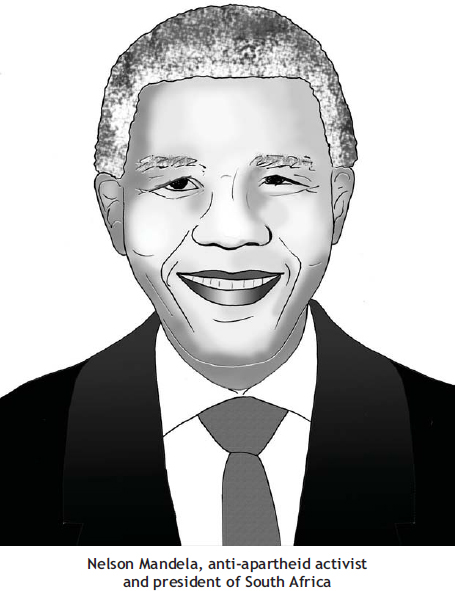
In 1991, the South African Parliament repealed the laws of apartheid. F. W. de Klerk ordered Nelson Mandela released from prison. Together, Mandela and de Klerk tried to work out a plan for South Africa. They agreed that elections should be held—the first “open election” in South African history, in which any candidate, white or black, could be elected by all of the voters.
In 1994, Nelson Mandela was elected the first black president of South Africa. Archbishop Tutu became head of the Truth and Reconciliation Commission, which began to uncover the wrongs done to blacks in the past.
“The changes in South Africa,” wrote one editorial in the magazine Commonweal, “happened in no small measure because of moral pressures exerted from abroad.” The rebuilding of South Africa will go on for many years. But it is one of the few times in the history of the twentieth century in which countries have united together to force change for the better—instead of a government seizing power and exercising it for the worse.
This history of the world ends in the twentieth century, not the twenty-first; its final chapter deals with events in 1994.
On September 11, 2001, two American airplanes, hijacked by radical Muslim terrorists, crashed into the World Trade Center towers in New York City. A third crashed into the Pentagon. A fourth, apparently headed for Washington DC, went down in a field in Pennsylvania.
I have not brought this history up to 2001, because I don’t understand how 9/11 will play into history. At the time that I write this, the war that the event spawned is still going on. The administration that took us into the war is still in power. Reconstruction in the countries shattered by that war has only just begun. These are current events, not history; they are acts that cannot yet be interpreted. Only now can we interpret World War II, and in many ways the Vietnam War still evades our understanding. Instead of ending with 2001 (or later), I have instead tried to give the historical background that led up to the current chaos. If we can begin to understand the background of that chaos, we may find ourselves understanding a little more about the chaos itself.
Below are the events from Volume 4 of The Story of the World. Following each entry is the chapter in which it can be found. Entries without chapter numbers are not included in Volume 4, but are included as a contextual aid in your study of history. If you are searching for specific events within Volume 4, check the index (immediately following this chronology, on page 489).
| 1821 | “New Spain” declares independence from Spain and becomes Mexico [20] | |
| 1830 | Les Trois Glorieuses (the Three Glorious Days) in France [7] | |
| 1831 | “The Carbonaria” revolts against Austrian rule [4] | |
| 1837 | Victoria begins her reign in England | |
| 1841 | Pedro II becomes Emperor of Brazil [13] | |
| 1845 | The blight comes to Ireland; the Potato Famine begins [12] | |
| 1846 | Iowa becomes a state [16] | |
| 1848 | Young Italy rebels against Austria [4] | |
| 1848 | The French Republic makes Louis-Napoleon president [7] | |
| 1848 | Karl Marx publishes The Communist Manifesto | |
| 1851 | The Australian Gold Rush begins [11] | |
| 1851 | The Crystal Palace is built in London for the Great Exhibition [1] | |
| 1852 | Harriet Beecher Stowe publishes Uncle Tom’s Cabin | |
| 1853 | Matthew Perry arrives in Japan [2] | |
| 1853–1856 | The Crimean War [2] | |
| 1855 | Dost Mohammad Khan signs treaty with Britain [3] | |
| 1856 | Peace of Paris signed, ending the Crimean War [2] | |
| 1856–1860 | Second Opium War | |
| 1857 | Livingstone writes Missionary Travels [3] | |
| 1857–1858 | The Sepoy Rebellion [1] | |
| 1859 | Charles Darwin publishes On the Origin of Species | |
| 1860 | The Taipings march towards Shanghai [4] | |
| 1861 | Victor Emmanuel II crowned king of Italy [4] | |
| 1861 | Italian states are united under King Victor Emmanuel [24] | |
| 1861–1865 | The American Civil War [5] | |
| 1862 | Francisco Solano López comes to power in Paraguay [6] | |
| 1863 | Dost Mohammad Khan drives foreign invaders from Afghanistan [3] | |
| 1864 | The Qing army retakes Nanjing [4] | |
| 1864 | Prussia and Austria attack Denmark [7] | |
| 1864–1870 | The War of the Triple Alliance [6] | |
| 1865 | John Wilkes Booth assassinates U.S. President Abraham Lincoln [5] | |
| 1865 | U.S. Congress bans slavery in the United States [5] | |
| 1867 | The Dominion of Canada forms [6] | |
| 1867 | The North German Confederation is created [7] | |
| 1868 | Japan re-opens during the Meiji era [8] | |
| 1868–1912 | Meiji Restoration [8] | |
| 1869 | The first transcontinental railroad in the U.S. is completed [8] | |
| 1869 | The Suez Canal opens [10] | |
| 1870 | France becomes a republic [7] | |
| 1870–1871 | The Franco-Prussian War [7] | |
| 1871–1918 | The Second Reich [7] | |
| 1873–1903 | Acheh War [9] | |
| 1876 | Bulgarian revolutionaries rebel against the Turks [9] | |
| 1876 | Abdul Aziz is assassinated [9] | |
| 1876 | The Battle of Little Bighorn [16] | |
| 1876 | Alexander Graham Bell submits a patent for the telephone | |
| 1877 | The Satsuma Revolt in Japan [8] | |
| 1877–1878 | The Russo-Turkish Wars [9] | |
| 1877–1879 | The Zulu-British Wars | |
| 1878 | Umberto I becomes king of Italy [24] | |
| 1878–1880 | The Second Afghan War | |
| 1879 | Thomas Edison invents the electric light [8] | |
| 1879 | The War of the Pacific begins in South America [10] | |
| 1880 | Police arrest Ned Kelly [11] | |
| 1880–1881 | The First Boer War [12] | |
| 1881 | Assassins kill Czar Alexander II [14] | |
| 1882 | The Triple Alliance forms [24] | |
| 1883 | The U.S. adopts time zones [8] | |
| 1884 | The Berlin Conference [11] | |
| 1886 | Parliament votes against the Home Rule Bill [12] | |
| 1889 | Brazil is declared a republic; Pedro II leaves Brazil [13] | |
| 1889 | Menelik takes control of Ethiopia [14] | |
| 1892 | Abbas II named khedive of Egypt [24] | |
| 1894 | The Armenians rebel against the Ottoman Turks [13] | |
| 1894 | Nicholas II becomes czar of Russia [14] | |
| 1894–1895 | The Sino-Japanese War [15] | |
| 1895 | The creation of Rhodesia [12] | |
| 1896 | Italy recognizes Ethiopian independence [14] | |
| 1898 | The Spanish-American war begins [15] | |
| 1899–1902 | The Second Boer War [12] | |
| 1895 | The “Young Turks” try to reform the Ottoman Empire [13] | |
| 1900 | The Boxer Rebellion in China [17] | |
| 1901 | The Commonwealth of Australia is established | |
| 1902 | Alfonso XIII is crowned king of Spain [27] | |
| 1903 | Macedonians declare themselves independent from Turkish rule [18] | |
| 1903 | Phan Boi Chau forms Duy Tan Hoi—The Restoration Society [19] | |
| 1903 | Wright brothers make the first powered and controlled flight | |
| 1904–1905 | The Russian-Japanese War [17] | |
| 1905 | Irish Catholics form Sinn Féin [22] | |
| 1906 | The first Majles begins after Liberal rebellion [18] | |
| 1908 | Empress Cixi dies [19] | |
| 1908 | Phan Boi Chau leaves Japan [19] | |
| 1910 | Mexican Revolution begins [20] | |
| 1911 | The end of the Qing dynasty [19] | |
| 1911 | Delhi becomes capital of India [22] | |
| 1912 | Sun Yixian flees to Canton [25] | |
| 1912 | The Titanic sinks | |
| 1912 | Arizona becomes a state [16] | |
| 1912 | The First Balkan War [18] | |
| 1912 | Sun Yixian forms the Kuomintang [25] | |
| 1913 | The Second Balkan War [18] | |
| 1914 | World War I begins [18, 20] | |
| 1914 | Russia enters WWI [21] | |
| 1914 | Egypt becomes a British protectorate [24] | |
| 1915 | Italy joins Allied Forces [24] | |
| 1915 | A German submarine sinks the Lusitania [20] | |
| 1916 | Rasputin is killed [21] | |
| 1916 | Easter Uprising in Ireland [22] | |
| 1916 | Yuan Shikai dies [25] | |
| 1917 | The U.S. joins WWI [20, 21] | |
| 1917 | Kerensky takes over Russia’s Provisional Government [21] | |
| 1917 | Bolshevik Revolution [21] | |
| 1917 | Bolsheviks renamed “Communist Party” [21] | |
| 1917 | Ahmad Fu*'*ad becomes sultan of Egypt [24] | |
| 1918 | Germany surrenders to the Allied Powers [21] | |
| 1918 | Germany signs armistice to end fighting of World War I [21] | |
| 1918 | Romanov family assassinated [21] | |
| 1918 | Great Britain gives women right to vote [21] | |
| 1918 | White Army forms [23] | |
| 1918 | Egyptian delegates visit England in wafd [24] | |
| 1918–1921 | Russian Civil War [23] | |
| 1919 | Sinn Féin sets up Irish Assembly [22] | |
| 1919 | Treaty of Versailles is signed [23] | |
| 1919 | League of Nations forms [23] | |
| 1919 | Amritsar massacre in India [22, 30] | |
| 1919 | Fascist Party is formed in Italy [24] | |
| 1920 | U.S. Congress gives women the right to vote [21] | |
| 1921 | Sinn Féin and Great Britain reach peace agreement [22] | |
| 1921 | Mohandas Karamchand Gandhi is elected head of the Congress Party [22] | |
| 1921 | Chinese Communist Party is formed [25] | |
| 1922 | Mussolini marches to Rome [24] | |
| 1922 | Michael Collins assassinated during Irish Civil War [22] | |
| 1922 | Lenin suffers stroke; Stalin takes control of Russia [23] | |
| 1922 | Britain grants Egypt independence [24] | |
| 1923 | Chiang Kai-shek starts Kuomintang military academy [25] | |
| 1923 | Irish Free State begins to govern itself [22] | |
| 1923 | Italy under control of the Fascists [24] | |
| 1924 | Lenin dies; Petrograd renamed Leningrad [23] | |
| 1924 | Henry Puyi leaves China [25] | |
| 1925 | Sun Yixian dies [25] | |
| 1926 | Emperor Hirohito ascends the Japanese throne [25] | |
| 1926 | Mao Zedong and CCP members rebel against Kuomintang [25] | |
| 1928 | Kuomintang takes control of China’s government [25] | |
| 1929 | The Wall Street Crash [26] | |
| 1930 | Gandhi leads thousands on Salt March [22] | |
| 1930–1960 | Russian Gulag in operation [23] | |
| 1931 | Japan withdraws from League of Nations [25] | |
| 1932–1933 | Famines in Russia kill up to 5 million people [23] | |
| 1933 | Franklin Roosevelt becomes President [26] | |
| 1933 | Hitler takes power in Germany [26] | |
| 1934–1935 | Mao Zedong’s Long March [25] | |
| 1936 | Berlin hosts the Olympics; Jesse Owens wins four gold medals [28] | |
| 1936–1939 | Spanish Civil War [27] | |
| 1937 | Japanese capture Shanghai and Beijing [28] | |
| 1938 | Kristallnacht [28] | |
| 1939 | Germany invades Poland; World War II begins [27] | |
| 1939 | General Franco gains control of Spain [27] | |
| 1940 | Japan joins the Axis powers [28] | |
| 1940 | The Dunkirk Evacuation [29] | |
| 1941 | U.S. enters WWII after Japan bombs Pearl Harbor [28] | |
| 1942 | The Battle of Midway [28] | |
| 1943 | Italian troops in North Africa surrender [29] | |
| 1943 | Juan Perón leads a revolt in Argentina [34] | |
| 1944 | D-Day: Allied soldiers land at Normandy [29] | |
| 1945 | Six million Jews have been killed in the Holocaust [28] | |
| 1945 | The founding of the United Nations [29] | |
| 1945 | The U.S. drops atomic bombs on Hiroshima and Nagasaki [29] | |
| 1945 | World War II officially ends [29] | |
| 1946–1954 | War over the French control of Indochina [33] | |
| 1947 | India and Pakistan gain independence from Britain [30] | |
| 1947–1948 | Palestine is partitioned [30] | |
| 1948 | Israel becomes a country [30] | |
| 1948 | The Marshall Plan [31] | |
| 1948 | Mohandas Karamchand Gandhi assassinated [30] | |
| 1948 | National Party comes to power in South Africa [32] | |
| 1949 | The Communist Party takes control of China [32] | |
| 1950–1953 | Korean War [33] | |
| 1952 | Eva “Evita” Perón dies [34] | |
| 1952 | Gamal Abdel Nasser comes to power [31] | |
| 1953 | Mohammad Reza Shah Pahlavi regains control of Iran [39] | |
| 1954 | Brown v. Board of Education [36] | |
| 1954 | French give up claim to Vietnam [33] | |
| 1954 | U.S. tests atomic bombs in the Pacific [29] | |
| 1955 | Armed forces rebel against Argentinian president Perón [34] | |
| 1955 | Bus boycott in Montgomery, Alabama [36] | |
| 1956 | Lumumba petitions Belgian government for the Congo’s freedom [34] | |
| 1956 | Suez Crisis [31] | |
| 1957 | Soviet Union launches Sputnik [35] | |
| 1957 | John F. Kennedy wins Pulitzer Prize for Profiles in Courage [36] | |
| 1959 | Revolution in Cuba puts Fidel Castro in power [35] | |
| 1960 | Congo gains independence from Belgium [34] | |
| 1960 | Nigeria and Zaire become independent [34] | |
| 1961 | Berlin Wall is built [31] | |
| 1961 | Russian cosmonaut, Yuri Gagarin, first man to orbit the Earth [35] | |
| 1962 | Cuban Missile Crisis [35] | |
| 1962–1966 | Civil rights protests [36] | |
| 1962 | Ruanda-Urundi is divided into Rwanda and Burundi [42] | |
| 1963 | John F. Kennedy assassinated [36] | |
| 1964–1975 | Vietnam War [37] | |
| 1965 | U.S. enters Vietnam War [37] | |
| 1966 | Beginning of the Cultural Revolution in China | |
| 1967 | Six-Day War [37] | |
| 1967–1970 | Civil war in Nigeria | |
| 1968 | Martin Luther King, Jr., is assassinated [36] | |
| 1968 | Soviet troops invade Czechoslovakia [38] | |
| 1969 | American astronauts walk on the moon [35] | |
| 1969 | IRA starts to campaign for a united Ireland [38] | |
| 1969 | ARPANET, the predecessor to the Internet, is created | |
| 1971 | Bangladesh becomes independent [39] | |
| 1972 | Black September takes hostages at Olympics [38] | |
| 1973 | U.S. signs treaty to withdraw from Vietnam [37] | |
| 1973 | Yom Kippur War [37] | |
| 1973–1974 | OPEC increases oil prices; gas shortages result [37] | |
| 1975 | Mozambique is free from Portuguese control [42] | |
| 1975 | General Franco dies in Spain, ends dictatorship | |
| 1976 | Mao Zedong dies [41] | |
| 1978 | Begin and Sadat win the Nobel Peace Prize [37] | |
| 1978 | Rebel group assassinates king of Afghanistan [38] | |
| 1979 | Shah of Iran overthrown [39] | |
| 1979 | USSR invades Afghanistan [38] | |
| 1979 | Nuclear accident at Three Mile Island [40] | |
| 1980–1988 | Iran-Iraq War [39] | |
| 1982 | Israel invades Lebanon | |
| 1983 | Argentinian government overthrown in favor of democracy | |
| 1984 | Indira Gandhi assassinated [39] | |
| 1984 | Factory gas leak in Bhopal, India [39] | |
| 1985 | Gorbachev becomes leader of USSR [40] | |
| 1986 | Chernobyl nuclear disaster [40] | |
| 1986 | Space shuttle Challenger explodes during liftoff | |
| 1987 | U.S. and USSR sign the INF treaty [40] | |
| 1987 | Hole in the ozone layer confirmed | |
| 1989 | Tiananmen Square massacre [41] | |
| 1989 | Berlin Wall comes down [41] | |
| 1989 | Ceaucescu is overthrown in Romania | |
| 1990 | Iraq invades Kuwait [42] | |
| 1990 | Tim Berners-Lee creates the World Wide Web | |
| 1990 | East and West Germany are reunited [41] | |
| 1991 | Nelson Mandela is released from prison [42] | |
| 1991 | Gorbachev resigns; Communist Party outlawed in USSR [41] | |
| 1991 | America goes to war with Iraq [42] | |
| 1994 | Genocide begins in Rwanda [42] | |
| 1994 | Nelson Mandela is elected the first black president of South Africa [42] | |
| 2001 | Terrorists attack World Trade Center in New York, Pentagon in Washington DC [Afterword] |
Also Available from Peace Hill Press
Don’t just read about history—experience it! Designed to turn The Story of the World, Volume 4 into a complete history program, this activity book provides comprehension questions and answers, sample narrations, maps and geography activities, coloring pages, lists of additional history and literature readings, and many hands-on learning activities, all designed for students reading Volume 4 of The Story of the World!
• Figure out how big the Chinese army was!
• Build a model of the Crystal Palace!
• Learn how armies talk in code! Write secret messages to your friends!
• Build a timeline of the modern age!
• Find out what you would weigh on the moon!
 I am not a crafty or creative person,
so all the crafts my children do come directly from the Story of the
World Activity Book. My older child is excellent at narrations and is an
avid reader, so the book lists help me to quickly obtain quality library
books for him to read. My younger child struggles with narration and
only recently became a reader, but he loves doing projects from the
Activity Book. I have discovered that after completing a project—like
when we made Henry Hudson’s boat or Robin Hood’s arrow quiver—my younger
son could then tell Dad all about what we learned. Thanks to the
Activity Book, our history is enriched to meet both my boys’ needs.”
— Carole M. • Middletown, DE
Available at www.peacehillpress.com and wherever books are sold.
ISBN 978-0-9728603-5-2
$36.95
parents who use our books say …
My daughter is 6½, and the lessons are perfect for her attention span. I love how The Story of the World includes history from places that are often overlooked for this age group—places like China, India, and Africa. The Activity Books are the perfect accompaniment! The maps and activities not only help my daughter understand and retain what she is learning but also help her enjoy it! I love the extra resources, like additional history reading and literature suggestions. To have maps available for her to color and projects for us to do together are the icing on the cake!
I am so thrilled that your books are working so well for us. They have taken away the headache of building my own curriculum and gathering my materials. Just keep your noses to the grindstone, now, because I’m going to want more! I’ve got 11 more years of school … you can quit then!
— Maria R. • Darlington, WI
I know The Story of the World is written for grades 1–4, but I personally have learned more from reading them to my children than I ever did in school. The Activity Books add so much to the program, and truly bring the series alive. What a brilliant series!
— Linda M. • Booleroo Centre, Australia
The Story of the World saved our homeschool! I can’t express my gratitude enough! The Activity Books are a comprehensive list of great ideas, categorized by chapter to go along with the books. It is such a tremendous help to have literature suggestions for each of my children (at different grade levels 2nd–6th) all at my fingertips. The activities are simple to do, yet make history come alive for the kids. They make what we are studying meaningful, instead of a boring memorization of dull facts. You know you have a great curriculum when your kids ask to read their history book as a bedtime story!
— Jennifer S. • Northern VA
The Story of the World and Activity Book have been extremely easy to implement with my boys. The variety of activities allows us to choose from several great resources immediately. The Activity Book has saved much time and work for this busy mom!
— Amy H. • San Antonio, TX
“You know you have a great
curriculum when your kids ask
to read their history book as a
bedtime story!”
— Jennifer S.
My children love The Story of the World. They have a better grasp on world history than I ever did. The best part is what I am learning along the way! The Activity Book is what makes my children beg for history even on days when we are not doing school. The projects cement the learning and my kids retain what we have read. We use every part of the Activity Book.
— Mindy B. o Spokane, WA
I started my 9-year-old daughter on Story of the World, Volume 1 this year and assigned her a chapter to read every week or so. About halfway through it she said to me “This is great!” and she proceeded to read on through it. Then she begged me to buy the next two volumes. I told her she could keep reading but we would need to go back to some of the previous chapters and learn more in depth. She said, “Great, I want to read them again anyway!” She went on to read Volumes 2 and 3 in her free time in the next two or three weeks and is on her second round of reading them all the way through, by herself. She will come to me and tell me things she has learned that she thought were really interesting. Thanks so much for getting her excited about history!
— Wendy A. o Carrollton, TX
for more comments from parents and schools
using
The Story of the World**, visit** peacehillpress.com
To buy more Classical Education or Home School Curricula,
visit the Peace Hill Press store.

For great discussions and advise join us at the
Well-Trained Mind Community