When we were last in China, the communist government of Chairman Mao was in power. Under communist rule, China expanded its territory. It took the island of Hainan Dao, south of the mainland, and then invaded and claimed the western nation of Tibet as its own.
Mao intended to make China the largest, most powerful, and wealthiest nation in the world. He thought that the best way to do this was to copy the Soviet Union. So Mao’s government told farmers that they had to combine their farms into collectives, just as the Soviets had. These collectives were huge. Some had twenty-five thousand people in them, all farming one huge piece of land! No one in the collectives owned their own land, their own homes, their own animals, or even their own tools. It all belonged to the collective. And like the Soviet government, Mao’s government also forced many of the peasants to stop farming and instead work at making steel.
As in Russia, this was disastrous. Harvests plummeted. Grain grew scarce. The collectives didn’t yield as much food as the individual farms had, because the farmers hated working on land that didn’t belong to them. The peasants now working in the steel mills weren’t raising any food at all—and they had so little experience making steel that it was very poor quality. A famine swept over China. Thirty million people died.
The other members of the Chinese Communist Party decided that it was time for Mao to share some of his power. His attempt to make China a world power had failed. Mao had “lost face,” and his time as leader of China seemed doomed to end soon. The general secretary of the CCP, a little man (less than five feet tall!) named Deng Xiaoping, seemed like a good choice to replace Mao.
Deng and the other CCP leaders may have thought that it was time for Mao to fade from the political scene, but Mao had a plan. He and his supporters began to accuse those who opposed him of being against communism, and of wanting to return China to the days of emperors. They started a rumor that Mao’s opponents were planning to assassinate him. Mao used this rumor as an excuse to bring part of the Chinese army into Beijing to protect him. The part that he brought had over thirty thousand soldiers in it. That was the biggest bodyguard in history!
Now Mao was safe from arrest or assassination—and he had control of a large army. Mao’s supporters wrote and preached that the Chinese must stay loyal to Mao. Loyalty to Mao meant loyalty to the Chinese Communist Party. China had been through a difficult time. But if the Chinese would join with Mao and support his policies, China would enter into a new time—a revolutionary and wonderful time.
This propaganda (words meant to persuade people of something that isn’t necessarily true) worked. Huge numbers of Chinese citizens agreed, and supported Mao against his opponents. With the might of the army behind him, Mao had many of his enemies arrested and sentenced to death. Deng Xiaoping was spared death because he was an old friend of Mao’s. But Mao had him marched through the streets with a dunce cap on his head. After that, Deng was sent to work in a factory, sandpapering the edges of unfinished screws.
The time between 1966 and Mao’s death in 1976 became known as the Cultural Revolution. Every part of Chinese culture—newspapers, public gatherings, theaters, operas, and novels—had to praise Mao and Mao’s policies. Children were encouraged to join the “Red Guard,” a youth military that swore loyalty to Mao. Every house in China had a picture of Mao in it. (It was dangerous not to!)
After Mao died in 1976, Deng Xiaoping left his screw-factory and came back to Beijing. He claimed his old position as general secretary of the Communist Party, and—eventually—leader of China. Deng Xiaoping could finally make a few much-needed changes in China. Deng returned some of the farms to their owners. He let the factories give up making bad steel. He told peasants that, if they raised extra food, they could sell it and make a profit, instead of giving it to the government.
Under Deng, China grew more prosperous. People had more to eat, better clothes to wear, and a chance of earning enough money to live well.
But one thing in China didn’t change. The Chinese were still not allowed to express their ideas openly—either in print or in speech.
The Chinese people began to protest this. They wanted not only freedom of speech, but also the right to take part in China’s government. Deng’s China was more prosperous than Mao’s, but it was still run by a very small number of people—and many of those powerful people were corrupt, giving favors to those they liked and ignoring those they didn’t.
The biggest protest began to gather itself on April 15th, 1989. Thousands of students joined together in Tiananmen Square, in Beijing. They demanded that the leadership of China change. They wanted to be given a chance to take part in China’s government. They wanted something closer to democracy, where they could elect their own leaders.
Communist officials went to the square to talk to them and to ask them to go home. But the students were convinced that, if they left, China would simply stay the same. Over six weeks, over one hundred and fifty thousand students came to Tiananmen Square.
It became clear that the students would not leave Tiananmen Square unless China granted them democracy—or drove them away. But the Communist Party, like the monarchs of long ago, weren’t willing to give up power simply because the people asked for it.
They chose to use force instead.
On June 2, 1989, the Chinese army warned the crowd to disperse. No one moved. The next day, June 3, tanks and soldiers closed in on the square. Tear gas grenades were thrown into the crowds of students. But the students refused to move. As a matter of fact, people from around the square who saw what was happening ran to join them.
So on June 4, the Chinese army attacked before the protest could spread over the entire city. They fired machine guns at the unarmed students. When the students linked their arms together and turned to face the army, the soldiers drove tanks towards them.
Over a thousand protestors were killed in the square. In the streets around the square, soldiers killed thousands more. “The army used tanks and machine guns on anyone who even threw a rock or shouted a slogan,” one student who survived the attack wrote, after escaping. “We kept telling the crowds that ours was a peaceful demonstration. … We felt that the patriotic democratic movement … would fail if the students tried arming themselves.”
Now that you have read the history of the twentieth century, you know that armies have often attacked their own people. But the June 4 Massacre in Tiananmen Square was different—because it took place on television. The Chinese army tried to put up canvas tents around the bodies of students, and wash the blood off Tiananmen Square. But it was too late. All over the world, millions of people had already watched in horror as the Chinese army shot at unarmed protestors. In one of the most famous pictures from that day, a single weaponless man stood in the middle of a street, shouting at tanks as they bore down on him. The tanks stopped—but the man was arrested and taken away.
The rest of the world protested the violence of the June 4 Massacre. But when it was over, the Communist Party still controlled China.
The Chinese Communist Party was holding onto China. But the Communist Party in the Soviet Union was beginning to change. Glasnost and perestroika were causing ripples that ran through all of the other communist countries in Eastern Europe.
The most dramatic ripples were felt in Germany.
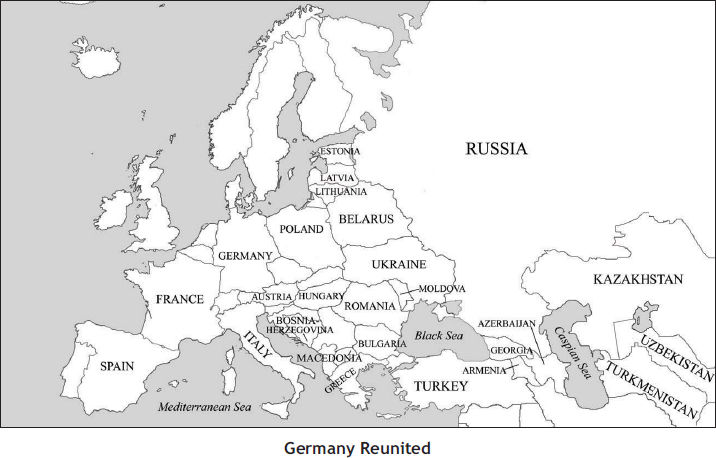
You’ll remember that after World War II, Germany was divided into two countries. West Germany had a democratic government, and East Germany had a communist government.
Life in East Germany was hard. Under communism, people suffered. There were few jobs and not enough food. And the East Germans couldn’t leave their country and go west, because a wall trapped them in their half of the country.
In the years that Germany was divided, about ten thousand East Germans tried to escape to West Germany. Some of them made it. Two families floated over the wall in a hot air balloon! In 1964, one group of Berliners dug a 164-foot tunnel from a bakery in West Berlin to an outhouse in East Berlin. The digging took six months, but hundreds of people crossed through it to freedom before East German officials found out about the tunnel and shut it down.
In September 1989, East Germans began to take glasnost (freedom of speech) seriously. They began to hold large, loud protests and rallies. They insisted that the communist government of East Germany allow them to travel—to West Germany, or to anywhere else in the world.
After a month of protests, the East German government could no longer resist. On November 9, 1989, the gates in the Berlin Wall were thrown open. East Germans poured through them. For the first time in many years, Germans could travel freely between the two Germanies.
Germans began to tear at the wall. They hammered at it, broke it down with shovels and tools and iron bars, and took chunks of it away. A man named Andreas Ramos who went to the wall that weekend wrote,
“The East German border was always a serious place. Armed guards kept you in your car, watching for attempts at escapes. Tonight was a different country. Over 20,000 East and West Germans were gathered there in a huge party. … Everyone had their radios on and everywhere was music. People had climbed up into trees, signs, buildings, everything, to wave and shout. … On both sides the guard towers were empty and the barbed wire was shoved aside in great piles. … From the East German side we could hear the sound of heavy machines. With a giant drill, they were punching holes in the wall. Every time a drill poked through, everyone cheered. … Many were using hammers to chip away at the wall. There were countless holes. At one place, a crowd of East German soldiers looked through a narrow hole. We reached through and shook hands.”
By November 11, it was clear that more than the Wall was coming down. The communist rule over East Germany was falling too. In 1990, East and West Germany were reunited into one country.
In the USSR, more changes were on the way. Gorbachev was trying to change his country.
Remember, the USSR was made up of Russia plus a number of smaller communist countries. Gorbachev himself was the leader of the whole USSR. A Russian leader named Boris Yeltsin, thought that Gorbachev’s reforms were happening too slowly. He believed that it was time to move towards a democracy much more quickly—and he had plenty of followers.
But another group of powerful communist leaders were resisting all of Gorbachev’s changes. They didn’t want the Soviet Union to become more open, or more free.
In August 1991, eight of these determined communists planned a takeover of the Soviet Union. They surrounded Gorbachev’s house, locked his doors, and cut his telephone lines so that he couldn’t contact anyone on the outside. Then they ordered him to resign. Gorbachev refused. So the eight conspirators announced, in public, that he was too sick to run the country, and that one of them would begin to act as Soviet leader in Gorbachev’s place.
When Boris Yeltsin heard what was happening, he called to all of his followers in Russia to gather behind him. Not only did thousands of Russians who wanted democracy come to join Yeltsin—so did the tanks and soldiers that the conspirators sent to arrest Yeltsin and get him out of the way! None of the army would follow the conspirators.
The Communist Party had lost its power to control the Russian people. And Russia was the largest country in the USSR.
The conspirators gave up. One of them killed himself! Gorbachev, once he had gotten out of his house, joined with Boris Yeltsin to decide what to do next. He banned all Communist Party meetings, and ordered every Communist Party office in the country locked up. Over the next few months, the countries that had been brought into the Soviet Union declared their independence one by one: Ukraine, Lithuania, Latvia, Armenia, and all of the rest. When it was over, Gorbachev resigned. He had no more Soviet Union to govern! Boris Yeltsin would serve as the head of the ancient country of Russia—no longer communist, and no longer part of the USSR.