When we last visited Vietnam, the country had been split in two. Ho Chi Minh governed the Democratic Republic of Vietnam, a communist country in Vietnam’s north. In the south, President Ngo Dinh Diem governed a different country—the Republic of Vietnam, which was not communist.
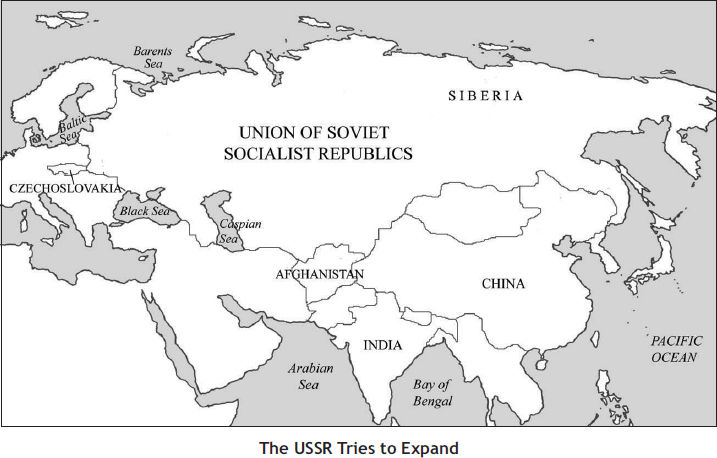
Now that you know about the Cold War and the American fear of communism, you can guess how the United States felt about the communist government of North Vietnam. The American government was afraid that North Vietnam would invade the south and take it over. If that happened, the whole country would be communist. And if one South Asian country became communist, all the others might follow—like a “row of dominoes,” in the words of one American official.
So the United States sent advisors and military officers to the south of Vietnam. These American “helpers” were supposed to make sure that the communist north didn’t take over South Vietnam as well.
The United States was right about one thing: the communist north did want to take over the south. Members of Ho Chi Minh’s revolutionary group, the Viet Minh, were still down in the south. In 1959, Ho Chi Minh ordered the Viet Minh to begin a guerilla war against the South Vietnamese government. He intended for this guerilla war to go on until South Vietnam surrendered to the north.
President Diem, who was supposed to be ruling over a republic, started to use his army to control South Vietnam and to fight back against the rebels, who were known in the south as Viet Cong. By 1962, he had declared South Vietnam under martial law.
A year later, the South Vietnamese army seized the government offices and murdered President Diem. Now the army would both fight the Viet Cong and try to govern the country.
The fighting grew fiercer and more widespread. Then, the civil war turned into an international war.
China and the Soviet Union sent guns, ammunition, and supplies to the Viet Cong, so that they would have a better chance of overcoming the South. This was exactly what the United States feared. So, in 1965, President Lyndon B. Johnson ordered U.S. Marines to go into South Vietnam.
This was the beginning of the longest war the United States had ever fought. It would drag on for eight long years. In 1969, at the height of the war, over half a million American soldiers were in the tiny country of Vietnam. American soldiers fought against the Viet Cong in the south, while American fighter planes bombed North Vietnamese military bases and cities.
The U.S. wasn’t the only country that sent soldiers to help the South Vietnamese fight against communist takeover. Soldiers from South Korea, Thailand, Australia, New Zealand, and the Philippines also fought with the South Vietnamese. But America sent more soldiers into Vietnam than any other foreign country. Between 1965 and 1973, American soldiers poured into Vietnam. In all, almost three million Americans fought in the Vietnam War.
Because so many soldiers were needed, young American men were drafted—forced to join the military. A country decides to use a draft (also called conscription) when it needs more soldiers than those who volunteer to join. The United States had used a draft during the Civil War, and also in both World Wars. When the Vietnam War began, the United States government decided that it was once again time to build a larger army. So during the Vietnam War, young men between 18 and 25 were given a “draft number.” If your number was called, you had to report to your nearest military office for a physical examination. If you passed it, you were sent off to train for war. And after you were trained, you might get sent to the jungles of Vietnam to fight against the Viet Cong, whether you wanted to or not.
Today, the American military is an “all-volunteer force.” To be in the Army, Navy, Air Force, or Marines, a young man or woman has to go to a recruiting office and ask to join. Young men in the United States still have to register with a government agency called Selective Service when they turn eighteen. That way, Selective Service knows how many men could be drafted, if the U.S. ever needed a larger army. But before anyone could be drafted, Congress would have to pass a law authorizing a draft—and because so many people in the United States oppose the idea of a draft, this will probably never happen. (The last time the Congress voted on a draft law, it was defeated, 402 votes to 2. Even the representative who introduced the law voted against it.)
Despite the thousands of Americans drafted, and despite year after year of fighting, nothing much seemed to be changing in Vietnam. The Viet Cong and the North Vietnamese showed no signs of giving up. The North Vietnamese government kept on sending more men, armed with Russian and Chinese weapons, to fight in the south.
Back in the United States, Americans were saying (with louder and louder voices) that the Vietnam War was a mistake. Thousands of young men were dying in Vietnam. Hundreds of thousands of protestors gathered together to shout, sing, and burn their draft cards (the cards that told young men when they would have to report for military duty).
In 1968, Lyndon B. Johnson announced that he wouldn’t try to be reelected. He was too unpopular—mostly because of the Vietnam War. Instead, Richard Nixon became president. As soon as Nixon took office, he announced that he would start pulling American soldiers out of Vietnam. In 1969, American troops began to leave Vietnam, a few at a time.
By 1972, the United States had agreed to meet with the North Vietnamese to talk about peace terms. Right at the beginning of 1973, the United States signed a treaty with the Viet Cong and both Vietnamese nations. The treaty said that every American soldier would leave Vietnam. South Vietnam would keep its independence—but North Vietnam would be allowed to leave over a hundred thousand soldiers in the south.
This wasn’t a very good treaty for the south. And almost as soon as the American soldiers left, the north resumed its attacks. In 1975, the communist armies of North Vietnam invaded the south, captured the southern capital city, Saigon, and took over the South Vietnamese government. Less than a year later, Vietnam had been reunited into one country, under communist rule: the Socialist Republic of Vietnam. Saigon was renamed Ho Chi Minh City.
The fighting had ended. But the country was in ruins. Almost a million North Vietnamese had died, as had over a million South Vietnamese. South Vietnamese who had opposed the communist takeover were sent to concentration camps. The Vietnamese government called these camps “reeducation camps,” and claimed that the camps would help southerners adjust to life in a communist nation. But many people in the camps died. Vietnamese who were afraid for their lives left their country, trying to sail across the South China Sea to other countries in southeast Asia. So many sailed away from Vietnam that they earned a nickname: the “boat people.”
In the United States, Americans mourned the loss of almost sixty thousand men. Hundreds of American soldiers captured by the Vietnamese, called POWs (prisoners of war) had been released. But hundreds more were missing. Many never came home. They remained “missing in action” (MIA). Their families never knew what happened to them.
Almost three million Americans had fought in the Vietnam War. Thousands came back wounded, or so disturbed by their years of fighting that they had trouble leading normal lives. And because the war had been so unpopular, soldiers who came back from Vietnam weren’t treated as heroes. After World War II, soldiers coming back home were cheered, honored, and thanked. Soldiers returning from the Vietnam War were just as likely to be jeered at, or criticized in public by those who had opposed the war.
Not until 1982, ten years after the withdrawal from Vietnam, did the United States build a memorial to the American soldiers who were killed in the war. Today, you can see the memorial, called the Vietnam Veterans Memorial, in Washington DC. The memorial is made of black marble, and is engraved all over with the names of those who died. It rises up out of the ground, like a huge scar that never healed. The memorial preserves the names of those who died in the war—and also shows that the Vietnam War wounded the American people.
In the Middle East, two more wars were about to erupt around the new state of Israel.
When we last visited Israel, it had declared its independence and fought against invading nations, all in the same day. In 1967, after Israel had been a country for almost twenty years, another war began. We call it the Six-Day War. It lasted for six days.
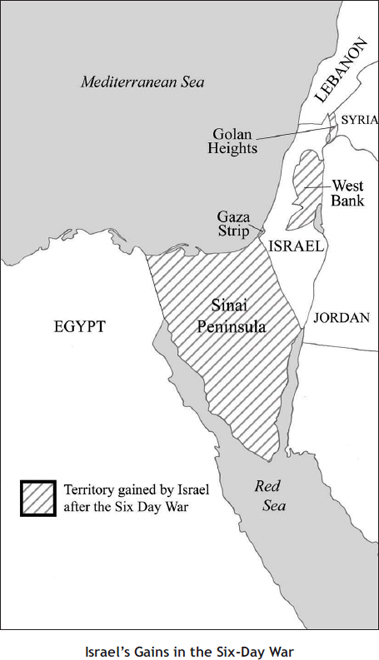
Once again, Israel and the Arab states of Syria, Egypt, and Jordan went to war. Only now, Israel had the help of its brand-new and very skilled air force. This time, Israel didn’t just defend itself. At the end of the war, Israel took land away from all three of the defeated countries. These territories—the Gaza Strip, the Sinai Peninsula, the West Bank of the Jordan River, and the Golan Heights—quadrupled Israel’s size. Suddenly, almost a million Arabs who had been living under Arab governments were instead controlled by Israel. Now, they were governed by a Jewish state.
Jews and Arabs were not good friends, and this new development didn’t make the Middle East any more peaceful.
For six years, Israel governed the unhappy Arabs in its new territories. In 1973, another war broke out. Once again, Egypt and Syria attacked Israel, hoping to get back some of the land lost in the Six-Day War. This third war between Israel and her Arab neighbors is called the Yom Kippur War, because Egypt and Syria launched their attack on Yom Kippur, the Day of Atonement—the most sacred day of the Jewish year.
The Yom Kippur War lasted longer than the Six-Day War, but not a lot longer. This time, the fighting went on for three weeks. At first, it seemed that Egypt and Syria might win this time around. Israel had been caught off guard by the first attack, and Egypt managed to shoot down many of Israel’s planes; this made Israel’s air force much less dangerous. And the Egyptian and Syrian attack was so violent that Israel quickly began to run out of ammunition.
Israel appealed to the United States for help. At first, America (which had just scolded Great Britain for getting involved in Egypt) refused to send aid. But then the Soviet Union decided to send weapons to Egypt and Syria. At once, President Nixon announced that the U.S. had changed its mind. New weapons were on the way!
At this, Israel’s soldiers took heart and began to fight with new energy. But after three weeks of fighting, the U.S. was afraid that the Soviet Union was getting ready to come into the war with soldiers—and nuclear missiles. American diplomats managed to convince all three countries to sign a cease fire. Israel claimed to be victorious, because all of the territories won in the Six-Day War were still under Israeli control. Egypt and Syria declared that they had won, because they had managed to destroy part of the Israeli air force and army.
Actually, not too much had changed in the Middle East. But the Yom Kippur War did have an immediate effect on the United States: It caused the U.S. to run out of gas.
The United States was filled with cars, buses, trucks, and other machines and vehicles that run on gasoline. That gasoline came from oil. The U.S. had some oil of its own beneath American ground—much of it in the state of Texas. But most of the oil used in the United States and in the world came from the Middle East. And most of this oil lay in Arab countries.
In 1960, five of the most powerful oil-producing Arab countries had formed an organization called the “Organization of the Petroleum Exporting Countries”—OPEC, for short. And as soon as the Yom Kippur War ended, the five countries in OPEC decided to stop selling oil to countries that had helped Israel in the Yom Kippur War.
That, of course, included the United States. From October 1973 to March 1974, OPEC refused to sell any oil to America. This was called an “oil embargo.”
The United States suddenly realized how much it depended on foreign—and sometimes unfriendly—nations for oil. Once OPEC stopped selling oil to the U.S., there just wasn’t enough gasoline to go around. Gas stations started to run out of gas. They had to put up signs for the cars driving by: “SORRY! NO GAS TODAY!” Some gas station owners wouldn’t even sell gas to people they didn’t recognize as regular customers.
The U.S. government announced that gas would be rationed. If the last number of your license plate was an odd number, you could only buy gas on odd-numbered days. If the last number on your license plate was even, you could buy gas only on even-numbered days. Since car engines use more gas when cars drive fast, the government also announced a new national speed limit. From now on, no state could have a speed limit higher than 55 miles per hour. (Until this time, some roads—long straight ones out in the desert—didn’t have speed limits at all; you could drive as fast as you wanted!)
Even with rationing and a lower speed limit, people waited in line for two or three hours to buy gas. In just a few weeks, the price of gas went up from twenty-five cents to over a dollar per gallon.
The OPEC embargo ended in March. Rationing ended too. Now, drivers could buy gasoline whenever they wanted—although gas prices never did go back down to the original twenty-five cents per gallon. Right after the embargo, scientists in America started to do research on other kinds of fuel and other kinds of energy, like solar power, so that America could never again be brought to a standstill by an oil shortage. But as time went on, Americans grew less worried about another embargo. Less time and money was spent on finding new sources of energy. Today, Americans use more oil than any other country—and the relationship between America and the countries of the Middle East is still affected by America’s need for Middle Eastern oil.
Five years after the Yom Kippur War and the embargo, the new president of the United States, Jimmy Carter, helped to bring a measure of peace between Egypt and Israel. The president of Egypt, Anwar el-Sadat, had led Egypt into the Yom Kippur War. Israel had a new prime minister, Menachem Begin.
Anwar el-Sadat had begun to hope for peace with Israel. In 1977, he became the first Arab leader to ever visit Israel. He even spoke to the Knesset, the Israeli Parliament. “I come to you today on solid ground to shape a new life and to establish peace,” Sadat told the members of the Knesset. “We all love this land, the land of God. We all, Muslims, Christians and Jews, all worship God.”
Anwar el-Sadat’s visit to Israel made other Arab leaders furious. They still hoped that the Jewish state of Israel could be wiped out, and that the Arabs of Palestine could get their land back. But Sadat refused to give up his plans for peace.
President Carter of the United States wanted peace, too. In September 1977, he invited the two leaders to meet with him at Camp David. Camp David is a presidential retreat spot in the mountains of Maryland, about an hour from Washington DC. Camp David was where FDR and Winston Churchill met to plan their war against Germany. And at Camp David, Menachem Begin, Anwar el-Sadat, and Jimmy Carter sat down to discuss peace in the Middle East.
The talks weren’t easy. Sadat and Begin didn’t even really want to talk to each other. Many hours passed with President Carter talking to one man, then going into another room to talk to the other, and then bringing back the second man’s remarks to the first. For twelve days, Carter persuaded the two men to stay at Camp David, listening to each other’s ideas. It was probably the most important act of Carter’s presidency.
Finally the two leaders worked out an agreement known as the Camp David Accords. The Accords stated that, from now on, Israel and Egypt would try to act in harmony with each other. Israel agreed to withdraw from the Sinai Peninsula and give it back to Egypt; and Egypt promised to be at peace with Israel.
In 1978, Begin and Sadat won the Nobel Peace Prize for their work at Camp David. But not everyone was thrilled. Many Arab leaders were outraged because Sadat had signed a treaty with Israel—which meant that he was recognizing Israel’s right to claim part of Palestine. Others thought that he should have asked for more land; why hadn’t he insisted that Israel return all of the territories it had won in the Six-Day War?
On October 6, 1981, President Sadat was watching a parade in Cairo when a handful of men, armed with guns and grenades, ran out of the parade towards the place where the president sat. They were members of the Egyptian Islamic Jihad, a group that wanted Muslim rule in all of the Middle East. They threw grenades and fired at Sadat. He was killed at once.
But although Sadat died, the assassins did not succeed in their plans. After Sadat’s death, his successor, Hosni Mubarak, honored the treaty with Israel.