In the ten years between the end of World War II and 1955, the South American country of Argentina put a new president into power and then threw him off again.
When World War II began, Argentinians were divided about what side Argentina should join. The people of Argentina were descended from at least four different kinds of people: the original Native American inhabitants, Spanish settlers who had come to South America in the seventeenth century, and Italian and German settlers who had arrived in Argentina during the 1800s. The Argentinians with Italian and German backgrounds hoped that their country would join with the Axis powers. Other Argentinians wanted to join the Allies.
The president of Argentina, Ramón Castillo, decreed that the country would remain neutral during World War II. But although Argentina didn’t fight on either side, it was friendly towards the Axis powers of Italy and Germany. During the war, Argentina even sent a few of its army officers over to Europe to learn new strategies from Axis commanders.
One of those officers was a captain named Juan Perón. Right at the beginning of the war, Perón went to Italy to study the best ways to fight in mountain territories. He spent two years in Italy, watching the Fascist army fight in World War II, learning techniques from the Italian officers—and observing Mussolini. Perón liked Mussolini’s ideas about how to run a country. He agreed that a country should obey its leader without debate in order to be strong. Even though Italy was at war, Perón thought that Mussolini’s Fascism had made the country purposeful, organized, and efficient.
In 1943, four years into World War II, Juan Perón joined a group of military officers who wanted to take over the government. He had returned to Argentina to find that its president, Ramón Castillo, had become weaker and more unpopular than ever. The poor people of Argentina believed that Castillo only cared about rich landlords and factory owners, not about the hungry workers who were struggling to survive. Rumors had also begun to spread about the coming presidential election. Ramón Castillo was up for reelection. But now, everyone was whispering that Castillo had already picked a rich plantation owner to be the next president—and that his government was ready to tamper with the votes, in order to make sure that Castillo’s chosen candidate was elected.
In the uproar, the military officers marched soldiers to the Casa Rosada, the president’s house in Buenos Aires, and suggested that Castillo resign. Faced with all those armed and hostile officers, Castillo had no choice. He left the Casa Rosada and his position as president. The officers then set up a junta—a military government—to rule Argentina.
A military government doesn’t seem any more fair than a president who had been elected by fraud. But Argentinians seemed willing to give the junta a chance.
In this new government, Juan Perón was put in charge of taking care of working people. Perón wanted to make sure that working people were paid a fair wage and had money to live on when they were too old to work. He introduced laws to bring these reforms about—and this made him very popular with the working poor.
But Perón became more and more unpopular with his own government. The other officers didn’t like the idea that Perón had so much popular support. And they also were worried about Perón’s admiration of Mussolini.
In 1945, when the junta had been in charge of Argentina for two years, the Axis powers surrendered to the Allies. It was a good time to point out that Perón had supported the Fascists—who were on the losing side! On October 9, 1945, Perón was arrested by his own government and put on a small but very comfortable island where he couldn’t command his supporters to rise up and free him.
Anti-Fascists rejoiced. But soon, the working people who loved Perón demanded his release.
Juan Perón was engaged to be married to a young woman named Maria Eva Duarte, an actress he had met several years before. When Eva heard that her fiancé had been thrown into jail, she encouraged the working people of Argentina to demand an explanation. What had happened to their champion?
These workers, nicknamed descamisados, or “shirtless ones” because they worked without shirts in the hot sun of South America, gathered in the streets in the thousands, demanding Perón’s release. The other officers could see that Perón would have to be set free.
He was. On October 17, 1945, Perón was set free. He went out to speak to his supporters. A huge mob cheered when he appeared, and waved torches in celebration. The next day, the workers all stayed home from work and took a vacation day in celebration of Perón’s release. They called this day, jokingly, the “Feast of Saint Perón”!
By arresting their champion, the officers of the junta had lost the confidence of the working people. The junta couldn’t hold onto its power. Its members agreed to hold an election for a new president.
Juan Domingo Perón won the election.
As president, Perón went on trying to improve the lives of the poor. He also did his best to get the important businesses of Argentina back under Argentinian control. Like China, Argentina was filled with foreign businessmen who controlled factories, trains, and ports. Great Britain owned most of the railroads. The United States owned almost all of the car factories. Perón brought these businesses back to the people of Argentina—by seizing them in the name of the government.
Although Perón worked for the people of Argentina, he also used the methods of the Fascists to make sure that he kept his power. If a newspaper criticized him, Perón ordered it shut down so that it could never print another issue. If a schoolteacher told his students that Perón’s policies might not be good for the country, he lost his job. Anyone who objected too loudly to Perón’s reforms and laws was likely to disappear, mysteriously. Perón called this way of running a country justicialismo. He believed that the poor people should have power—but the way to give them power was for the government to tell everyone how they could use their land and their money.
Argentina did have a constitution that gave the citizens the rights to certain freedoms—such as the right to be tried in a court if they were accused of a crime. So how did Perón get away with “disappearing” Argentinians who disagreed with him (and violating all sorts of other rights that the people were supposed to have)? There was one clause in the constitution that gave the president of Argentina the power to act like a dictator if the country was in the middle of a national emergency. So Perón simply declared that Argentina was suffering from an emergency! Argentinians put up with Perón’s dictatorship for nine years. In part, Perón was able to keep his position because his wife Eva was so popular. Eva was beautiful, charming, and soft-hearted. As wife of the president, she started an organization called the Eva Perón Foundation that gave money to the poor, helped working people visit doctors, and paid for children to get an education. The poor people of Argentina called her “Evita,” a nickname showing their love for her. She was even nicknamed “the Madonna of America” for her mercy.
In 1952, Evita died. She was only thirty-three years old. At her funeral, thousands of Argentinians lined the streets and wept out loud as her coffin was carried past.
After Eva died, Juan Perón grew more cruel. More and more Argentinians “disappeared” and were never seen again. The people of his country began to mutter (very quietly) about Perón’s tyranny. Meanwhile, Argentina was growing poorer and poorer. Perón had spent huge amounts of the government’s money on education and health care for the poor. This was good for the poor—but now the government was out of money.
Perón, faced with a rapidly emptying treasury, announced that for two years, no one in Argentina would get a pay raise. He suggested that Argentinians eat less meat and more bread, so that the meat could be sold to other countries for money. Argentinians weren’t too happy at the prospect of a meatless diet!
Then Perón made himself even less popular by starting to criticize the Roman Catholic Church. He accused Catholic priests of preaching against him in their sermons, and sent two of the most well-known priests back to Rome, accusing them of treason. He declared that several church holidays—days when Argentinians were accustomed to staying home—would now be regular workdays. The devout Catholics of Argentina resented all of these actions.
Perón had begun to lose the loyalty of his people.
On June 16, 1955, the armed forces suddenly rebelled against Perón. Military planes flew over the Casa Rosada and dropped bombs on it. The rebellion only lasted a day. But Perón reacted by announcing that he would wage war on anyone who opposed him. He also ordered his supporters to attack anyone who criticized him.
Even Perón’s supporters were shocked by this. Perón was encouraging Argentinians to beat each other up! The army again tried to revolt. This time, soldiers managed to capture several large Argentinian cities. They began to call for Perón to resign, and for Argentina to hold new elections for another president.
Perón left his country and went first to Paraguay and then to Madrid, in Spain. Back in Argentina, his own people knocked his statues over and smashed them, and chipped his name out of all of the engravings in public squares.
Over the next eighteen years, Argentina had nine different leaders. In 1973, eighteen years after his flight, Juan Perón even returned to Argentina and became president again—for a single year. Then, at the age of seventy-nine, Juan Perón died.
Across the Atlantic from South America, the countries of Africa were struggling to establish their own governments. One by one, the countries that Europeans had created were throwing off European rule.
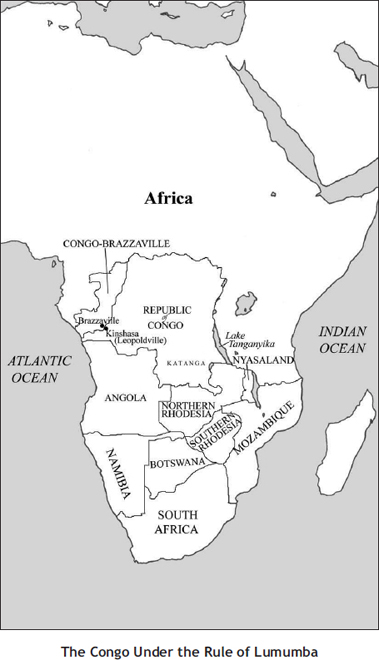
One of these struggles for freedom took place in the Congo, at the center of Africa. Almost a hundred years before, King Leopold II of Belgium had claimed the Congo as his own personal property. He called his land in Africa the “Congo Free State” and named one of its cities after himself: Leopoldville.
The Congo Free State stretched from the Pacific Ocean, on the western coast of Africa, all the way to Lake Tanganyika. It went from just below the Sudan in the north down into the south of Africa. The Congo Free State was huge. Its land was fertile, and many different African tribes lived in it.
King Leopold treated the many tribes in his colony badly. He forced them to pay high taxes. To earn enough money to meet the king’s demands, Africans had to work long hours making rubber or go on dangerous elephant hunts so that they could sell the elephants’ ivory tusks. Leopold allowed slave traders to raid the Congo, taking Africans to sell in Europe as slaves. Every village in the Congo had to send four people every year to work as slaves for Leopold—like sacrifices to a dragon. He even made a notorious slave trader the governor of part of the Congo.
By the time the Congo had been in Leopold’s possession for twenty-five years, half of its people had died. By 1908, many people both in Belgium and in the rest of the world were so indignant about the way that the Congo had been treated that the officials in the Belgian government appointed a new governor of the Congo and forced King Leopold to give up his personal claim to the land.
Life got to be a little better for the Africans of the Congo. They were no longer taxed quite so heavily or made to serve as slaves—but they weren’t free. Like the blacks of South Africa, the African peoples of the Congo had to live separately from the whites. They couldn’t study to be doctors, lawyers, or even tradesmen, and they weren’t allowed to leave their country to find a better life elsewhere.
In 1956, an African patriot named Patrice Lumumba wrote a petition to the Belgian government, asking for more freedom for his country. Lumumba was from a small tribe known as the Batetela. He didn’t have much political experience; he had worked in a post office and then taken a job as a salesman for a company that made beer. But he had always been active in speaking and writing about the Congo’s need for independence.
In 1958, Lumumba formed a group called the MNC or the “Mouvement National Congolais.” Lumumba told his followers, “Independence isn’t a gift that can be given by Belgium. It is the right of the Congolese people.”
The MNC led demonstrations and riots, trying to claim this right for themselves. At first, the Belgian government arrested some of the MNC leaders, hoping that the movement for independence would die down.
Instead, it grew more powerful, thanks to an action taken by the country of France. The French prime minister, Charles de Gaulle, allowed the French colony just northwest of the Belgian Congo to declare itself free. This area, known as Congo-Brazzaville, was only separated from the Belgian Congo by a river. As a matter of fact, the capital city of Congo-Brazzaville, Brazzaville, was right across the river from the capital city of the Belgian Congo, Leopoldville. Now the people of Leopoldville could look across the water and see free Africans.
Again, Congolese leaders sent messages to Belgium, asking for independence. When the Belgian government refused, riots broke out in Leopoldville. Belgian soldiers couldn’t bring the mobs under control, even when more troops were sent from Belgium.
When the Belgian government realized that the Congo was out of control, it agreed to give the Congo its independence. In 1960, the first Congolese election was held. It had been arranged so quickly that the people of the Congo hadn’t been able to form political parties, or find out much about different candidates.
Patrice Lumumba, the most well-known Congolese leader, was elected prime minister of the newly independent Congo. In his speech to his people, he delivered the Congo’s Independence Day address. “I salute you in the name of the Congolese Government!” he announced. “[A] noble and just struggle … was needed to bring to an end the humiliating slavery imposed upon us by force. … We have experienced contempt, insults and blows, morning, noon and night, because we were ‘blacks.’ … We have known that the law was never the same for a white man as it was for a black. … All this has meant the most profound suffering. But all this … is now ended. The Republic of the Congo has been proclaimed, and our land is now in the hands of her own children. … Long live the independence and unity of Africa! Long live the sovereign and independent Congo!”
To celebrate independence, the people of Leopoldville pulled down and broke up the statue of Leopold II that stood in their capital city. They changed the name of the city to Kinshasa.
Not every African who lived in the Congo was pleased with independence. Under Patrice Lumumba, the Congo become one big country called the Republic of the Congo. But before the Europeans had settled in Africa, the area of the Congo had been divided into many small territories, each the home of a different tribe. Now, many Africans thought that the Congo should go back to being many small, independent states, each governed by its native tribe.
Just six days after the election, the eastern part of the Congo declared itself independent from the big Republic of Congo. Patrice Lumumba didn’t want the eastern area, known as the Katanga, to leave the Republic. His new government needed money to run the country properly, and the copper mines that provided the Congo with most of its wealth lay in Katanga.
Lumumba’s government demanded that Katanga rejoin the Republic. Katanga asked Belgium for soldiers to protect its new independence. Civil war broke out. Less than a year after becoming prime minister, Patrice Lumumba was captured by Katanga rebels and murdered.
A Congolese general named Joseph Mobutu announced that the Congo would now be ruled by a “caretaker government”—in other words, by military officers who had seized control of the country. (No one tried to organize another election.) Four years later, Mobutu gave himself the title “president.” (Still no election!)
Under Mobutu, the Congo was a totalitarian state. Mobutu’s own political party, the “Popular Movement of the Revolution,” was the only party allowed to take part in the government. He kept control of the country with his army. And he got some of the money he needed to run the Congo from the United States. Mobutu had promised the U.S. that, if America helped him out, he would keep the Congo from becoming a communist country.
Mobutu ordered the Belgian names of the Congo and its cities changed to African names. Today, the Congo is known by the African name “Zaire.” And during Mobutu’s rule, Zaire was controlled by Africans, not by Europeans.
But Mobutu, like many rulers, managed to keep his power by threatening his opponents. He arrested those who disagreed with him, accused his enemies of treason, and sent out spies to find out whether anyone was criticizing him. He even had a squad of special police called “The Owls” who went out at night to drag people from their homes if Mobutu thought they were a threat to his power. The people of Zaire were afraid to even say his name—in case someone might be listening. They called him “Uncle Mo” instead. Under Mobutu, government officials took bribes to do their jobs. Policemen threatened to arrest innocent people unless they were given money. The Congo was free from European rule, but it still wasn’t free from tyranny and corruption.