When Egypt helped invade the new country of Israel, it did so under the rule of King Faruk, Egypt’s second king.
The first king of Egypt, King Fu’ad I, had died a few years earlier. His son Faruk, only sixteen years old, inherited the throne in his father’s place. Egyptians hoped that Faruk would manage to bring some agreement between the three powers jostling each other for control of Egypt—the king, the Wafd, and the British.
But Faruk wasn’t a skilled ruler—or even a moral one. He spent a lot of money travelling to Europe, where he gambled away still more money and went to parties at disreputable clubs. He also kept getting Egypt involved on the losing side of wars. When World War II broke out, Faruk tried to keep Egypt neutral. This was foolish, since Egypt had actually signed a treaty to fight on Britain’s side in any war. It also annoyed the British, who forced Faruk to change his mind. Then, when Egypt lost the 1948 war with Israel, Faruk’s people blamed him.
In 1952, an Egyptian military officer named Gamal Abdel Nasser threw Faruk off his throne.
Nasser grew up in a household that was respectable, but not rich. His father was a postal clerk. Nasser was able to go away to school, as poorer boys couldn’t—but he said, later in life, that he often came home from school to discover that there was nothing to eat at home!
Nasser was a reckless boy, full of fight. He got into more than one street brawl, where Egyptian boys did their best to punch each other out. So it isn’t surprising that Nasser decided as a young man to join the army. When the 1948 war with Israel began, Nasser was an army officer of thirty, tough and experienced.
During the war, Nasser learned a lesson that stayed with him for the rest of his life. One evening, he was sitting beside one of his friends, a man named Kamal. Kamal was telling Nasser about another officer, a colonel they had both known, who had just died. “Do you know what the Colonel said to me, before he died?” Kamal said to Nasser. When Nasser remained silent, Kamal went on, “He said that the real battlefield is Egypt.”
Nasser thought about this—and took it to heart. As an Egyptian, his future would not be spent fighting wars in other countries. He would put his energy into defending and shaping his own homeland.
Four years after the war ended, ninety army officers, led by Nasser, took over the Egyptian government. The officers, like most of Egypt, were fed up with Faruk’s weak, useless leadership. They seized control of the government offices (almost no one tried to stop them), ordered Faruk to leave the country, and set up an eleven-man council to run Egypt.
The rest of the world watched carefully to see what Nasser would do with the Suez Canal. Remember, the Suez Canal made it cheaper and much quicker to travel from Europe to India and the east. No one wanted Nasser to close the canal, or to put restrictions on who might be able to use it.
During World War II, both the Italians and the Germans had tried to invade Egypt and take over the canal. But when Nasser came to power in 1952, the canal was still under Egyptian control—which meant that it was also under the control of the British, who still had soldiers stationed in Egypt.
Nasser wanted all of the Arabs in the world to unify into a powerful country that would, he hoped, become known as the United Arab Republic. Above all, he wanted Egypt to be free and independent of any European influence.
Still, Nasser knew that it would be very bad for Egypt if he were to challenge the British over control of the Suez Canal. The canal made a lot of money for Egypt. Ships that used the canal had to pay a fee, and in the 1950s, 122 million tons of cargo (over half of which was oil) were ferried through the canal each year.
But in 1956, Nasser got angry enough to close the canal. This became known as the “Suez Crisis.”
The crisis began when Nasser tried to borrow enough money from the United States to build a dam across the Nile River. The dam would be huge—365 feet high, and 3 miles across. It would catch the Nile waters, and allow the Egyptians both to irrigate their fields and to generate electricity from the power of the running water.
But the president of the United States, Dwight Eisenhower, didn’t trust Nasser. He thought that Nasser was too friendly with the Soviet Union. Even though the Soviets and the Americans had ended up on the same side by the end of World War II, Americans feared the growing power of the USSR. So Eisenhower refused to give Nasser a loan.
Nasser was furious. On July 26, 1956, he gave a rousing speech to a gathering of Egyptians. In this speech, Nasser said that the history of the Arabs had been, for a hundred years, the history of a struggle to get out from under the thumb of Western countries like the United States. He declared that from now on, Egypt would show its independence by taking full control of the Suez Canal. Egypt had the right to decide who could use the canal, and who couldn’t. And the first country that would be banned from using the canal was Israel.
Actually, Egypt still owed France and Great Britain a great deal of money that Said Pasha and Ismail Pasha had borrowed in order to build the canal in the first place. Technically speaking, the canal belonged, in part, to French and British banks. But Nasser didn’t let this bother him. He claimed control over the canal anyway.
The prime minister of France and the prime minister of England worried that Nasser was a dictator in the making. They knew Nasser wanted to unite all the Arabs together. Didn’t that sound a little bit like Hitler’s plan to make Europe into one German Empire? What if Nasser tried to take over the whole Middle East? The European countries should stop him before he grew more powerful.
The leaders of Israel were willing to help out. They believed that Israel needed to show that Arab countries couldn’t bully the Israelis. If they reacted to Nasser’s closing the canal to Israeli ships with force, other Arab states would be more likely to leave Israel in peace.
Officials from Israel, Britain, and France held a secret meeting in a suburb of Paris. Huddled in a tile-roofed villa, the officials hatched a plan called “Operation Musketeer”—all for one and one for all! Afterwards, they toasted each other with champagne.
The plan was a little bit complicated, but here’s what Operation Musketeer (Operation Mousquetaire in French) involved:
First, Israel would invade Egypt.
Then, France and Britain would step in and offer to help. They would tell Nasser, “Turn the control of the Suez Canal over to the French and British, and we’ll tell Israel to leave you alone.”
Then, after Nasser agreed, the Israelis (who never really intended to conquer Egypt at all) would retreat. France and Britain would get the canal, Israel would be able to use it, and Israel’s invasion of Egypt would show that the Israeli army was strong and ready to fight.
Although Israeli officials didn’t realize it, France and Britain actually hoped that Nasser would turn down their offer to help. That way, French and British soldiers would have a good excuse to invade Egypt and take the Suez Canal over by force—permanently.
The plan went into action on October 29, 1956. The Israeli army began to march into Egyptian territory. British and French officials at once sent a message to Nasser, offering to help. If Egypt would just let England and France supervise the Canal for a little while, they would convince Israel to back out of Egypt.
Nasser laughed at this offer, and refused. So British and French soldiers joined the invasion. Fighting began between Israeli and Egyptian soldiers. Several thousand Egyptians were killed. When French and British soldiers arrived at the Egyptian city of Port Said, another battle began. Almost three thousand more Egyptians died.
The fighting ended only because the United States decided to get involved. American officials objected that France and Great Britain were breaking one of the rules that all of the countries in the United Nations had agreed to: Every country has the right to control its own territory. The French and the British were trying to take this right away from Egypt.
The United Nations agreed, and ordered Great Britain and France to leave the Egyptians alone.
This was terribly embarrassing for both countries. The French and British had been accused, in front of the whole world, of acting like bullies. Both governments ordered their troops out, with as much dignity as possible, and tried to act as though they had never really intended to take over the canal by force. The British prime minister was so humiliated that he resigned just a few months later.
The Suez Crisis had two other results. In the United States, President Eisenhower asked the U.S. Congress to pass a new law called the “Eisenhower Doctrine.” This new law said that U.S. soldiers could go and fight on the side of any Middle Eastern country that asked the United States for help against an attacking army. Congress agreed to pass the law.
And in the Middle East, Nasser became a hero. He had defied the orders of European countries—and particularly Great Britain, which had so long ordered Egypt around. Arab leaders all around the world cheered for Nasser, who had shown himself to be strong, decisive, and ready to stand up to bullies.
In the same year that the United States refused to lend Nasser money for his dam, millions of American dollars went to the war-destroyed countries of Europe.
Imagine that you were born in London, in the year 1930. When you are four, Adolf Hitler becomes the leader of Germany. Maybe you notice that your parents frown and furrow their brows when they read about this in the newspaper. They don’t know much about Hitler, but what they know, they don’t like. But for the most part, you don’t pay much attention. You’re four years old, after all.
By the time your ninth birthday rolls around, though, you are more and more aware that things happening in the far away country of Germany do matter to you in England. Just after your birthday, England declares war on Germany. The very next day a German ship sinks a British ship with 1,418 people on it. Most of the people are saved—but the event is terrifying anyway. Your parents say that you won’t be travelling anywhere on a ship, not until the war is over.
In 1940, the year you turn ten, the government declares that most English sugar, butter, and meat needs to go to the army, to feed soldiers. Your family is issued a ration book, which has coupons in it for each of the scarce items. You have to turn over a coupon every time you want to buy sugar, butter, or meat. When the coupons are gone, you can’t buy any more of those foods. There’s not enough sugar to make you a birthday cake, so you get “war cake”—cake made without eggs, butter, or sugar in it.
It doesn’t taste much like cake, and it doesn’t feel much like a birthday.
Next, clothes are rationed. Then soap. Your mother learns to make casserole out of chicken bones. The German air force starts to bomb London. When you walk to school, you see that houses nearby have been flattened during the night. Everyone in them was killed.
Soon the government announces that all children must leave London, because it is too dangerous for them. Your parents put you on a train that takes you out to Wales, a country place where distant cousins of your mother have a farm. You live in their spare bedroom, learn to milk cows, and help in the garden. You miss your mother, you’re sick of bone casserole, and you want to go home.
Finally in 1945, when you are fifteen, the war ends. Everyone in England is ecstatic. There are even parties in the streets! No more bone casserole, no more ration books, and no more bombs. You can go home! Your parents greet you at the train station with big smiles. Now, they say, everyone can go back to normal.
But, after six years of war, what is normal?
The Allied Powers—especially England and France—had made huge sacrifices to fight, and win, World War II. Many English and French citizens were dead. People were tired. Businesses and banks were out of money. Many buildings, from churches to schools, had been bombed and needed to be repaired or rebuilt.
America had made sacrifices to win the war too. American soldiers had died. But the closest place to America that had been attacked was Pearl Harbor, and that was in Hawaii—still far away. No battles had been fought on American soil. American schools didn’t need to be rebuilt. After 1945, life could get back to “normal” in America pretty quickly.
America knew it needed to help its allies in Western Europe get back on their feet. The job fell to the secretary of state, a man named George Marshall.
The secretary of state is an advisor to the president. His job is to help America keep its friendship with other countries around the world. On June 5, 1947, Secretary of State Marshall made a speech at Harvard University, explaining that America had an obligation to help Europe recover from the war. He said, “I need not tell you, gentlemen, that the world situation is very serious. … It is logical that the United States should do whatever it is able to do to assist in the return of normal economic health in the world, without which there can be no political stability and no assured peace.”
The United States very much wanted stability and peace! George Marshall had a plan to bring this stability and peace. In his speech at Harvard, he went on to explain what the plan was. The United States would give twenty billion dollars to the countries of Europe so that they could rebuild. This plan became known as the Marshall Plan.
The United States offered some of this money to Joseph Stalin, the leader of the Soviet Union. Stalin refused to take the money. He had been willing to fight on the side of the United States during the war, but if he took money from the U.S., America might one day ask him for a favor. He was sure he didn’t want to do whatever the United States might ask, so he decided that the Soviets would do without the American money.
The other countries in Europe accepted the help. Now, George Marshall had to convince the people of the United States that Europe needed twenty billion dollars of American money. So, as the money began to go out to the countries of western Europe, the government made a series of movies about the Marshall Plan. These movies helped persuade Americans that the Marshall Plan was a good idea.
One movie, made in 1950, was called The Home We Love. It was about a real town in southern France called Mazamet. Mazamet was shattered by the war—but because of the Marshall Plan money, life in Mazamet was finally getting better. The movie showed the people of Mazamet buying food, going back to school, and working in the factories that had been re-opened with the help of American dollars.
Another movie, called The Extraordinary Adventures of a Quart of Milk, was made in 1951. The hero of this film was a container of milk that made its way from a farm in Normandy to a factory that transformed the liquid milk into a can of powdered milk. What did the adventures of this quart of milk have to do with the Marshall Plan? Without American aid to France, the roads would not have been good enough to get the milk from farm to factory—and, indeed, there might not have been any factory at all! Thanks to the Marshall Plan, the French people had roads, factories, and milk—liquid and powdered.
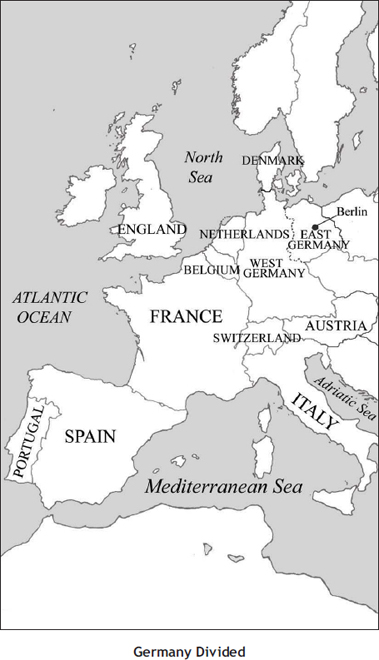
The Marshall Plan even gave money to Germany.
After World War I, Germany had been forced to pay huge amounts of money to the rest of the world. The Allies weren’t going to repeat this mistake after World War II. Instead of saddling Germany with a huge debt, America, France, England, and the Soviet Union wanted to help Germany rebuild its government.
But while America, France, and England wanted Germany to become a democracy, the Soviet Union wanted to turn it into a communist country. The four countries couldn’t come to an agreement about Germany’s government—so they divided Germany in half. England, America, and France got to re-organize the western half of Germany. They helped set up a new German democracy, and used Marshall Plan money to rebuild Germany’s roads and buildings.
Meanwhile, the Soviets turned the eastern half of Germany into a communist country. They decreed that the other Allies could have nothing to do with East Germany. No shipments could go back and forth between communist East Germany and democratic West Germany.
For several years, people could travel back and forth between East Germany and West Germany. People went across the border to visit relatives or friends. Shops in West Germany were often better stocked, so East Germans crossed the border to buy everything from food to pantyhose!
Often, they didn’t come back. Life in West Germany was easier and freer than life under the communist government of East Germany. Over two million East Germans went west and never returned. The East German government realized that it was losing too many scientists, university professors, doctors, and lawyers to the west.
So in the middle of the night on August 12, 1961, East German soldiers put up a fence right through the middle of the city of Berlin, and also along the border between the two Germanies. People got up in the morning to discover that barbed wire and cinder blocks now cut them off from the other half of Berlin. People visiting relatives were caught and couldn’t go back home. Families were divided. No one was allowed to cross the fence without government permission.
Over the next few years, concrete walls fifteen feet high, lined with electric wire, topped with guard towers, and surrounded by guns and land mines, were built to replace the fence. It was illegal to sneak across this wall, which became known as the Berlin Wall. Almost two hundred people were killed by East German guards or by land mines, trying to get from one side of the Berlin Wall to the other. The Wall would stay up, dividing East from West, for almost thirty years.