In the 1920s, well before the start of World War II, Great Britain had promised to give the country of India the right to govern itself. The nonviolent protests led by Gandhi, and the violent protests of Indian revolutionaries who wanted British soldiers out of their land, had made India impossible to govern.
But India was not declared free and independent until August 15, 1947—because it took more than twenty years for Indian Muslims, Indian Hindus, and British officials to agree on how the new country would be governed.
Between the Amritsar Massacre in 1919 and the declaration of independence in 1947, Muslims and Hindus in India argued over how the two different religions could live together in the same country. Most people in India were Hindu. The Hindu religion is very old; it goes back to at least 2000 BC (or BCE). Hindus practice spiritual disciplines called “yogas.” One of the most important yogas is karma-yoga, selfless service to others.
The Muslims of India, who were a much smaller group, didn’t object to selfless service; this was part of their religion as well. But they disliked the Hindu belief in many different gods. Muslims believe in one God, Allah. Instead of “yogas,” Muslims practice five “pillars” of their religion, including the giving of money to the poor and the practice of fasting.
During the British occupation, both Muslims and Hindus were governed by British officials—who were Christians. When Indian Hindus began to demand the right to govern themselves, Muslims in India also began to dream about a country in which they would not be governed by people of another faith. They didn’t want to live in a country run by Hindus, any more than the Hindus wanted to live in a country run by Christians.
One of the most outspoken Indian Muslims was a man named Muhammad Iqbal. He was a lawyer, a poet, and a scholar of Islam. And he believed Muslims from India should have their own country, where they could govern themselves.
Another outspoken Muslim, Mohammed Ali Jinnah, agreed with Muhammad Iqbal. Jinnah was also a lawyer. His nickname was Qaid-e-Azam, which meant “Great Leader,” and he became the leader of a powerful group of Indian Muslims called the Muslim League. Jinnah suggested that, since Muslims and Hindus were two separate peoples, they should be separated into two different Indian nations—instead of being forced into one country. Jinnah wanted India partitioned.
A partition is a wall or divider that you place in a room to break the room in half. You might have partitions at your local public library—tall, rolling boards that can be wheeled in to divide one giant room into, say, four smaller rooms.
Jinnah did not want a real wall to be built down the middle of India. But he did want some of India to be “partitioned,” or set aside, to be a new, Muslim country. In 1940, Jinnah announced that the Muslim League had a demand. The League didn’t believe that Gandhi’s Congress Party, now known as the Indian National Congress, would treat Muslims fairly once it had power over India. When India achieved independence, the British and the Hindus had to agree to separate off part of the country for Muslims to rule. This part would be called Pakistan.
When World War II swept across the world, Indians had to put off their wish for independence. But once the war was over, the British promised to give India its freedom just as soon as the Muslim League and the Indian National Congress could decide how India should be governed.
Gandhi, still the leader of the Indian National Congress, was firmly against partition. Muslims and Hindus, he insisted, could learn to live together in peace. He tried to convince Jinnah to give up the idea of partition, but Jinnah could not be budged. He threatened to use violence to create Pakistan, if necessary.
After more than a year of arguments and riots, the Muslim League and the Indian National Congress still had not managed to come to an agreement. So the British decided that partition would have to be put into place. Only this would bring an end to the hostility—and the violence—between India’s Hindus and Muslims.
On August 14 and 15, 1947, India was declared independent—and the country of Pakistan was born. The new Islamic Republic of Pakistan was divided into two parts, East Pakistan and West Pakistan, separated by India in the middle.
Partition caused horrible chaos in India. Hindus who lived in the lands that had suddenly become Pakistan were terrified of staying, afraid that Muslim mobs would attack them. They collected their belongings and their children and piled onto trains headed south, hoping to get into India safely. Muslims in India were doing the same thing and going north into Pakistan. The trains filled with panicked Indians, all fleeing to the country where they would be in the majority instead of the minority, often passed each other, headed in opposite directions. Thousands of men, women, and children died in riots where Muslims killed Hindus and Hindus killed Muslims. In all, fifteen million Indians left their homes.
Independence and partition didn’t end the violence between Hindus and Muslims. For years, Pakistan and India argued and sometimes fought over a piece of land called Kashmir, just north of India. Both countries wanted to claim it. Finally, they agreed to divide it (although the two countries still argue about where the boundary line between Pakistani Kashmir and Indian Kashmir should lie). In both India and Pakistan, Indians were still killed in riots because of their religion.
Gandhi had agreed to partition, with great reluctance, but he was deeply saddened by it. He had hoped that all Indians, whatever their religion, could live together in India. The bloody riots in India and Pakistan disturbed him so much that he went on a fast that lasted for days. When Indians across India learned of Gandhi’s fast, the riots began to die down; both Hindus and Muslims were afraid that Gandhi might die if they didn’t stop fighting.
Not all Hindus had such respect for Gandhi. A small group of Hindu Indians was furious with Gandhi because he had allowed the partition to take place. They believed that all of India should have remained under Hindu rule.
One member of this fanatical group was a young man named Nathuram Vinayak Godse. Less than a year after partition, Godse put a pistol in his belt, under his shirt, and went to a prayer meeting where Gandhi would be speaking. Gandhi had just finished another fast, and he was too weak to stand alone. He was leaning on a friend’s arm, speaking to the Hindus who had come to the meeting, when Godse leaped out of the crowd and shot Gandhi to death.
The Hindus in India and the Muslims in Pakistan were not the only people who wanted to be ruled by a government of their own faith. Jews from around the world wanted their own country, too.
The Jewish people had not lived all together in Israel since the year AD 70 (or 70 CE), when the Romans drove the Jewish people out of Jerusalem and out of their country. But Jews had always thought of the land of Judea, on the eastern edge of the Mediterranean Sea, as their homeland. Their sacred scripture told them that God had chosen that land for the Jewish people and that one day they would return to it.
In the nineteenth century, some of the Jews in Europe began to think that the time had come for Jews to have their own country. Why should Jews live scattered all over the world—a few in Russia, a few in Germany, a few in England, a few in America? There should be one land where all the Jews could come and live. This idea that there should be a Jewish country is called Zionism, because one of the scriptural names for the city of Jerusalem is Zion.
There were a handful of Zionists in the nineteenth century. But Zionism did not really gain a big following from thousands and thousands of Jews until after World War II.
After the horrible killings in Hitler’s death camps, both Jews and non-Jews became more interested in the idea of a Jewish homeland. Many Europeans had grown up knowing that their neighbors, and sometimes their own parents and aunts and uncles, disliked Jews. But few had imagined that a government might build death camps and try to kill all the Jews.
World War II made many Jewish people feel that they must have their own country. They believed Jews would never be safe living in a nation governed by non-Jews, a country that might secretly—or not so secretly—dislike Jews and Judaism. Many non-Jews around the world, sickened by the events of the Holocaust, understood why the Jews wanted and needed their own country.
Where would this new Jewish country be? Some Zionist leaders said it didn’t really matter—it could be anywhere, as long as it was a Jewish country governed by Jews. Some suggested a Jewish state could be squeezed into the continent of Africa!
But most Zionist leaders said that the Jews should return to the land that God had promised their ancestors. They should go back to the ancient land of Israel.
At the beginning of the twentieth century, that land was called Palestine. For the last thousand years, Arabs had been living in Palestine. The Jews believed that Palestine was their homeland, because their ancestors had lived there for centuries and their sacred scriptures promised it to them. But the Palestinian Arabs had lived there for a millennium. It was their homeland too.
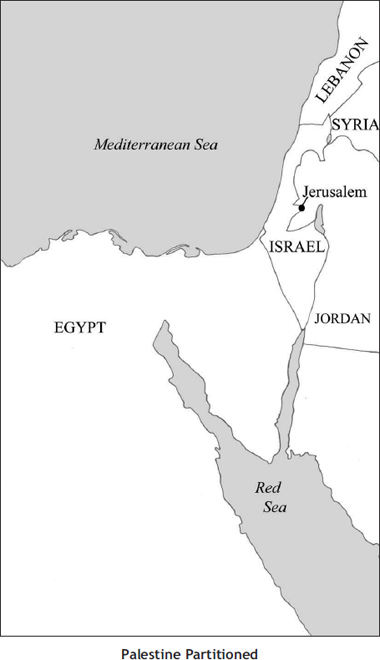
How could one homeland become two countries? Through partition. In 1947, the United Nations voted to partition Palestine into two countries—an Arab country and a Jewish country.
Zionists around the world cheered! The Jewish people would have their own country again, after living scattered through all nations (the “scattering” of the Jews or diaspora) for almost two thousand years. In New York City, Jewish families partied in the streets for joy.
Not everyone was pleased with the UN decision. Imagine that, when your mother was a child, she grew up in the house you live in now. Her grandmother grew up there. So did her great-grandmother, and her great-great-grandmother, all the way back for a thousand years. Then, one day, a family you never met knocks on your door and says, “We lived in this house two thousand years ago, and it was taken away from us. So we’d like to move back in now.”
How would you feel? Of course it was wrong for the family to lose their house two thousand years ago. But, after all, it has been yours for as long as anyone can remember. You’d probably be surprised, confused, saddened, and outraged—like the Palestinian Arabs felt when the UN announced that the Jews could have part of Palestine back again.
On May 14, 1948, the Jewish state of Israel was born. May 14 is Independence Day in Israel. In Hebrew, the term for the day is Yom Ha’atz’ma’ut.
Fighting between Jews and Arabs broke out almost at once. The Arabs who had lost their land were angry at the UN, and at the Jews. So were the Arabs who lived in the nearby countries of Syria, Lebanon, and Egypt.
Let’s go back to our illustration about the house. You’d be upset if you had to give your house back to a family that owned it two thousand years ago—but so would your relatives and neighbors who live nearby. Your neighbors have gotten used to living near you. They like you and your family. They don’t want new neighbors. That’s not too different from the reaction that the Arabs near Palestine had. They didn’t want to see their friends and neighbors kicked off the land where they had lived for hundreds of years.
Arabs from the neighboring countries decided they would fight Israel. They would try to destroy the new Jewish state before it was even a year old. On the very day that independence was declared, troops from five different Arab countries—Egypt, Lebanon, Iraq, Jordan, and Syria—invaded Israel. The new Jewish country knew it would have to act quickly if it was going to win this war. They recruited thousands of Israeli soldiers, both men and women. Volunteers from other countries came to help the fledgling Israeli army.
Six thousand Israeli soldiers, one out of every hundred Israeli citizens, died in the fighting. But to everyone’s amazement, the Israeli army managed to win the war! In 1949, the attacking countries (except for Iraq, which refused) agreed to sign peace agreements with Israel.
The victory made the Israelis proud of themselves, and of their country. Nations around the world now knew that Israel was a strong nation that would protect itself. But this would not be the last conflict between Israelis and Arabs. In fact, it was only the beginning.