Just three years after the Second Opium War ended, another king, in another country, managed to drive the British and all other foreign invaders out of his homeland. The king’s name was Dost Mohammad Khan, and he ruled in Afghanistan, a rocky, parched country that lay sandwiched between Russia to the north and India to the south.
By the time that Dost Mohammad became its leader, Afghanistan had already been invaded over and over again. First, the Mongols had taken the country over. Then, a prince of India named Babur had added part of Afghanistan to his Indian Empire. Persia, which lay along Afghanistan’s western border, moved in to take over the rest of Afghanistan.
Two hundred years later, a heroic Afghan chief named Mirwais Hotoki Khan drove the Persians out. At first, Mirwais Khan had worked for the Persians. He even lived at the Persian royal court. But then the Persian shah (king) assigned a cruel, ruthless Persian governor to run Mirwais Khan’s home, the eastern city of Kandahar. Mirwais Khan saw his people suffering, arrested, and killed for no reason. So he invited the governor and his bodyguard to a country picnic—and had them both killed. Then, Mirwais Khan led an army into Kandahar and drove the Persians out of his country.
But when Mirwais Khan died, after six years of rule, the Persians invaded Afghanistan once again.
Another hero arose to push back the foreign invaders. He was a native Afghan who had served in the bodyguard of the Persian shah. He fought against the Persians, pushed them back out of his country, and ruled for twenty-six years over all the different tribes who lived in Afghanistan. He became known as Durrani, which means pearl, because his rule was as valuable as a jewel to the people of Afghanistan.
But then Durrani died, and the tribes began to quarrel about who should be king next. Finally, one soldier managed to take control of Kabul, the largest, most important city in Afghanistan. His name was Dost Mohammad Khan.
At first, Dost Mohammad Khan was khan, or chief, only in the city of Kabul. But he spent the next ten years fighting to spread his power around the surrounding countryside. Finally, the other leaders of Afghanistan agreed to recognize him as their leader. They gave him the title of Amir, or Commander, because it would be his job to lead the Afghan people in war against their enemies.
Dost Mohammad was a skilled warrior and general; a tall, keen-eyed, energetic man who preferred plain soldier’s clothes to fancy court costumes. But he soon learned that fighting alone would not protect Afghanistan from invasion. To keep his country independent, Dost Mohammad would have to scheme and plot.
You see, Afghanistan lay right between Russia and British-run India. Russia and Britain were enemies. Neither country wanted the other to control the country between their two borders. So Russia and Britain each tried to convince Dost Mohammad to sign an alliance. The Russian and British strategies to get control of Afghanistan became known as the Great Game.
The first move in the Great Game came from Russia. The Russian government convinced Persia to join Russia in an invasion of western Afghanistan. The combined Persian-Russian army could easily overcome the west of the country and then march on towards Kabul, where Dost Mohammad ruled. But when the British saw this army on the move, they sent a message to the Shah of Persia. The message warned the Persians that, if the invasion continued, Persia would be considered an enemy of Britain—and would suffer the consequences.
The Shah of Persia wasn’t particularly afraid of Dost Mohammad. But he didn’t want to make enemies of the entire British Empire! So the Persian soldiers all withdrew from Afghanistan. Britain had won the first match in the Great Game.
Now the British tried a move of their own. They planned to lend a lot of money to Dost Mohammad, so that he could use it to hire soldiers to fight against the Persians and the Russians. This would keep the Russians out of Afghanistan. It would also put Dost Mohammad in debt. “A loan of money,” one British diplomat wrote, “would give us a great hold upon him!”
Instead of taking the money, Dost Mohammad decided that he too would join in the Great Game. He told the British government that Afghanistan would be a friend and ally to Great Britain—as long as British soldiers would help him drive out the Indians who still lived in the southern parts of Afghanistan.
When the British government refused, Dost Mohammad asked the Russians for help instead. At this, the British grew angry. “It is time,” one British official announced, “to interfere decidedly in the affairs of Afghanistan.”
Instead of helping Dost Mohammad drive the Indians out of Afghanistan, the British sent sepoys (Indian soldiers under British command) and English soldiers from India northward into Afghanistan. This Indian-British army marched through the wilds of Afghanistan until they reached the fortress city that protected Dost Mohammad’s kingdom. Dost Mohammad had put his son in control of this fortress—but his son had neglected to wall up all of the fortress’s gates. When the Indian-British army discovered that one of the gates was not bricked up, they blew it up, captured the fortress, and then stormed on towards the center of Dost Mohammad’s kingdom, the city of Kabul.
Dost Mohammad wanted to stand and fight, but his soldiers, seeing the overwhelming British force, had begun to desert him. He had to flee into India!
Meanwhile, the Indian-British army occupied the city of Kabul—and grew more and more unpopular. They ate food that belonged to Afghans, took whatever they wanted from the markets, and treated the people of Kabul with contempt.
Finally, the Afghans had had enough. In Kabul, angry Afghans killed a British official before soldiers could arrive to protect him. Then they besieged the army’s headquarters. When another British official arrived to settle things down, the rebels killed him as well.
The British-Indian army decided that it was time to leave Kabul. But now winter had come. The soldiers marched south towards India in freezing cold, with Afghan fighters following them and attacking from behind. Four days into the journey, over four thousand British soldiers had died. Only 120 were left. As this tiny remainder approached the border, the rebels made a final attack against them. Only one wounded man escaped. The army that had invaded Afghanistan had been completely destroyed.
The British gave up the idea of conquering Afghanistan. But they were angry over the massacre of their army. Troops of British soldiers marched into Afghanistan, burning, killing, and looting. When they had destroyed dozens of villages and killed hundreds of Afghans, they withdrew. Their revenge was over.
Now Dost Mohammad returned from India. His kingdom had shrunk. The Persians had taken advantage of the chaos to invade the west. Other warlords had seized bits of the country for themselves. All Dost Mohammad had left was the city of Kabul.
But Dost Mohammad was a patient man. He spent over fifteen years slowly rebuilding his kingdom. And because he knew that another war with Britain would only weaken Afghanistan more, he decided to make peace with his enemy.
In 1855, twelve years after the disastrous British invasion of Afghanistan, Dost Mohammad signed a treaty with Britain. This treaty promised that he would not attack the British, and that the British would stay out of Afghanistan. When the Sepoy Mutiny broke out in India, two years after the treaty was signed, Dost Mohammad kept to his part of the treaty. He did not go down into India and join the sepoys against the British. “Had Dost Mohammad turned against the British,” one British general said later, “I do not see how any part of the country north of Bengal could be saved.”
Meanwhile, Dost Mohammad kept on expanding his territory. He added Kandahar to his kingdom, and gave it to one of his sons to rule. Then, in 1863, he drove the remaining Persians out of the west.
Finally, Afghanistan was free of invaders.
Two weeks later, Dost Mohammad died, late one night, in his own bed. He had ruled over an independent Afghanistan for fourteen days.
Far away from Afghanistan, a Scottish missionary was about to find out about the continent of Africa. His love for Africa would pave the way for yet another invasion.
It was a chilly spring night in Scotland, and David Livingstone was tired of studying for his medical degree. He stood up, stretched, and looked around his tiny room. He was ready for a break.
Just down the street, a missionary was giving a special talk on Africa. Livingstone knew nothing about this mysterious, unexplored continent. He decided that he’d go down and listen to the missionary’s adventures before he went back to his books.
The missionary, Robert Moffat, told story after story of his life in Africa, as David Livingstone sat fascinated. Moffat had been living for years in a town called Kuruman, five hundred miles from the southern coast of Africa. In the far south of Africa, the Dutch and British and other Europeans were already living and trading; they had built a busy city called Cape Town on the coast, and had settled all around Cape Town as well.
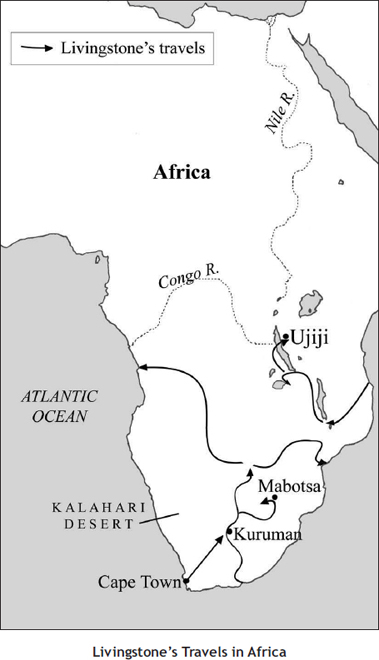
But north of Kuruman lay the rest of the huge continent of Africa: hundreds and hundreds of miles that no European had ever seen. “Often, as I have looked to the vast plains of the north,” Robert Moffat told his audience, “I have, in the morning sun, seen the smoke of a thousand villages where no missionary has ever been!” As he heard those words, David Livingstone was filled with a great desire to visit those thousand villages, to care for the sick and to preach Christianity.
A year later, Livingstone had finished his studies and become a doctor. He boarded a ship and sailed for Africa. When he arrived at the port of Cape Town, he found hundreds of Europeans, building trading posts and settlements along Africa’s coast. But Livingstone was anxious to move away from Europeans, towards the mysterious heart of Africa. He travelled slowly northward, learning to survive like an African. He ground flour for his bread by hand, ate boiled caterpillars and locusts, and enjoyed one of the great delicacies of Africa: an enormous frog that lived in the earth and croaked loudly right before rain. “It is nearly as large as a chicken!” Livingstone wrote in his journal.
As he learned more and more about Africa, Livingstone came to hate the slave trade (the practice of taking Africans from Africa, and selling them as slaves to other countries). Even though the slave trade was illegal, slave traders were still visiting the coast of Africa and taking Africans away into slavery.
David Livingstone hoped to stop the slave trade. He thought that if he went on exploring Africa, he might find rivers and other trade routes that ran into the center of Africa. If Europeans could reach the center of Africa easily, they could come in and trade with the Africans for ivory, salt, and other goods—instead of for slaves.
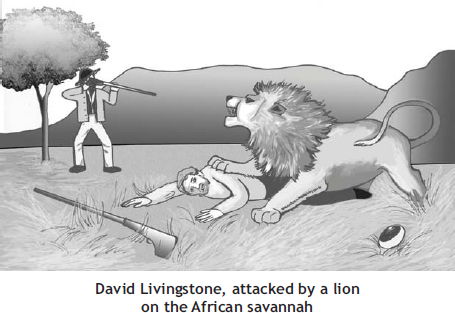
Livingstone’s explorations almost killed him. Three years after his arrival, he was living in Mabotsa, a town just east of the burning sands of the Kalahari Desert. For weeks, the people of Mabotsa had been losing their cows to lions that broke into their cattle pens. Livingstone agreed to go out with his African companions to drive the lions away.
But as he was loading his gun, a lion crept up behind him, unnoticed. It leaped on Livingstone, knocked him to the ground, grabbed his shoulder and shook him back and forth. Later, Livingstone wrote, “[The shaking] caused a sort of dreaminess, in which there was no sense of pain, nor feeling of terror … a stupor similar to that which seems to be felt by a mouse after the first shake of the cat.”
Two of Livingstone’s African friends shot the lion with their rifles. The lion turned and attacked them—but before it could kill either man, it staggered and collapsed.
Livingstone’s arm was badly broken. But he refused to return home. He wanted to keep on looking for those trade routes that would bring the slave trade to an end.
In 1857, the same year as the Sepoy Mutiny, Livingstone wrote a book about his explorations called Missionary Travels. He returned to England so that the book could be published. It was a tremendous success. Thousands and thousands of copies were sold. The British were happy to forget about the troubles in India for a little while, and read about an exciting new continent instead. David Livingstone became famous.
A year later, in 1858, the government of Great Britain gave David Livingstone the official job of finding trade routes into Africa for British traders. The papers that made Livingstone a consul (a British government official) told him to go on exploring Africa, so that Great Britain could “promote commerce and civilization [in Africa], with a view to the extinction of the slave-trade.”
So David Livingstone set sail for Africa once more, this time with the support of his country.
For the next fifteen years, he would go on exploring Africa, mapping out its rivers and lakes, and learning about its dozens of kingdoms: the land of the Oromo, of the Masai, the Burundi, the Luba, and many, many more. Livingstone spent so many years in the center of Africa that many people began to wonder whether or not he was still alive. Finally the American newspaper the New York Times sent one of its journalists, Henry Morton Stanley, to find the missing explorer.
Stanley travelled across Africa for weeks until he found the famous missionary at Ujiji, a village just east of the Congo River. He saw a man whose face was carved with deep lines and tanned brown as leather by the sun. The skin seemed to stretch tightly over his bones. A branch had snapped back into one of his eyes and injured it. His left arm hung at his side, twisted and almost useless.
Stanley was so awed in the presence of this great man that he decided to display the best American manners he could. He walked up to David Livingstone, took off his hat, and said, “Dr. Livingstone, I presume?”
Stanley offered to take Livingstone back home to England, but the missionary refused. He had decided to remain in Africa for the rest of his life. Two years later, David Livingstone died in a hut in central Africa. His African friends took out his heart and buried it under a tree, according to African tradition. Then they wrapped his body in bark and canvas, tied it to a pole, and carried it to the coast so that a European ship could take David Livingstone home.
David Livingstone had hoped to make Africa stronger. But his maps of Africa would make it easier, years later, for England and other European countries to come into Africa and to treat it just as India had been treated: like a land to be captured, conquered, and used.