By the time the United States entered World War II, in 1941, Hitler’s Germany had already claimed Austria, Czechoslovakia, and part of Poland. The Soviet Union had taken the rest of Poland, and had also taken over Estonia, Latvia, and Lithuania (countries that had been given their independence after World War I). Soviet soldiers had also invaded Finland, on the eastern side of the Scandinavian peninsula.
What else had happened, in the months before the United States entered the war?
The war had gone badly for the Allies. German soldiers had invaded Denmark, a Scandinavian country that lay not on the Scandinavian peninsula, but instead jutted off the mainland of Europe, just north of Germany. Then, German forces began what was called a “Lightning War,” or Blitzkrieg, by sweeping down the coast of Europe, through the Netherlands and Belgium, and invading France.
France had already lost thousands and thousands of men in the fighting that had already taken place. The approaching German soldiers overwhelmed the French defenders and the Allied soldiers who fought with them. The Allied troops in France were forced to retreat to the port of Dunkirk, where they hoped they could sail across to England, and safety. Over three hundred Allied ships began to ferry the soldiers across to England, as the Germans showered down bombs and torpedoes on them. The German gunners had been told to aim especially for hospital ships, which were marked with large crosses to show that they carried wounded men.
The “Dunkirk evacuation” was a defeat for the Allies. But Winston Churchill, who had now become the prime minister of Great Britain, told the British people that, no matter what happened, Great Britain would never give in to the Nazis. On June 4, 1940, just after the Dunkirk evacuation, he told the House of Commons:
Even though large tracts of Europe and many old and famous states have fallen or may fall into the grip of the Gestapo [the Nazi police] and all the odious apparatus of Nazi rule, we shall not flag or fail. We shall go on to the end, we shall fight in France, we shall fight on the seas and oceans, we shall fight with growing confidence and growing strength in the air, we shall defend our island, whatever the cost may be. We shall fight on the beaches, we shall fight on the landing grounds, we shall fight in the fields and in the streets, we shall fight in the hills; we shall never surrender. And even if, which I do not for a moment believe, this island or a large part of it were subjugated and starving, then our Empire beyond the seas, armed and guarded by the British Fleet, would carry on the struggle, until, in God’s good time, the New World, with all its power and might, steps forth to the rescue and the liberation of the old.
After Dunkirk, in 1940, France was forced to sign a peace with Germany. The Germans took control of the northern beaches of France, the ones that faced Great Britain, and seized Paris. The northern part of France refused to cooperate with the Nazis at all, so Nazi soldiers occupied it, and Nazi officials governed it.
In the south of France, some of the French agreed to live at uneasy peace with the Nazis. A French official named Henri-Philippe Pétain swore allegiance to the Nazis, and in exchange was given the right to govern the south. Now the south of France was the only official “France” in existence, with the city of Vichy as its “capital.” The Allies called this southern France “Vichy France” and despised it for agreeing to cooperate with the Germans. But even in Vichy France, many loyal French men and women worked secretly to defeat the Nazi forces. Outside of France itself, French soldiers continued to fight in Allied troops against the Axis powers. They called themselves the “Free French” to distinguish themselves from the French who were cooperating with Hitler.
Now that the Germans controlled France, Hitler turned his forces towards Great Britain.
Like Napoleon’s forces so many years before, Hitler hoped to sail troops across the English Channel and land them on the shores of England. But first, he planned to weaken Great Britain by starving it. Hitler told his naval commanders to sink every ship headed for England. That way, the British would begin to run short on weapons, ammunition, oil, clothing—and food. The most dangerous ships in Hitler’s navy were the “U-boats,” or submarines. German U-boats prowled along underneath the water in groups called “Wolf Packs.” Germany built almost a thousand U-boats, and they sank more than two thousand ships headed for Great Britain. Winston Churchill, the prime minister of England, called the U-boats the “worst evil” faced by the British forces.
Before an invasion could succeed, the Germans also had to destroy the British air force, called the Royal Air Force, or RAF. The German air force, the Luftwaffe, began to attack the RAF in the air. The fight between the two air forces, which became known as the Battle of Britain, went on for two whole months.
The RAF managed to keep the Luftwaffe at bay. Finally, Hitler decided to postpone the invasion of Great Britain. Instead, he turned around to attack his allies, the Soviet Union! German troops took Estonia, Latvia, Lithuania, and other territories away from the Russian troops and began to drive them back into Russia. German soldiers marched so far into Russia that they reached the edges of the city of Moscow.
It was at this point that the United States entered the war. And not only did the American soldiers flood over to help the Allies—so did the Soviet troops. The Russians changed sides, rejecting their alliance with Germany and instead fighting for the Allies.
The war now covered the world. In the east, British and American forces fought with the Chinese against the Japanese. All across Russia and Europe, Soviet, British, and American soldiers fought against the German occupiers. Down in North Africa, British soldiers were battling with Italian and German soldiers for control of Egypt.
But Germany was about to lose another ally.
The Italians, tired of the war, had begun to protest against Mussolini’s determination to keep Italy on Germany’s side. The Italian soldiers were exhausted and wanted to come home. In 1943, Italian troops in North Africa surrendered. Not long after, Allied troops invaded the island of Sicily and occupied it.
At this, the Fascist Grand Council that ruled Italy gathered together, under orders from King Victor Emmanuel III, and told Mussolini that he would no longer be Italy’s prime minister. Mussolini ignored this decree—so the Council arrested him and locked him in a hotel, high in the Italian mountains. German soldiers flew gliders up to the hotel, rescued Mussolini, and helped him set up a new government in the north of Italy. But from this point on, Italy was divided. Mussolini’s northern government was still allied with the Germans (as a matter of fact, the German government was actually running it, not Mussolini). The rest of Italy declared war on Germany. For the remainder of the war, Fascist and Nazi supporters in Italy fought a civil war against Italians who wanted nothing more to do with either Fascism or Nazi Germany. These anti-Nazi Italians were called partisans.
Now Japan and Germany were the remaining Axis forces, arrayed against almost the rest of the world. Japanese soldiers held their own in the east. But in Europe, the Soviet army began to push the German forces out of Russia. By 1944, after a year of fighting, the Germans had been driven back into the center of Europe.
The Allies planned one huge attack that might finally break the German army. The Allies would land on the beaches of France and try to take them away from Germany. If this could be done, Allied soldiers could fight their way, on land, through France and attack Germany’s western borders. At the same time, the Soviets would be pushing over from the east. The Germans would have to fight on two fronts at once.
The attempt to capture the beaches of France was known by the nickname “D-Day.” It would be the largest assault ever made on German forces. The plan was to land as many men on the beaches as possible, in as short a time as possible, even though German troops would be firing on the men as they landed. Over five thousand ships and ten thousand airplanes were lined up. Five different groups of soldiers would land along a northern stretch of France. The Americans would land at two beaches in Normandy that were given the code names Omaha and Utah. Soldiers from England and Canada would land on three other beaches, nicknamed Gold, Juno, and Sword.
On June 6, 1944, Allied soldiers landed on the beach at Normandy. Airplanes dumped paratroopers (soldiers using parachutes) and dummies dressed like paratroopers down on the Germans to confuse them. But the Germans could see that the attack was coming from the water. German gunners, firing machine guns and cannons, killed thousands of Allied soldiers as they charged ashore.
By the end of the day, at least five thousand men were dead. But the Allied troops, under the command of the American General Dwight Eisenhower, had managed to capture the beach. Now, Allied troops could land safely and begin the job of recapturing France—and then march through France against Germany itself.
Months of fighting followed. American and British forces began to advance forward, taking mile after mile of French land away from German control. They were joined by Free French soldiers, commanded by the French general Charles de Gaulle. As they got close to Paris, long occupied by Nazi soldiers, American and French troops raced each other to be the first soldiers into the city!
On August 25, 1944, the Allies marched into Paris. The long Nazi occupation was over. That night, the street lights of Paris were turned on for the first time since September 1, 1939.
Then Allied forces began to move into Germany. Meanwhile, Soviet troops marched in from the east, towards Berlin. German surrender seemed inevitable—but Hitler planned one last effort to drive the Allies back. On December 16, 1944, the German army launched the biggest attack the American soldiers had ever seen.
This battle, fought in the Ardennes Forest in Belgium, became known as the Battle of the Bulge, because the German attack pushed the Allied lines so that they bulged backward, like a capital “C” on the map. The Allies were overwhelmed by the power of the German attack, but the Allied soldiers dug themselves down into trenches in the ground and kept on shooting. Finally, the Germans were forced to retreat one more time.
It was the last German offensive of the war. By April 1945, Soviet troops were marching into Germany’s capital city of Berlin. The power of the Nazis was broken.
Over in Italy, anti-Nazi partisans killed Mussolini and dumped his body on an Italian street, where a mob spat on it. In Berlin, Hitler was hiding underground, in a reinforced room called a bunker. On April 30, 1945, Hitler shot himself. A little more than a week later, Germany officially surrendered. May 8, 1945, became known as V-E Day—“Victory in Europe” day.
In Europe, the fighting was over. But hundreds of thousands of men had died. The ancient cities of London, Coventry, Brussels, Dresden, and Berlin had been bombed, their great buildings destroyed. Europe lay in ruins.
In the United States, August 6, 1945, just seemed like another hot summer day. In the cool of the evening, families all over America turned on their radios to catch the evening’s news.
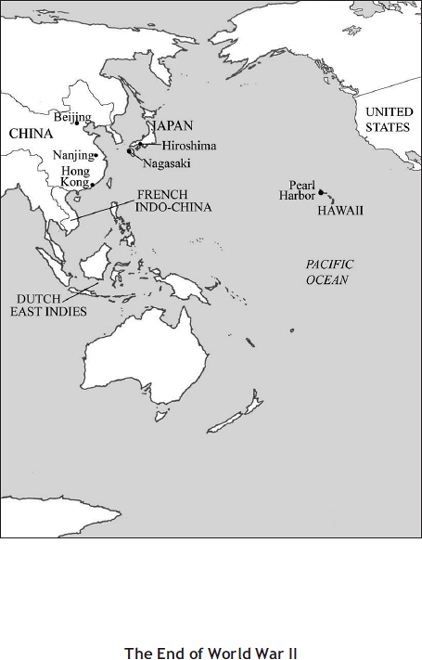
They heard the voice of the president of the United States, telling the world that the United States had just dropped an atomic bomb on the Japanese city of Hiroshima.
In Europe, World War II had ended on May 8. But although Germany surrendered, Japan refused to do the same. Fighting in the East went on for three more months. At the end of July, the president of the United States, Harry Truman, met together with Winston Churchill of Great Britain and Joseph Stalin, the leader of the Soviet Union. The three leaders decided together that they would give Japan a choice: Surrender and sign a peace treaty, or be invaded by Allied forces.
The Japanese considered the offer, and rejected it. They would not surrender.
Now the Allies had to form a plan. Invading Japan might mean more years of war, with more soldiers dying every day, and no assurance of victory against the fearless Japanese fighters.
There was another option: to use a new kind of bomb, developed by the United States, against Japan.
Let’s go back a few years, to the 1930s. The German scientist Albert Einstein had been studying how atoms (the smallest building blocks of matter) worked. He was making discoveries that would astound the world. But because Einstein was Jewish, Hitler believed that his discoveries must be wrong. He sent thugs to terrorize Einstein. They trashed his home, burned his papers, and even stole his violin.
So Albert Einstein left Germany and came to the United States. He told the president of the United States at that time, President Roosevelt, that he had a great fear. He was afraid that the German army was developing an atomic bomb.
An atomic bomb was the most destructive kind of bomb that could be built. It split atoms apart, so that the energy at the heart of the atoms created a huge explosion. A country that had atomic bombs could rule the world in a very short time.
On December 6, 1941—one day before Pearl Harbor was attacked—President Roosevelt ordered government scientists to begin figuring out how to build an atomic bomb for the United States. This research was top secret. It was known by the code name “the Manhattan Project” (although the work was done in Washington, New Mexico, and Tennessee). Two famous scientists, an Italian named Enrico Fermi and an American named J. Robert Oppenheimer, led the research. On December 2, 1942, Enrico Fermi managed to create the kind of reaction (in his laboratory) that the bomb would need in order to work properly. The scientists were eager to tell President Roosevelt the good news, but because the project was top secret, they had to communicate with FDR in code. The message the scientists sent to Roosevelt read: “The Italian navigator has landed in the new world.”
It took three more years to make the reaction into a bomb. In July of 1945, two months after the German surrender, the United States was finally ready to test its first atomic, or nuclear, bomb. The test bomb was exploded in secret on July 19, at 5:30 in the morning, at Alamogordo, New Mexico. A scientist named Kenneth Greisen who got to watch the test later said, “I felt heat on the side of my head toward the tower [where the bomb had exploded], opened my eyes and saw a brilliant yellow-white light all around. The heat and light were as though the sun had just come out with unusual brilliance. … A tremendous cloud of smoke was pouring upwards, some parts having brilliant red and yellow colors, like clouds at sunset. These parts kept folding over and over like dough in a mixing bowl.” Germany had never actually managed to develop an atomic bomb, but now the United States could use them—if the president approved.
By now, Truman was president of the United States. He decided to use atomic weapons on Japan so that World War II would finally end. On August 6, a U.S. Air Force colonel named Paul Tibbets flew his plane, the Enola Gay (named for his mother, Enola Gay Tibbets) over the Japanese city of Hiroshima. He dropped one atomic bomb, nicknamed “Little Boy,” on the city beneath him.
Eighty thousand people died in a moment. The Japanese did not know what had hit them—literally. The Japanese Broadcasting System noticed that Hiroshima could no longer be reached by radio. Army officials tried to call the military headquarters in Hiroshima, but couldn’t get through. The entire city had been obliterated.
Three days later, on August 9, another American plane dropped a second bomb, nicknamed “Fat Man” (in honor of the portly Winston Churchill), on the Japanese city of Nagasaki. Seventy-five thousand people were killed at once. “A warm wind began to blow,” one survivor said “Here and there in the distance I saw many small fires … smoldering. Nagasaki had been completely destroyed.”
Today, not only Americans but people from many countries still argue about President Truman’s decision to drop the bomb. Some say that the killing of so many Japanese men, women, and children who were not soldiers, and were not involved in the fighting, can never be justified. Along with the thousands who died when the bombs exploded, hundreds of thousands more died later on because the “nuclear fallout” (the poison spread by the bomb) caused them to develop cancer and other diseases. Others say that by dropping the bomb, the United States prevented many more years of war, in which many more people would have died—because the Japanese had no intention of ever surrendering.
But one historical fact is certain: The atomic bomb spelled the end of World War II. On August 10, the day after Nagasaki burned, Japan offered to surrender. The Japanese could see that there was no purpose in fighting against a country that had atomic bombs.
On August 14, 1945, World War II officially ended all over the world.
After the end of the war, the nations of the world made another attempt to prevent a world war from happening again. Do you remember the League of Nations, which formed after World War I? After World War II, a new organization of “peace-loving nations,” called the United Nations, was formed. The United Nations, or UN, still exists. You can visit their headquarters in New York City, or you can just visit them online at http://www.un.org/.
The countries of the United Nations are supposed to join together to defend freedom and democracy. Like the League of Nations, the UN is also supposed to try to prevent war, by helping countries settle their differences. But right after World War II, the most pressing job of the UN was to prevent any more atomic bombs from being dropped. At the very first meeting of the UN General Assembly, in 1946, the UN formed a committee to try to convince the nations of the world to stop developing atomic weapons—and to disarm (take apart) the weapons they already had.