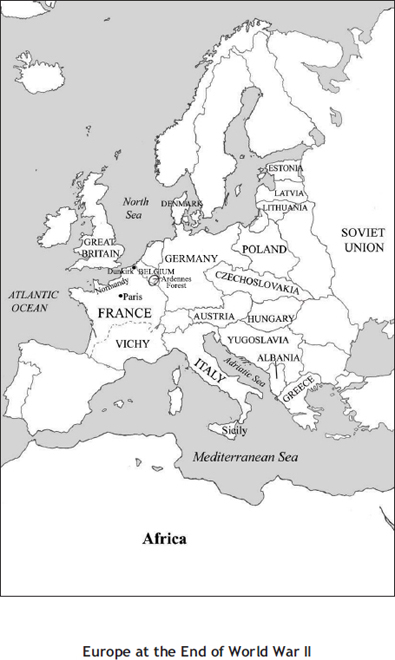
The League of Nations and the Peace of Versailles hadn’t prevented another great war from spreading across Europe. Soon, like World War I, the war would spread across the whole world. It would become known as World War II.
The Allies (France, Great Britain, and Britain’s allies) were fighting against Germany and Italy, called the Axis powers. Before long, Germany and Italy were joined by another powerful country: Japan.
Two years before Hitler’s invasion of Poland, the hatred between Japan and China had erupted into out-and-out war. In 1937, Chiang Kai-shek of China had agreed to make an alliance between his Kuomintang government and the Chinese Communist Party because he knew he could not fight both the CCP and the Japanese. Almost at once, the new allies found themselves fighting the Japanese army, which had marched from Manchuria down towards the Chinese city of Beijing.
On July 7, 1937, the Japanese army had attacked the Marco Polo Bridge outside of Beijing. The bridge, a beautiful marble span with eleven different arches, was controlled by the Kuomintang army in the east—and the Japanese army in the west. Early in the morning, the Japanese demanded permission from the Kuomintang to cross the bridge, over to the Kuomintang side, and search the houses nearby. The Japanese said that their officers needed to search for a deserting Japanese soldier who might be hiding there. But the Chinese thought that this was just a pretense to get across the bridge. When they refused to let the Japanese officers pass, the Japanese began to march across the bridge—with tanks!
The Kuomintang army managed to drive them back. But the Japanese reorganized themselves and attacked again. After two weeks of fighting, the Japanese finally made it across the bridge and seized hold of the Chinese side.
This was the beginning of the Second Sino-Japanese War.
The Chinese had a different name for this war. They called it the Chinese People’s Anti-Japanese War of Resistance. China lost land to the Japanese all along the north of China, and in the middle of the country as well. One of the most horrible events in modern history took place in China, when Japan marched into the southern city of Nanjing, in the province of Jiangxi. Japanese soldiers killed two hundred thousand unarmed Chinese citizens who had nothing to do with the war.
Still, China refused to surrender.
This war had been going on for two years by the time that World War II began over in Europe. When Great Britain and France declared war on Germany, Japan saw a chance to expand its own empire. Great Britain, France, and the Netherlands (which also joined the Allies) all had colonies in southeast Asia: the British ruled Hong Kong, the French still had control over Vietnam, and the Dutch governed the East Indies. Those European countries were so busy fighting against Hitler that none of them had the time or the soldiers to defend their Asian colonies. Japan could swoop in and take those colonies for itself.
In 1940, Japan declared itself to be an Axis power, along with Germany and Italy. Now, Japan had the perfect excuse to attack the colonies held by the Allies.
Japan did have one country standing in the way of its conquest of Asia: the United States.
The United States wasn’t fighting in World War II, so Japan wasn’t at war with them. In 1940, more than three-quarters of American citizens didn’t want the United States getting involved in Europe’s troubles. The president of the United States, Franklin Delano Roosevelt, knew that his people didn’t want to fight. The United States had agreed to send oil, guns, and other necessary supplies to Great Britain, even if Britain couldn’t pay, but that was as far as most Americans wanted to go.
But even though the United States wasn’t one of the Allies, Japan knew that the U.S. wouldn’t sit quietly and watch Japan take over the colonies in Asia, one by one. A whole fleet of American battleships lay in the South Pacific, anchored at Pearl Harbor in Hawaii. If Japan moved against the Allied colonies, the U.S. battleships at Pearl Harbor would set out to block Japan’s ambitions.
Years before, Japan had beaten one of the world’s strongest navies by torpedoing Russian battleships first—and then declaring war afterwards. In December of 1941, the Japanese commander, General Hideki Tojo, decided to follow the same strategy. Tojo wasn’t just an army general; he had also become the prime minister of Japan, the man who advised Emperor Hirohito. He told the emperor that unless Japan stood up to the United States, Japan would never be a great country. Hirohito agreed that the time had come to attack the U.S.
On a quiet Sunday morning, December 7, 1941, U.S. servicemen who were scrubbing the decks, eating their breakfasts, and going through the morning routine heard the sound of airplanes. Some scrambled up on deck. Others didn’t bother to look. No one in Pearl Harbor expected an attack.
Over the horizon swept wave after wave of Japanese fighter planes—almost two hundred. Bombs began to fall. The Americans, taken off guard, were almost helpless. Some of the ships caught on fire and burned. Others capsized, trapping sailors inside them. A marine named E. C. Nightingale later described how he was finishing breakfast when he heard warning sirens go off. He didn’t pay much attention to the sirens until he began to hear explosions. He ran up to his battle station, seeing that men all over the ship had already manned their guns and begun to fire. But then the ship began to shake. It had been hit by a bomb. The entire front of the ship was burning. Many of his friends had been killed already.
Before Nightingale could escape, another bomb hit the ship. The jolt threw him over the side, into the water! He was about to go under when an officer swimming by grabbed his shirt and hauled him towards the beach.
The attack was over in less than two hours. But twenty-one American ships and 188 American fighter planes had been destroyed. A high school student on the shore wrote in her diary that when the attack ended, the barracks where the soldiers lived was burning and the warehouse where supplies were kept was on fire. Houses all along the harbor had been blown up. The water of the harbor couldn’t even be seen. A solid wall of smoke blocked it from view.
Pearl Harbor brought an end to American neutrality. Almost three thousand American soldiers were killed. Thirteen hundred men had died on one battleship, the Arizona, alone—the ship that E. C. Nightingale had escaped. News photographs published in American newspapers showed American ships burning and sinking and U.S. servicemen dying. December 7, said President Roosevelt, was a “date which will live in infamy.”
The American people could no longer ignore the disaster sweeping over the rest of the world. Roosevelt asked Congress to declare war on Japan and all its allies, meaning Germany and Italy.
While the Americans were trying to recover from the destruction of the fleet at Pearl Harbor, the Japanese swept down over Hong Kong and the islands south of the Asian mainland. Japanese troops took over the Philippine Islands and Malaya too. British soldiers who occupied all three of these places had to flee to Singapore. Soon they were forced out of Singapore as well. Japan was extending its empire all over Asia. Within a year, the Japanese would claim the Dutch East Indies for themselves.
The Americans fought back. Recruits poured into the American navy, anxious to avenge Pearl Harbor. Half a year after Pearl Harbor, in the spring of 1942, the Americans launched an attack against the Japanese fleet near the island of Midway. In the Battle of Midway, four huge Japanese aircraft carriers (ships that carried fighter planes that could take off, attack targets, and return to the ship for refueling, so that planes could fight much further away from land) were destroyed by a much smaller American force.
The war between Japan and the Allies in the east had its own name: the War of the Pacific. When Allied soldiers went to China to help the Chinese fight back against Japanese invasion, the War of the Pacific mingled with the Sino-Japanese War. And now that the Allies and the Axis powers were fighting in both Europe and in the East, the three wars had all blended together. The Sino-Japanese War, the War of the Pacific, and World War II had become one huge, world-swallowing disaster.
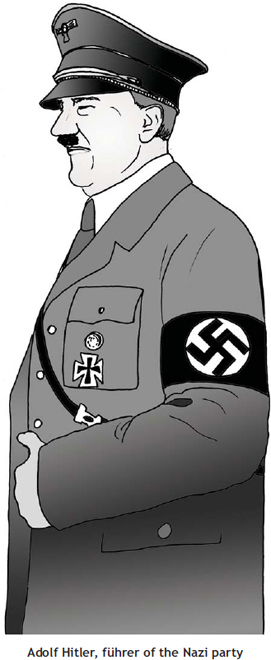
When Hitler came to power in Germany, before the beginning of World War II, he promised the German people that he would get rid of the Jews. During World War II, he did his best to fulfill this promise.
This is a very difficult story to tell, because it is so horrible. All during World War II, Hitler was sending his soldiers to fight against the Allies. But this was only part of his scheme for a German takeover of Europe. Because Hitler believed that Germans were better than any other race, he also wanted to wipe out people who were “inferior.”
Hitler’s ideas about “inferior people” were based on very bad science. He believed that people with “Aryan” (German) blood were smarter, stronger, and better than other people. Scientists working for the Nazis believed that they could measure the length of someone’s nose, the size of his skull, look at the color of his eyes, and tell whether or not he was “Aryan.” In other words, the length of your nose and the color of your eyes could tell how intelligent you were.
For Hitler and his followers, Roma (often called “Gypsies”), Africans, and other races were all inferior to Aryans. But the most “inferior” people of all were the Jews.
German attacks against Jews had begun even before Austria was claimed. In 1935, German laws were changed so that no Jew could be a German citizen, marry a German, or vote.
In 1936, the Olympics were held in Berlin. No Jews from Germany were allowed to compete. The Germans took down many of the signs that said “No Jews Allowed” in Berlin, because they did not want to make the rest of the world angry. But they made sure that every German athlete was blond, blue-eyed, and tall—like perfect Aryans were supposed to be. Even though the anti-Semitic signs were missing, it became very clear what Hitler thought of non-Aryans during the Games. An African-American athlete named Jesse Owens won four gold medals and beat the most famous German athlete in the long jump. The German athlete, Lutz Long, congratulated Jesse Owens on his victory, in full view of all the Nazi officials. But Hitler refused to acknowledge that Owens had won the competition.
Just before the beginning of the war, Germans launched a night of attacks against Jews. All over Germany, German mobs broke the windows of houses and shops owned by Jews. Many of them were burned. This night, November 9, 1938, became known as Kristallnacht, or “Night of the Broken Glass.”
In every territory that the Germans claimed, Jews were forced to wear yellow six-pointed stars on their clothing so that everyone would know they were Jews. This six-pointed star was called a “Star of David,” after the great Hebrew king in the Bible.
It was bad enough to live with a yellow star on your clothing. Often shops and restaurants would not serve Jews wearing the Star of David. Sometimes Jews were attacked and beaten on the street. Their businesses were broken into and destroyed, and the police refused to do anything about it. Jewish children were expelled from all public schools and were not allowed to go to museums or playgrounds. In many cities, Jews were forced to all move to the same part of the city. This neighborhood, or “ghetto,” was surrounded with barbed wire and guarded by armed Nazis.
But soon, the Jews with yellow stars were rounded up into groups, put on trains, and taken to concentration camps—camps like those that the British had put Boers in, forty years before.
The concentration camps were not the end of their journey. Hitler was not content only to keep the Jews in camps. He wanted to kill them.
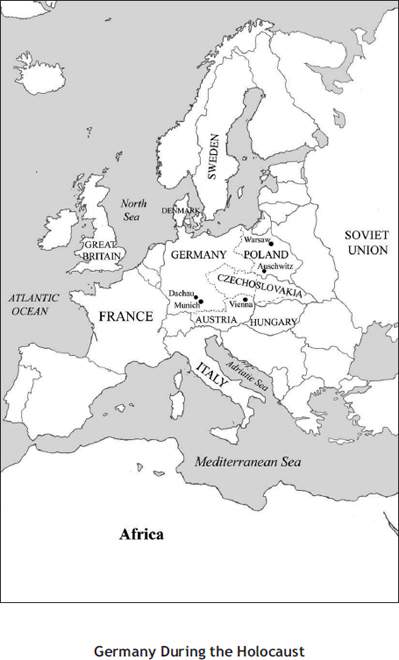
In 1942, Hitler’s advisors agreed with him that Germany needed to find a “final solution” for the “problem” of the Jews in Europe. The concentration camps were turned into death camps. Jews were killed in hundreds of camps all through Germany and German-held territory. The most horrible, and most well known, of these death camps were at Dachau and Auschwitz.
By 1945, six million Jews had been put to death by Hitler. This systematic killing of an entire nation, or genocide, had never been carried out before. The six million Jews weren’t Hitler’s only victims. Other “inferior” people like Catholics, handicapped people, gypsies, and many Russians, Poles, and Serbs were also killed in the death camps.
Even before the end of the war, the Allies heard about the death camps. Many people didn’t believe the stories, or thought that the stories had been exaggerated.
But after the surrender, Allied soldiers came to the camps and opened the gates. They found bones, heaps of shoes, and piles of hats and jewelry taken from Jewish prisoners. They found thousands of graves—and thousands of bodies that the Nazis had not yet buried.
Hitler’s “final solution” became known as the Holocaust. “Holocaust” is a Greek word for a sacrifice that is completely burned up by fire. Hitler tried to completely wipe out the Jewish nation—along with five million other people.
Many Europeans in the occupied countries stood by and watched as Jews and other “inferior” peoples were taken to death camps. The only country to act officially in protection of its Jews was Denmark, which rounded up all of the Danish Jews and helped them get across to Sweden, where they would be safe.
A few brave people fought back. In France, clergymen helped Jewish children hide and escape to Switzerland. Dutch families like the ten Booms, whose story is told in a famous book called The Hiding Place, hid Jews in their basements and helped them escape. In Poland, the director of the Warsaw Zoo hid Jewish children in the cages, beneath the straw, so that Nazi soldiers couldn’t find them.
In the United States, Franklin Roosevelt organized a War Refugee Board that helped rescue Jewish refugees from countries where Nazis were in charge. The War Refugee Board was formed in 1944, and helped to rescue over two hundred thousand Jews.
But United States government officials had known that Jews were being murdered at least two years before, and had done nothing. The same was true of officials in France and in many other places. The Holocaust was a horrible shame to the German people, but the shame was shared by many other people who knew that Jews were being put to death—and yet made no protest.