The country of Spain hadn’t taken part in World War I. It hadn’t fought against Russia or Great Britain or Japan. It hadn’t been divided up during the Peace of Versailles, or lost thousands of soldiers in the battles of the Great War. Despite that, Spain was no more peaceful than any other part of the world.
The king of Spain, Alfonso XIII, had inherited the throne even before his birth. His father had died when his mother was still pregnant—so the unborn Alfonso became king! Alfonso’s mother ruled for him as regent until 1902. In that year, the sixteen-year-old Alfonso was coronated (crowned) in the great cathedral in Seville. He was the youngest crowned king in the world at that time.
While Alfonso XIII was being coronated—in an elaborate ceremony that lasted for hours—a little boy named Francisco Franco Bahamonde was sitting on the doorstep of his house, tossing rocks into a puddle and wondering what he would be when he grew up. Francisco’s father had left their family, years before. His mother struggled to feed her family and raise her children. Francisco didn’t want to spend the rest of his life struggling to survive. He decided that the life of a soldier was a good one for him.
When he grew old enough, Francisco Franco entered the Spanish army and became an officer. He fought well, and always obeyed orders. He won medals for bravery and was promoted again and again. He even came to the attention of King Alfonso XIII. When Franco was only twenty-eight, Alfonso put him in charge of the Spanish Foreign Legion—a Spanish fighting force commanded by Spanish officers, but mostly made up of soldiers from other countries.
When World War I began, Spain remained neutral. Instead of fighting, Spain made a lot of money by selling steel, machines, and engines to the countries who were fighting. But when the war ended, so did the sales. Spanish factories closed. Ships sat idle. Many Spanish workers lost their jobs.
Three years after the Great War ended, Spain had to fight a smaller war. A Spanish territory called Morocco, a small strip of Northern Africa just across the Mediterranean Sea from Spain, rebelled. Spain sent its army across the Straits of Gibraltar (the small neck of the Mediterranean Sea between Spain and North Africa) to stop the revolt. Over ten thousand Spanish soldiers were killed by the much smaller army of Moroccan rebels.
The slaughter humiliated Spain and angered the Spanish people. Spain was poorer than ever, and unhappy over the loss of its men. As in so many countries, hard times gave revolutionaries a chance to call for change.
These revolutionaries were known as “Red Spain.” For many years, Spanish rebels had been insisting that Spain needed to get rid of its king and to become a republic, with a constitution, like so many other countries in Europe. These “Red Spanish” wanted to see the end of the monarchy and the beginning of rule by the common people. As a matter of fact, “Red Spain” had tried more than once to get rid of the king. Alfonso XIII had almost been assassinated on his wedding day!
Wealthy, aristocratic Spaniards who wanted Spain to stay a monarchy were called citizens of “Black Spain.” In this traditional Spain, the king and his noblemen had most of the power. The army, which had many Spanish noblemen as officers, tended to be on the side of “Black Spain.”
In the five years after the Moroccan War, “Red Spain” and “Black Spain” quarrelled with each other—and threatened violence. Alfonso XIII became less and less popular. He was blamed for the Spanish losses in the Moroccan war, for ignoring the needs of his people, and for having too much power. By 1931, Alfonso XIII could see that, if he kept holding onto his power as king, Spain would break apart into civil war between Reds and Blacks.
So he composed a public statement, to be read to the Spanish people. “[It is clear that] I no longer enjoy the love of my people,” he wrote. “I could very easily find means to support my royal powers against all comers, but I am determined to have nothing to do with setting one of my countrymen against another in a fratricidal civil war.” Then Alfonso XIII left Spain, and went to Rome.
While he was gone, Spain held an election for an assembly—a Spanish Parliament. Spanish voters elected a president. The assembly wrote out a constitution. Spain had become a republic, and it looked as though “Red Spain” had triumphed over “Black Spain” for good.
But although Alfonso XIII had told his people that he didn’t want civil war, he also refused to give up his throne. Even in exile, he claimed to be the rightful ruler of Spain. And the new Republican government wasn’t supported by all of Spain. Some Spaniards wanted Alfonso XIII to come back to his country. Others wanted the Roman Catholic Church to have more power than it was allowed under the new constitution of Spain. One area of Spain, called Catalonia, started to insist that Catalonia should be a free country in its own right, independent of Spain.
In 1936, open war broke out in Spain. Monarchists, Republicans, and independence fighters took up weapons and started battles in the streets. Spain was full of political groups, each wanting something slightly different. Leaders of each group were assassinated by others. Down in Morocco, Spanish soldiers who were supposed to be keeping order in this restless Spanish territory declared that they would no longer obey the republican government of Spain. They were soon joined by army soldiers in Spain itself.
By now, Franco had become a general in the Spanish army. He was the youngest general in Europe—just as Alfonso had been Europe’s youngest king. The Spanish army, calling itself the “Nationalist” party of Spain, made Franco their leader.
After the army rebelled, the fighting in Spain settled down into two opposing sides.
The Nationalists (the army), under Francisco Franco, didn’t want Alfonso XIII back. But they did believe that Spain needed a strong, decisive leader—like Mussolini of Italy. The other side, called the “Popular Front,” were the Spaniards who wanted Spain to keep its constitution. The Spanish Civil War, between the Nationalists (who had adopted Fascist ideas about the need for a strong leader) and the Popular Front (who wanted Spain to be a republic) went on for three years.
Many Spanish were killed in the battles between the Popular Front and the Nationalists. The rest of the world got involved. Fascist Italy and Nazi Germany were on the side of the Nationalists. Communist Russia, on the other hand, sent money and weapons to the Popular Front, because the Soviets thought that the Popular Front might be sympathetic to communism.
So the United States decided to support the fascist Nationalists and General Franco, so that the Communist Party wouldn’t have the chance to gain more power. The Nationalists slowly won the upper hand. Nationalist soldiers took over the west of the country, and began to march north and east.
The two largest cities of Spain, Barcelona and Madrid, remained under the control of the Popular Front. But after months and months of fighting, the Soviet Union saw that the Popular Front cause was doomed—and stopped sending help. Now, the Popular Front had lost its steady supply of weapons and supplies.
Nationalists took over Barcelona and then surrounded Madrid. A siege began and went on for months. “Madrid is a hungry city,” wrote an American reporter who was in Madrid, describing the war for the New York Times. “Rice cooked in rancid olive oil, a thin slice of beef … and oranges—just that and nothing more, day after day, week after week. … Winter is nasty in Madrid … the cold is particularly penetrating. … [In] the districts of Madrid that have been most heavily bombed, it is a common sight to see men, women and children foraging among the ruins of houses for parts of beams, pieces of flooring, broken furniture—anything so long as it is wood and will burn.”
Finally, the Popular Front was forced to give up the last city that they still controlled. On March 1, 1939, Madrid surrendered.
Francisco Franco and his army now controlled Spain. Another New York Times reporter described his experiences, driving through Spain and seeing peasants and schoolchildren everywhere giving the straight-armed Fascist salute. The country, he wrote, was “orderly, subdued if not unified. … There are no books on sale … but there are newspapers, cigarettes, large loaves of bread, coffee and wine. In the train soldiers fill the compartments and aisles, sit or lie on the platforms, overflow into the vestibules.”
Those soldiers would help Franco keep control of his new power. General Franco would now rule as a military dictator over Spain! Like Mussolini, he would control his country with his army.
Franco earned a reputation as a ruthless, intolerant dictator. Those who opposed him were taken prisoner—and often died of starvation, if they weren’t put to death. Later, historians estimated that as many as two hundred thousand Spaniards died because of Franco’s rule.
Two years after the surrender of Madrid, Alfonso XIII died in Rome, on the last day of February 1941. He left the throne of Spain to his son Prince Juan Carlos, who had been born in Rome just three years before. But Juan Carlos would not rule over Spain until Francisco Franco died—forty years later!
Adolf Hitler had now been the chancellor of Germany for five years. For five years, he had preached to the German people that their nation was the best in the world. Anyone who was born German had a natural right to rule. Everyone else, in his own words, was “eternally fated to serve and obey” the German people. “We must rule Europe!” Hitler declared.
Hitler intended to claim Europe for Germany a little bit at a time. First, he intended to “reunite” Germany by taking over all of the countries where German-speaking people of German descent lived. Hitler explained to the German people that he wouldn’t be conquering a new German Empire; he would just be recreating the “Fatherland,” a Germany that had existed in older times and had been destroyed.
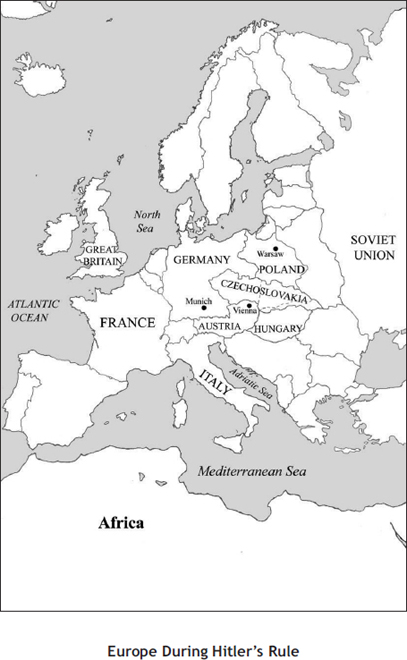
The way that the Peace of Versailles had created new countries made this quest simpler for Hitler. To start with, the treaty had divided the Austro-Hungarian Empire into two separate—and weaker—countries: Austria and Hungary. Hitler wasn’t very interested in Hungary. But for decades, Hitler had believed that Austria, whose people spoke German, should be part of Germany. He thought that Austria’s separation from Germany made both nations weaker. And since Austria was his own home country, he wanted to enfold it into his new, restored Germany.
In March of 1938, Germany claimed Austria for its own. Hitler led a triumph parade into Vienna. Many Austrians supported him; Austria had been humiliated and made weaker by World War I, and German-speaking Austrians thought that Hitler might lead Austria back into a glorious time of victory. During the German takeover of Austria, called the Anschluss, these Austrians lined the streets of Vienna and shouted, “Sieg Heil! Sieg Heil!” In German, this meant, “Hail, Victory!”
But this was only the beginning. Just before claiming Austria, Hitler had made a speech to the Reichstag, the German parliament, in which he said, “There are more than ten million Germans in states adjoining Germany which before 1866 were joined to the bulk of the German nation. … Against their own free will they were prevented by peace treaties from uniting with the Reich. … To … the German Reich belongs also the protection of those German peoples!”
Great Britain and France grew nervous. Just how big would this “reunited” Germany grow? Germany had already signed an alliance with Italy, so Mussolini’s soldiers would support Hitler’s army in whatever Hitler commanded them to do. Hitler’s army itself had grown enormously. For years, Hitler had been secretly breaking the Treaty of Versailles by training thousands and thousands of soldiers. Remember, according to the Treaty, the German army was supposed to be smaller than one hundred thousand men. But by 1938, Germany’s army had close to a million soldiers in it.
Of course, it wasn’t possible to keep an army with a million soldiers in it secret for long. Most of the powerful countries in the world knew Hitler was making his army larger. But the United States, which had refused to join the League of Nations, had decided not to interfere in Europe. The U.S. was still recovering from the Depression. It had its own problems! And France and Great Britain, the other two countries that had helped to write out the treaty, were more afraid of communism than of the Nazi party. At least if Hitler had a large army, the Soviet Union wouldn’t be able to claim Germany as a communist country.
No one knew just how determined to rule the world Adolf Hitler was. And no one realized that, in 1938, Hitler was a much bigger problem than communism.
But then Hitler announced that he would now add Czechoslovakia to the German “Fatherland.” Czechoslovakia had millions of German-speaking citizens in it who needed to be reunited with their own people. At this, France and Great Britain were worried enough to send their prime ministers to the German city of Munich to talk to Hitler.
It became clear that Hitler was determined to have Czechoslovakia, and would fight for it if necessary. Disastrously, both countries decided not to oppose Hitler. Neville Chamberlain, the prime minister of Great Britain, worked out a careful agreement with Hitler that would let Hitler have the western half of Czechoslovakia—the part called the “Sudetenland.” When he went back home, Neville Chamberlain made a famous speech to the British people. By giving Hitler what he wanted, he told them, he had assured that there would be “peace in our time.”
Here are Neville Chamberlain’s exact words.
“Last Wednesday. … a war more stark and terrible than had ever taken place before seemed to be staring us in the face. … [Now] our anxiety has been lifted from our hearts. … Hard things have been said about the German Chancellor. … [but I hope to] extend a little further the personal contact which I had established with Herr Hitler, which I believed to be essential to modern diplomacy. … We regard the agreement signed. … as symbolic of the desire of our two peoples never to go to war with one another again. Does any one doubt that this is the desire of the people? … I believe that there is sincerity and goodwill on both sides. … The path that leads to peace is a long one and bristles with obstacles. This question of Czechoslovakia is the latest and perhaps the most dangerous. Now that we have got past it I feel that it may be possible to make further progress along the road to sanity.”
The British politician Winston Churchill retorted that Chamberlain’s speech was cowardly and short sighted. England had been given the choice between war and shame. Chamberlain had chosen shame. And now war would come as well.
Churchill was right. Hitler, perhaps thinking that he would not be opposed at all, didn’t stop at the Sudetenland. He marched into the rest of Czechoslovakia and claimed it as well. Just months later, he made a deal with Joseph Stalin, the Soviet leader. Hitler wanted to claim Poland too. If the Soviets would help Germany conquer Poland, Germany and Russia would divide Poland between them. Russia also agreed to a “pact of nonaggression,” meaning that Russian soldiers would not join in any resistance to Germany.
Far from serving as a protection against communism, Hitler had made an alliance with the Soviets—so that Germany could claim Europe.
On September 1, 1939, the German troops marched into Poland from three different directions. Later, the beginning of the war that sprang from this invasion—World War II—was put at 4:45 a.m. on September 1. A German soldier who belonged to one of the invading divisions, Erich Hoppe, later wrote, “We were at war, but there was no sound of conflict, except for a low rumble which could have been thunder but wasn’t. It was gunfire, but very distant. … That first morning of the war was a warm, bright, quiet and peaceful one.”
By 6 a.m., German bombers were swooping over Warsaw, the capital city of Poland. German bombs destroyed Polish fighters before the planes could even lift off from the ground. The Polish army, ill equipped, had to line up on horseback to face approaching German tanks.
This invasion showed both Great Britain and France that there would be no peace. Just two days later, on September 3, Great Britain and France declared war on Hitler. Before long, Canada, Australia, New Zealand, and India joined Great Britain and France. The armies fighting against Hitler became known as the Allied Powers. Germany, Italy, and their allies were known as the Axis powers.
The Polish army resisted for a single month. But on September 28, Warsaw could no longer resist. Thousands of Polish soldiers had died. The city had to surrender.
It would be the first surrender of many.