Across the Pacific Ocean, Japan was also trying to build an empire.
Around the time of World War I, Japan’s empire-building got mixed up with China’s ex-emperor. When the young Qing emperor Henry Puyi left the Forbidden Palace, he went first to Japan. He lived in Japan for several years, hoping that the Japanese might one day help him to get his throne back.
Over in China, Sun Yixian was forced to hand over power to a warlord named Yuan Shikai. Sun Yixian fled to the city of Canton, while Yuan Shikai took over the new Chinese government and ruled as a military dictator.
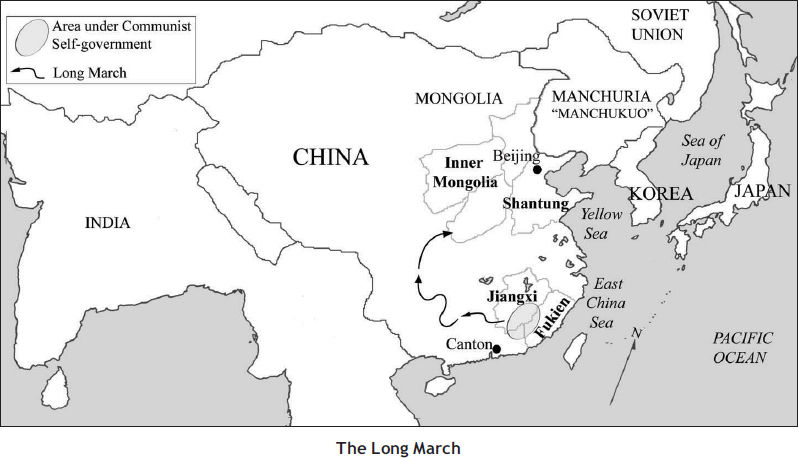
To keep his power, Yuan Shikai had to fight off other warleaders. While all this fighting was going on, Japan ordered Yuan Shikai to hand over not only Manchuria, but also the nearby provinces of Shantung and Inner Mongolia. Yuan had no choice. He couldn’t resist Japan and fight against other warlords to keep his power in China. He agreed.
A year later, Yuan died. Now competing warlords and their bands of soldiers battled to rule the parts of China that hadn’t been given over to the Japanese.
Sun Yixian, still in Canton, hadn’t abandoned the hope of a united, peaceful China. He had organized a group of followers into a political party called the Nationalist Party, or the Kuomintang. The members of the Nationalist Party hoped to get rid of the warlords and unite China again, into a republic.
Sun Yixian and another Chinese revolutionary, Chiang Kai-shek, asked Russia to send help so that the Nationalist Party could fight against the warlords. When Russia agreed, Chiang Kai-shek went to the Soviet Union to see how the Red Army worked. With the help of Soviet advisors and Soviet weapons, the Nationalist Party started its own military academy to train its own soldiers. Soviet officers came to China to help prepare the new National Revolutionary Army for battle. Chiang Kai-shek, now the commander in chief of the National Revolutionary Army, began to plan a campaign against the warlords of the north.
In 1925, Sun Yixian died. But his plan to unify China lived on. A year later, the National Revolutionary Army began to march north. One by one, the army defeated the warlords that lay between Canton and Beijing. By 1928, the Nationalist Party had taken control of the city of Beijing, and of China’s government.
But further away from the capital city, in the most distant provinces of China, warlords still reigned supreme.
In Japan, meanwhile, a new emperor had just ascended the throne. Hirohito was twenty-five years old. For the last five years, he had been the regent for his father, the emperor Yoshihito. Yoshihito had grown so old that he had begun to lose his wits. When Hirohito was twenty, Yoshihito went to a solemn meeting of Japan’s government leaders. The meeting was long and dull, so the old man rolled up the papers on which his royal speech was written, and amused himself by peering at all of the important men through it, like a telescope.
At this, the leaders decided that Yoshihito was now too old to rule the country. Hirohito would take control of Japan and rule in his father’s name. Five years later, in 1926, Yoshihito died and Hirohito became emperor in his own name. He was the 124th emperor of Japan, and he would rule Japan longer than any other emperor.
Hirohito governed a Japan that was torn by disagreement about who was really in charge. Like many other nations, Japan now had a constitution, and an elected assembly that made and passed laws. The emperor was only supposed to make decisions after his “cabinet” (a group of advisors) told him what the people wanted.
Hirohito was an energetic, well-educated young man. Before he became emperor, he had travelled in Europe, gone fly-fishing in Scotland, and visited with the king of England. He didn’t want to be a figurehead; he wanted to be a real emperor. And all of his life, Hirohito had been taught that, like all emperors of Japan, he was part divine—a descendant of the sun goddess Amaterasu. Hirohito would not be content to simply sit and do as his advisors told him.
Hirohito wasn’t the only man who wanted to rule Japan. Japan’s large army had become less and less willing to do as the government ordered. The Japanese army had already taken land away from China, occupied Korea, and seized Manchuria. It was a powerful, well-organized force, and many Japanese military officers didn’t like the attitude of the Japanese assembly towards the armed forces. After the war with Russia, the assembly had reduced the size of the army. The officers resented this. Some wanted Japan’s constitution thrown out, so that Japan could be led by military officers who would expand the Japanese Empire all across Asia.
In 1931, five years after Hirohito ascended the throne, the Japanese soldiers posted in Manchuria took matters into their own hands.
These soldiers were alarmed when the Nationalist Party took control of Beijing. If China grew strong and unified again, it might manage to reclaim Manchuria. So the soldiers in Manchuria accused Chinese soldiers of trying to bomb a train with Japanese soldiers on it.
Was there really an explosion near the train? No one knows—but the train certainly arrived safely at its station. Still, Japanese soldiers started to invade and capture Chinese towns all over Manchuria, in revenge. Other Japanese soldiers marched up from Korea to help. Back in Japan, the government knew nothing about this military action. When the Japanese assembly did find out that the Japanese soldiers had begun a small war in Manchuria, they were powerless to stop it. The army simply ignored all of the instructions coming out of Tokyo, Japan’s capital city.
Next, the army found Henry Puyi and offered to smuggle him into Manchuria. There, he could become the emperor of a Japanese Empire in China, called Manchukuo. Puyi accepted the offer at once. So the officers put him on a ship that would take him to Manchuria.
Puyi didn’t know it—but the Japanese had no intention of allowing him to fall back into Chinese hands. The boat was booby-trapped. If it were attacked by the Chinese, it would explode—and Puyi would die. Fortunately, the boat reached Manchuria safely. The Japanese army immediately announced that Puyi would be the Chief Executive of the new country Manchukuo.
No one was particularly happy about this. The Chinese said that Manchukuo was an unreal country, a fairy tale, and that Puyi was a traitor. Puyi was indignant, because he had thought he would be made emperor. “Chief Executive” was not nearly as interesting a job. The Japanese government in Tokyo was unhappy with the army’s actions—but was afraid of too much resistance. Hirohito could make an imperial decree removing the army from Manchuria, but what if the army simply refused to go? Then it would be obvious to everyone that the Japanese assembly and the emperor were helpless. So Hirohito and the Japanese government agreed to recognize Manchukuo as a legitimate country.
China appealed to the League of Nations. The League of Nations, after hearing the whole story of the founding of Manchukuo, announced that Japan was at fault, and should withdraw from China. Instead, Japan simply left the League of Nations.
But both Italy and Germany (neither of which was very fond of the League of Nations) agreed to recognize the new country of Manchukuo as a real nation. The Japanese army, to keep Puyi happy, agreed to give him the title of emperor. They gave him money, a palace—and no power. They made all of his decisions for him.
Manchukuo would remain under Japanese power for many years. In time, Japan would use Manchukuo as a place to build naval and army bases—and the Japanese military would grow stronger yet.
Chiang Kai-shek, the commander in chief of the National Revolutionary Army, had led his army into Beijing and captured it. But he still had a civil war to fight. The National Party, or Kuomintang, controlled part of China, but elsewhere powerful warlords with bands of soldiers claimed to rule over the distant provinces of China.
Chiang Kai-shek still had to defeat them. And soon he would have a falling out with his own allies.
Chiang Kai-shek and his army had grown stronger with the help of Soviet advisors and Soviet allies. Many Chinese, seeing the devastation of their country caused by the weakness of the Qing emperor, and the struggle for power between warlords that followed, believed that the Soviet Union was a good model for a new China. Representatives of the Russian Communist Party travelled to China, to help the Chinese learn more about communism. They even drew up a “manifesto,” or statement of beliefs, that the Chinese communists could use, and brought it to Shanghai. There, people who were interested in seeing China become communist gathered to read the manifesto, talk about it, and argue about it.
After a week of discussion, these “delegates” formed the Chinese Communist Party. One of the first members of the Chinese Communist Party, or CCP, was a young teacher named Mao Zedong (also spelled Tse-tung).
At first there were only about seventy Chinese communists in all of China. But these first Chinese communists left Shanghai and went back to their hometowns, ready to convince other Chinese to become communists. Mao Zedong went to his home in Hunan, quit his job as a teacher, and started to hold classes to teach the Chinese more about communism.
As the CCP grew bigger, some of its members thought that the CCP should try to take over and drive the Kuomintang and the National Revolutionary Army out of power. But the Soviets in Russia thought that it would be better for the CCP and the Kuomintang to be allies. So the CCP, which now had its own army, agreed to help the National Revolutionary Army defeat the rest of the warlords.
But when the CCP and the Kuomintang tried to agree on policies by which China would be governed, trouble began. Many Kuomintang members and National Revolutionary Army officers began to suggest that the CCP was more Russian than Chinese. They accused the Chinese Communist Party of helping foreigners, once again, gain control over China.
Chiang Kai-shek agreed that the Russians had too much power in the CCP. So he ordered all CCP members, including Mao Zedong, to be fired from their jobs. He had all of the Soviets in China he could find, and many Chinese communists as well, arrested. He ordered some of them to be executed. The CCP and the Kuomintang would no longer be allies; now they were deadly enemies.
Mao Zedong and three thousand soldiers, peasants, and laborers gathered in Hunan and tried to attack the Kuomintang back. But this small rebellion was at once scattered by the National Revolutionary Army. Other Chinese Communist Party members who tried to fight back were defeated as well. By the time fighting had ended, scores of Chinese communists were dead.
Now that Chiang Kai-shek had driven off the CCP, he settled down to fight against the warlords that still ruled over the western provinces of China. For years, the National Revolutionary Army fought against and defeated them, one by one. And although the goal of the Kuomintang was supposed to be to make China into a republic, with a constitution and assemblies, the truth was that Chiang Kai-shek and the army really held all of the power in China.
At first, Chiang Kai-shek was too busy worrying about the Japanese in Manchuria and the warlords in China to pay any more attention to the CCP. But by 1930, he decided that it was time to worry about the Chinese communists once more.
The Chinese communists had retreated to wild, distant places, setting up camps in the mountains. Mao and his remaining followers had gone east, into the Jinggang Mountains on the edge of the province of Jiangxi. Over the years, other CCP members came to join them. One of them, an army officer named Zhu De, brought a whole troop of soldiers with him.
In the mountain retreat where they had settled, Mao and Zhu De took the land away from the rich landlords who owned it and gave it instead to the peasants. This made all of the peasants very happy to join with the Chinese communists! Mao and his followers announced that this new community was actually a new nation, the Chinese Soviet Republic (or the Kiangsi Soviet), and that Mao was its chairman.
In 1930, Chiang Kai-shek ordered a hundred thousand National Revolutionary Army soldiers to surround the Kiangsi Soviet. The CCP fought back. Even though they were outnumbered more than two to one, they managed to drive Chiang’s men back.
Chiang sent another force—this time, with two hundred thousand men. The same thing happened. Twice more, the Kiangsi Soviet drove back the invaders. Four attacks had been unsuccessful.
But the fifth was a different story.
In 1934, Chiang Kai-shek sent four hundred thousand men against the Kiangsi Soviet settlement. This time, Mao realized, the army was too large to defeat. The Chinese Soviet Republic would fall—and its people would have to flee.
The members of the Kiangsi Soviet began to retreat away from the approaching army, towards the outer, western edges of China. On October 15, 1934, a hundred thousand men, women, and children began to march west.
They would march for over a year. They crossed rivers by building rafts, attaching baskets filled with stones to the rafts by ropes, and then poling the rafts into place, end to end, and dropping the baskets. This formed a narrow wooden bridge! As they marched, they passed Nationalist Army outposts and were fired on. Some were killed. Some drowned while building the raft bridges. Women who had babies while marching gave them to families in villages that they passed, because it was too hard to care for a little baby while marching. When they reached the high mountains at the border of the province, Mao told them that they could only cross if they kept walking. If they sat down, in the high mountain passes, they would freeze! The marchers made up a song to remind themselves of this:
The mountain is high, so high,
We cannot stop.
Wrap your feet up! Rub them well!
Don’t rest at the top!
As they marched through the mountains, sleet storms lashed at them. Some of the marchers collapsed from cold. No one had the energy to rescue them. Others lay down at the very top, where the air was thin and there was not very much oxygen, because they felt sleepy. They never woke up.
On the other side of the mountains, they had to cross the Grasslands—a wide, dry waste with few villages and little food. The grain they carried with them began to run out. They started to eat grass and plant roots. They boiled their leather shoes and belts with leaves of nearby plants and made soup out of it. They called it the “Soup of the Three Delicacies” to make it taste better!
When the Kiangsi Soviet arrived in the town of Wuqi, in Shaanxi province, one year and four days later, only five thousand remained. Their journey became known as the Long March.
With the Long March over, Mao had become the best-known, the most respected, and the most powerful of the Chinese communists. He was now acknowledged as the leader of the CCP. Meanwhile, many Chinese who were not communists were beginning to wonder why Chiang Kai-shek was spending so much energy fighting the CCP, when the Japanese were trying to take away more and more of Manchuria. Rather than fighting other Chinese, why didn’t the Nationalist army put all its energy into fighting Japan?
The CCP wanted these Chinese on their side. They began to use as their slogan, “Chinese don’t fight Chinese.” Many of the Chinese soldiers in the Nationalist Army agreed—and didn’t want to fight against the CCP any more.
Chiang Kai-shek had to make a journey north, to tell the commanding officer of the National Army soldiers stationed there that he needed to fight against the Chinese communists with more fervor. When he arrived, the commanding officer took Chiang prisoner for two weeks! The officer realized that keeping Chiang in jail would cause a big problem, so he released Chiang Kai-shek.
But Chiang had gotten the message. Continuing the fight against the CCP would make his authority weaker. The Kuomintang and the Chinese Communist Party would have to become friends. It was time for the long civil war to end.