In 1922, the year that the communist government finally gained control over all of Russia, the country of Egypt also changed its government. For the first time in centuries, Egypt got its own king.
In ancient times, of course, Egypt was ruled by a pharaoh. But by the time of the 1800s, Egypt had become part of the Ottoman Empire. And by 1900, Egypt had been occupied by British soldiers. The leader of Egypt, the khedive, ruled under the guidance of a British “consul general.” Great Britain wanted to keep Egypt under its control because the Suez Canal, which connected the Mediterranean Sea to the Red Sea, was in Egypt. As long as British ships could sail through the canal, the trip to Japan would be six thousand miles shorter!
Just before World War I broke out, the khedive of Egypt was 'Abbas II. 'Abbas II had become khedive twenty years earlier, at the age of seventeen. He had only been a little boy when the British marched into Cairo and took it over. He had never known an Egypt without British soldiers.
Although he was young, 'Abbas resisted following the orders of the British. Under his rule, Egyptian patriots began to talk and write about an Egypt ruled only by the khedive, without a British consul general or British soldiers occupying it.
At the beginning of World War I, Great Britain announced that Egypt would no longer have any relationship with the Ottoman Empire, its old ruler. The Ottoman Turks had joined the Central Powers, along with Germany, and Great Britain wanted Egypt to be on the side of the allies. The Egyptians weren’t given any choice. To make sure that Egypt stayed loyal, the British also declared that Egypt was now under “martial law.” This meant that the army, filled with British soldiers, had the final say in running Egypt—not 'Abbas II and the rest of the Egyptian government.
When this declaration was made, 'Abbas II wasn’t even in the capital city of Cairo, where the Egyptian government had its offices. A few weeks before, an Egyptian student had tried to assassinate him in the street. The assassin had shot at the khedive, wounding him in the cheek and in the arm—and then had been killed by 'Abbas’s bodyguard as he ran away.
'Abbas wasn’t in danger of dying from his injuries, but he was in pain. So he left Cairo for a few days and went to his summer palace on the shores of the Bosphorus to recuperate. The Bosphorus beach, cooler than the hot city of Cairo, was a good place for a sick man to rest.
When martial law was declared, 'Abbas realized that it would be dangerous for him to return to Cairo. He didn’t want Egypt to declare itself the enemy of the Ottoman Empire. Most Egyptians were Muslims, like the Ottoman Turks, and still felt loyalty towards the Turks. But he couldn’t go back to Cairo and tell the British that he would prefer to be an ally of the Central Powers. He’d be surrounded by British soldiers, all of them enemies of Germany and of the Turks.
The British seized on 'Abbas II’s absence as an excuse to remove him from power. The official in charge of Egypt announced that the British had “ample evidence” that 'Abbas was already an ally of the Ottoman Turks. This made him an enemy of Great Britain. He had “forfeited” his right to the throne. Now, Egypt would become a protectorate of Great Britain—an extension of Britain’s empire.
'Abbas II fled to Vienna, in Austria, and watched from a distance as his country was changed. Instead of a khedive, Egypt would now have its own sultan—a Muslim ruler who didn’t have any loyalty to the Turkish sultan. This position would be filled by 'Abbas’s own uncle, Ahmad Fu'ad.
Even while World War I raged all around them, the Egyptians continued to hope that they might gain freedom from British rule. Just three days after World War I came to an end, three Egyptian patriots visited the British consul general and asked for permission to travel to London, in a formal diplomatic visit called a wafd. There, they hoped to present their request for Egypt’s independence to Parliament. They promised that their visit would be peaceful, and that the British could keep control of the Suez Canal.
Instead of allowing them to go to London, the consul general had the leaders imprisoned!
In protest over this unwise act, riots broke out in Cairo. Students refused to go to class. Office workers stayed home. Railroad engineers and bus drivers refused to go to work. Taxis wouldn’t carry anyone. Lawyers announced that they wouldn’t go to court. The Irish technique of “boycotting” had spread to Egypt. The failure of the wafd turned into a national movement for independence—one that took the name Wafd to identify itself.
On March 15, 1919, fighting erupted between armed Egyptians and British soldiers. Ten thousand Egyptian men and women joined in—the first time that women had ever taken part in modern Egyptian politics! The battles went on for eight months. More than eight hundred Egyptians were killed.
Once again, the British began to realize that they could not keep hold of a country if its people were determined to win their freedom. On February 28, 1922, Great Britain formally granted Egypt its freedom. The sultan, Ahmad Fu'ad, would become King Fu'ad I—the first king of an independent Egypt. The Egyptians also drew up their own constitution, and began planning to elect an Egyptian parliament. Egypt would become a constitutional monarchy, a country with a king whose powers were limited by a constitution and by an elected assembly.
On March 16, Fu'ad I was publicly declared King. He sent out a letter to the whole country that said, “God has graciously permitted the independence of Egypt to be attained by our hands. … We have taken for ourself the title His Majesty, King of Egypt, in order to insure the country’s dignity. … We hope this day will inaugurate an era which will restore Egypt’s grandeur.” Throughout Egypt, this letter was read aloud to gathered crowds. A salute of 101 guns was fired in Cairo, Alexandria, and Port Said.
Egypt was free.
But a three-way struggle for power had begun. In Parliament, the Wafd had won most of the seats—and wanted to keep as much power out of King Fu'ad’s hands as possible. Fu'ad I didn’t always agree with the Wafd, so he tried to bring Egyptians who weren’t members of the Wafd into positions of power. And the British still hadn’t left Egypt. British soldiers were still assigned to stay in military camps throughout the country, and British officers still held jobs in Egypt’s police force and army. The prime minister of Great Britain was afraid that, if the British left Egypt altogether, other countries might seize control of the Suez Canal. He warned the rest of the world, “We will consider any aggression against the territory of Egypt as an act to be repelled with all the means at our command.”
For the next few years, the king, the Wafd, and the British would all push and shove at each other, trying to increase their power in Egypt.
In 1923, the year after Egypt was declared independent, a great upheaval began in Italy. It happened because nine thousand square miles of land wasn’t enough.
Italy had joined World War I on the side of the Allies in 1915, the year after the war began. Over half a million Italian soldiers had died fighting against the Central Powers. When the prime minister of Italy, Vittorio Orlando, arrived in Versailles for the peace talks after the armistice, he expected that he would join with the other victorious leaders in writing out the treaty.
But this didn’t happen. David Lloyd George, the British prime minister, and Georges Clemenceau, the French prime minister, refused to allow Orlando to have much of a say about the treaty’s terms.
Why? Because they didn’t trust Italy. Before the war began, Italy, Germany, and Austria had signed a treaty called the Triple Alliance. According to this treaty, if any one of the three countries went to war, the other two would join it.
When the war began, Italy broke the Triple Alliance and didn’t join with Germany. But Italy didn’t immediately join the Allies either. Instead, Italy’s government remained out of the war for a year. During this year, thousands of French and British soldiers died. Now that the war was over, Italy’s leader was still treated with suspicion, because Italy had once been Germany’s friend, and hadn’t immediately joined with Germany’s enemies.
The British, French, and American leaders took credit for the Allied victory in World War I. As a matter of fact, the French and British viewed Woodrow Wilson of the United States as the savior of the Allied forces, even though the U.S. had entered the war so late. When David Lloyd George of Britain was asked how he had fared, at the Peace of Versailles, he answered, “Not bad, considering that I was seated between Jesus Christ and Napoleon”—by which he meant Woodrow Wilson of the United States and the French leader, Clemenceau.
So at Versailles, the three powerful countries set the terms of the peace treaty, while Vittorio Orlando watched. Orlando had hoped that, at the very least, Italy would get some of the land that lay along the Adriatic Sea. But Woodrow Wilson thought that it would be much better to create new, independent countries, so he refused to agree. The land along the Adriatic became part of the new country of Yugoslavia.
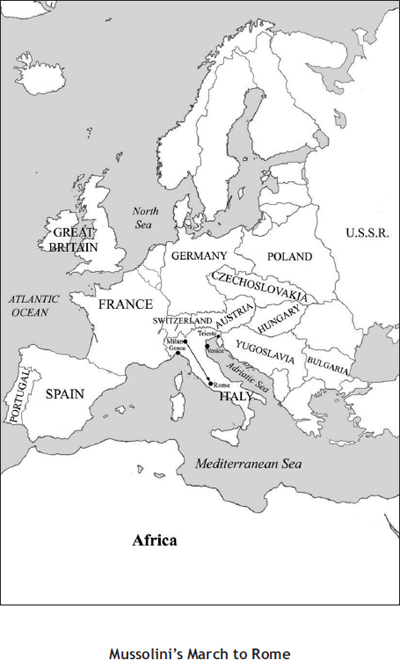
Italy did get some of the land that had once belonged to Austria, including the city of Trieste and the land surrounding it. It got nine thousand square miles—an area just a little bit bigger than the state of Massachusetts. But that didn’t seem like nearly enough to the Italians. After all, Great Britain had claimed more than two hundred thousand square miles of Turkish land—an area almost as big as the state of Texas. And Italy had another complaint. When Italy had joined the war in 1915, it had signed a secret treaty with Great Britain. In return for Italy’s help in the war, Great Britain had promised to give Italy huge amounts of land, all down the Adriatic Sea. Now, the British were ignoring the secret treaty.
When Vittorio Orlando returned home, he discovered that he had become very unpopular. The Italian people were angry that their country hadn’t gained more land from the treaty. Italy had lost half a million men in the war, and almost another million had been wounded—a quarter of them crippled for life. Italy had spent as much money fighting World War I as it had spent in the fifty years before! Italy deserved more—and Orlando hadn’t managed to get it.
Just days after the end of the Versailles conference, Vittorio Orlando resigned his position. This was the opportunity for a young politician named Benito Mussolini to move into power.
In the year of the Versailles peace conference, Mussolini was twenty-six years old. He came from a poor family, and had worked as a blacksmith alongside his father. He had fought in World War I, but in 1917 he was wounded and sent home. Like many Italians, Mussolini believed that Italy should have gotten more land in return for helping the Allies.
He also believed that Italy needed a new kind of government. If you remember, the Italian states were all united under King Victor Emmanuel II in 1861. Italy was a constitutional monarchy, which meant that a prime minister and an elected assembly had power, as well as the King. But even at that time, many people still thought that the nation of Italy should be a republic, not a monarchy.
In the fifty years since then, the king had not exactly been the most popular man in Italy. Victor Emmanuel II had passed the throne on to Umberto I—who had signed the Triple Alliance with Germany and Austria. During Umberto’s rule, Italy grew poorer because it fought with its neighbors and also fought in Africa to protect its colonies. The people grew so restless and unhappy that they began to riot. Umberto announced that the country would be put under martial law. This made him so hated that he was assassinated! The throne went to his son, Victor Emmanuel III.
Victor Emmanuel III allowed Vittorio Orlando, his prime minister, to help him make his decisions. When Orlando resigned, Victor Emmanuel III could not find a strong prime minister to replace him. Italy had four different prime ministers in three years!
In the middle of all this chaos, Mussolini began to write and talk about his new political philosophy. He made speeches, and put out a newspaper called Il Popolo d’Italia, or “The People of Italy.” In this newspaper, Mussolini explained that the most important thing for any country was that its government be strong. The government, and the nation itself, were more important than individual people. Individuals shouldn’t demand rights if those rights would be bad for the country as a whole. Instead, each person should find fulfillment in serving the state. Mussolini also believed that a strong Italian leader could make the state of Italy as glorious as it had once been in the days of the Roman Empire. And because the state was so important, everyone should pay unquestioning, absolute loyalty to the leader of the state.
This might not sound like a very appealing idea to you. But Italy was poor, unhappy, and had no leader at all. For many Italians, the idea that a strong leader might take control, fix all of Italy’s problems, and return Italy to a glorious place as the strongest nation in Europe was very wonderful indeed!
Mussolini’s followers joined together in an organization that he called the Fasci di Combattimento, or the “Band of Fighters.” The word fasci, or “band,” actually referred to the fasces, the bundle of tightly joined-together sticks with an axe in its center that had been a symbol of the ancient Roman government. Mussolini believed that individuals should be bound together so tightly that they formed a single united state, and that this state could never be broken apart.
Soon his followers were nicknamed “Fascists.” And because they wore black shirts as part of their uniform, they also were given the name “Blackshirts.” They saluted their leader by holding out their right arms at a stiff angle. They claimed that this salute was the same as the one the ancient Romans used—but this was a myth. The stiff-arm salute isn’t found in one single painting or statue. It had been used in different countries for many years. No one knew for certain where it came from—but in movies made in the early 1900s that were set in ancient Rome, movie directors told the actors playing Romans to use this salute. So the “ancient Roman salute” probably came from the movies!
Mussolini planned to gather Fascists from all over Italy and march into Rome. Some of his followers would seize the government buildings. Others would wait outside the city, carrying guns. If the Italian government refused to give Mussolini the power to run Italy, the Fascist army waiting outside would march in and begin a war.
Mussolini collected his Fascist followers and marched towards Rome. But he never really had to occupy the city. Victor Emmanuel III was too afraid of starting a civil war.
If Victor Emmanuel had called out the army and declared martial law—as his advisors begged him to do—the army could have driven off the Fascists. There were many, many more Italian army soldiers than there were fighters in the Fascist army. Many of the Fascists hadn’t actually managed to get hold of guns. They carried hoes and pitchforks instead.
But Victor Emmanuel didn’t call out the army. Perhaps he remembered what had happened to his father, Umberto I, after he declared martial law! He didn’t even wait for Mussolini’s Fascists to arrive in Rome. Instead, he summoned Mussolini to meet him and agreed to make him prime minister.
By 1923, Italy was firmly under control of the Fascists. Mussolini, the prime minister, was nicknamed Il Duce—“The Leader.” He would remain prime minister of Italy for the next twenty-one years.
Although he held the title prime minister, Mussolini was actually a military dictator. He wanted to build a new Roman Empire by recapturing land all around the Mediterranean Sea. He knew that Romulus, the legendary founder of Rome, was supposed to have taken a plow and plowed out the borders of his new city. So, imitating Romulus, Mussolini got on a tractor and drove around the borders of new cities that he hoped to build in his “new Roman Empire.”
If Italy had to go to war to build this new empire, Mussolini would declare war.