World War I was over. Every country in Europe had suffered. Among the Allies, Great Britain had lost nearly a million men. Another million and a half had been wounded, hundreds of thousands so badly that they would never again have a normal life. France had suffered even more; almost a million and a half French soldiers had died, with millions more wounded. Russia had lost nearly two million men, Italy over half a million. Among the Central Powers, nearly two million German soldiers, over a million Austrian men, and half a million Turkish and Bulgarian fighters had died. The war had shattered much of the countryside. Houses were in ruins. Roads had been blown up. Coal mines had been destroyed.
Now it was time to decide how these countries would recover from the war.
In 1919, the leaders of the victorious countries gathered together at the immense, glittering palace built by Louis XIV at Versailles, not far from Paris. Here, they would try to decide what penalties Germany, Austria, and their allies would have to pay.
The three most powerful leaders at the conference were Woodrow Wilson, the president of the United States; David Lloyd George, the prime minister of Great Britain and Georges Clemenceau, the French prime minister. All three of these men had different ideas about what the peace treaty should do.
Of the Allies, France had suffered the most from the war. Clemenceau, the prime minister of France, had seen much of his country destroyed. He wanted Germany punished!
England too had suffered. The people of England shouted, “Make Germany pay!” at the British prime minister, Lloyd George, whenever he went out in public. But Lloyd George was also afraid that, if Germany were treated too harshly, its people would turn to communism and make another alliance with Russia. He didn’t want the Germans to feel so desperate that they were willing to become a communist country. Great Britain had always been a little bit afraid of Russia. It was huge and well armed, and it always seemed to be getting bigger. Now that Russia was communist, Great Britain was even more worried about it. What if the Communist Party decided to spread communism through force, by conquering other countries in Europe? If Germany and Russia allied together, they might make an unbeatable enemy.
Woodrow Wilson of the United States had a third set of ideas. He too agreed that Germany should be punished. But he thought the most important job of the meeting in Versailles was to figure out how to keep such a war from happening again. He believed that the countries of the world should join together to work out an agreement that all countries would honor. This agreement, he thought, should have fourteen different points. But three of the points were the most important.
The League of Nations would act like the parents of a big, argumentative family. If two countries argued about something, they wouldn’t start a war over it—any more than two siblings should settle an argument by a fist-fight. Instead, the countries would bring the problem to the League of Nations. The countries in the League would discuss the problem, decide what should be done, and tell the hostile countries to do it. Wilson thought that a League of Nations might stop a world war from ever happening again.
When the three leaders and representatives of the other countries that had fought in World War I all got together at Versailles, they agreed on three important points. First, the other leaders agreed that Wilson’s idea about the League of Nations was a good one. The Versailles Peace Settlement, a document that both the winners and the losers of the Great War signed, formed this League of Nations.
Second, they agreed that the Versailles Peace Settlement would rearrange the whole map!
When World War I began, the large country of Austria—land that had once belonged to the Holy Roman Emperor of the Middle Ages—lay just east of Germany. Remember, Austria was also known as the “Austro-Hungarian Empire” because the people in the eastern half of it had insisted that, although they would pay allegiance to the Austrian emperor, they wanted their part of the empire to have its own name (Hungary) and its own, separate constitution—even though both countries were ruled by the emperor and the same army. The countries of Croatia and Bosnia lay within the borders of the Austro-Hungarian Empire. Just south lay the independent countries of Serbia and Montenegro, and to the east Bulgaria, with the Russian territory of Romania above it. Greece, on the south of the peninsula, and Albania, just above it, were independent countries.
The Peace of Versailles changed almost all of this. First of all, Austria would be divided into two parts. From now on, the empire would be two separate countries—Austria to the west, and Hungary to the east. A big slice of land across the top of both was taken away and made into a brand new country called Czechoslovakia. On the bottom half of the Austro-Hungarian Empire, Croatia and Bosnia were taken away from Austro-Hungary, put together with Serbia, and made into yet another brand new country, called Yugoslavia. Montenegro was also folded into Yugoslavia. Only Albania and Greece got to keep their own land.
Bulgaria, which had sided with Germany, would also be punished by losing some of its territory. Land in western Bulgaria would be pulled into the new country of Yugoslavia as well. So this new country would have people from five different old countries in it.
And what about the Turkish Empire, which had also sided with Germany? The only part of the Turkish Empire left to the Turks was Asia Minor—the land that today we know as the modern nation of Turkey. France and Britain divided up the Turkish land south of Asia Minor. The land along the eastern coast of the Mediterranean Sea went to France; Britain claimed the land north of the Arabian Peninsula, all the way over to the border of Persia. (Ten years later, in 1929, Britain would divide part of this land that once belonged to the Turks off, and name it “Iraq.”) The empire of the Ottoman Turks, an empire that had governed in the east for centuries, was no more. It would become the Turkish Republic instead.
Rearranging the whole eastern part of Europe was the second task of the Peace of Versailles. The third was the punishment of Germany.
Germany had to give up huge amounts of its empire. The northern part of the empire was divided up. Some of the land went to Poland, which lay on Germany’s eastern border, between Germany and Russia. Some went to Russia itself. Other parts of Germany were given their freedom and became the independent nations of Lithuania, Latvia, and Estonia.
Germany would lose all of its colonies. It could never have an army larger than one hundred thousand soldiers. Its navy could only have six battleships. Germany wasn’t allowed to have any air force or submarine fleet. Most damaging of all, the Germans had to agree to sign a part of the treaty called “Article 231,” or the “War Guilt Clause.” This clause said, “Germany accepts the responsibility for all the loss and damage that the Allies suffered during the war, since the war was caused by Germany and her allies.” This meant that Germany was solely responsible for the war—and had to pay over thirty-two billion dollars in losses and damages to other countries.
The German representatives were furious over this clause. Germany too had suffered during the war. If Germany had to pay all of this money, the country would never be able to recover. And why was Germany being blamed for the entire war, when it had actually started over on the Balkan Peninsula?
But the Allies refused to budge. Each one of the leaders had gotten what he wanted. Wilson of the U.S. got his League of Nations. Clemenceau of France saw Germany punished. Lloyd George of Great Britain was happy, because all of the new countries formed by the Peace of Versailles would act like a barrier between Great Britain and Communist Russia.
Unfortunately, the Peace of Versailles led to a lot of trouble.
When Woodrow Wilson returned home, he wasn’t able to convince the United States Congress to join the League of Nations. Congress didn’t want the United States too involved with European politics! Instead, it thought that Americans should focus only on what was good for America. So the League, which had been thought up by an American president, went on without America.
Most of the countries formed by the Peace eventually fell apart. After all, their boundaries had been drawn by people who didn’t live in them. Different groups of people, who didn’t share the same history or the same culture, had been shoved together and told that they were now citizens of the same countries. In some of these new countries, people who had hated each other for centuries were now trapped inside the same borders.
And the debt imposed on Germany made it poorer and poorer, and its people more and more miserable. In a few years, the German people would be ready to listen to anyone who offered to revenge the wrongs done to Germany, and who promised to make their country great again.
After Nicholas II and his family were killed, civil war broke out in Russia.
Russians loyal to the czar formed an army called the White Army to avenge the czar’s death. In return, the communists organized their own army, the Red Army. For three years, civil war raged between the White Army and the Red Army.
By 1922, the Red Army had won. A million and half Russians who had supported the czar and the White Army, called “White Russians,” were forced to leave their country. Those who didn’t leave were arrested, jailed, or executed.
Now Russia was a totalitarian state (a country with only one political party). Most countries have at least two political parties (the United States has Republicans and Democrats). In a country with more than one political party, the two parties argue with each other about how the country should be run. Usually, the two sides have very different ideas. The people of the country listen to the arguments and decide which side has a better chance of making the country work. This way, all of the candidates get a chance to air their ideas. Perhaps the arguments even change some people’s minds.
But in a totalitarian state, no one gets to disagree with the one political party that runs the country. Lenin and the Communist Party exiled, jailed, or executed the Russians who disagreed with the communist takeover, or who wanted Russia ruled in some other way.
Lenin didn’t get to govern his totalitarian state for very long. Almost as soon as the war between White Russians and Red Russians was over, Lenin had a stroke (an illness that caused his brain to stop working properly). He remained “leader” for two more years—but during those two years, the real leader of Russia was Joseph Stalin.
When he was born, Joseph Stalin’s name was Ioseb Dzhugashvili. He changed his name to “Stalin” when he joined the Communist Party at the age of 24. “Stalin” came from the Russian word for “steel.” Joseph Stalin, the steel ruler of Russia, was as hard as metal—and as cruel as a steel sword.
When Lenin died, Joseph Stalin became Russia’s undisputed leader. He ordered the city of Petrograd (once St. Petersburg) to be renamed Leningrad, in honor of Lenin. Stalin also ordered Lenin’s body put in a glass coffin, so that Russians could come and look at him. Scientists took out Lenin’s brain so that they could study it to find out why he was such a political genius. Then, other scientists soaked the body in chemicals to preserve it. Today, Lenin’s body is still in its glass coffin, in the Moscow town square known as “Red Square.” Anyone who visits the square can see it. A fifteen-member committee has taken care of the body for the last eighty years. Every week, they check the body to make sure that it isn’t beginning to disintegrate, and put more chemicals on it. Every once in a while, they change Lenin’s clothes.
Under Joseph Stalin, two things happened to Communist Russia.
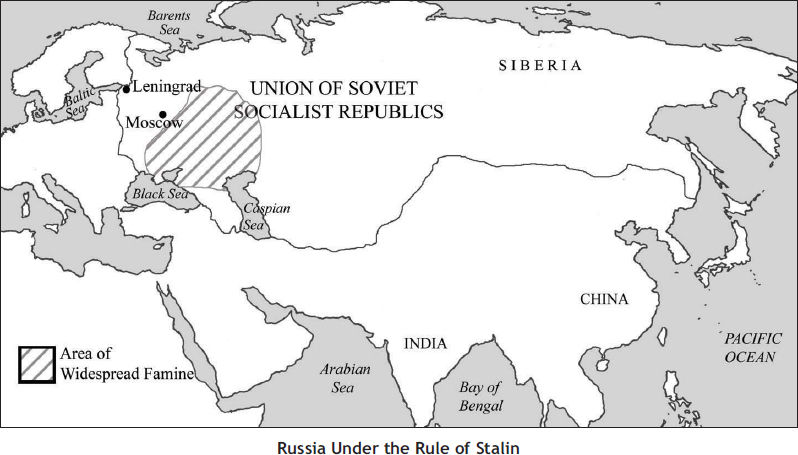
The first was that Russia became the Union of Soviet Socialist Republics, or the “USSR.” Threatening war if they didn’t join, Joseph Stalin told the countries that lay just at the western border of Russia, between Russia and Poland, that they had to become part of a new communist empire. Over the next twenty years, the USSR, or “Soviet Union,” would spread eastward and swallow five little countries in the center of Asia. It would also reach over to the Baltic and gulp up Estonia, Latvia, and Lithuania, countries that had been given their freedom after World War I by the Peace of Versailles. That freedom didn’t last for long!
The second thing that happened during the rule of Joseph Stalin is that millions of Russians died. Many were executed by Stalin. And many more starved to death.
Stalin had his own ideas about how Russia should become great. Most of Russia was farmland, where peasants grew crops. But Stalin wanted Russia to have factories and mines, like the wealthy western nations. He wanted steelworks that would make new rails for railroads that would go across Russia, and parts for electrical generators that would light up Russia’s homes and streets. He ordered these new industries built—many of them in the icy wasteland of Siberia. And then he forced thousands and thousands of Russians to work in these factories, steelworks, and mines. If they didn’t produce a certain amount of metal and goods, they were punished.
He also ordered the peasants who still worked on farms to produce more food by working harder and planting more. They had to join together into huge “collective farms,” where hundreds of farmers worked on the same fields. Almost all of the food grown in these fields went into a “common stockpile.” In other words, most of it went to the government! The communist government was supposed to then hand it back out evenly to the people of Russia.
The peasants and farmers of Russia hated these new arrangements. Many didn’t want to leave their land and work in factories. Those who were still allowed to work on their farms now couldn’t own their own fields, or decide how to care for their own crops. And after all that hard work, they had to turn most of the food over to the government.
The new “collectives” were so unpopular that many farmers simply refused to work on them. But Stalin knew how to deal with disobedient Soviet citizens. Anyone who resisted Stalin was arrested and shot, or sent to “work camps.” The work camps, scattered all through Siberia and far to the east, were freezing cold. The prisoners who lived there labored for days, or weeks, or months, with very little to eat. These labor camps, scattered through the open wasteland of Siberia, were nicknamed “the Gulag Archipelago,” because they were spread out and isolated, just like a string of islands. Most people sent to the Gulag died there.
Then a drought spread across Russia. Crops began to wither. The harvests grew poorer and poorer; the peasants grew hungry. But instead of offering help, Stalin ordered them to keep on sending the same amount of grain to Leningrad.
The peasants began to die of hunger. In the end, six million Russians starved during the famine. Joseph Stalin didn’t care. He was determined to make Russia powerful. If people died, that was just part of the process.
Anyone who muttered about Stalin’s methods or his cruelty could expect to be shot or sent to Siberia. Stalin became infamous for his “purges.” To “purify” Russia of dissent, Stalin ordered his critics, called “dissidents,” to be arrested and sent to the Gulag. During Stalin’s power, fifteen million Russians went to the Gulag! Almost nine million were arrested and shot. One of the most famous Russian dissidents, Alexander Solzhenitsyn, spent eleven years imprisoned by the Soviets, many of those in a labor camp in the Gulag. He wrote that Russians could expect to be arrested at any time of the day or night, by Russian police in disguise. Often, the prisoners weren’t even told what their crime was. “They take you aside in a factory corridor after you have had your pass checked—and you’re arrested,” he wrote. “You are arrested by a religious pilgrim whom you have put up for the night ‘for the sake of Christ.’ You are arrested by a meterman who has come to read your electric meter. You are arrested by a bicyclist who has run into you on the street, by a railway conductor, a taxi driver, a savings bank teller.” Once arrested, you could expect to be sent to a camp without trial—or a chance to clear your name.
Solzhenitsyn wrote that revolution can never get rid of the evil inside human beings. It can only get rid of particular governments. Even when the evil of those governments is destroyed, the evil inside human beings remains.
Solzhenitsyn was right. The communist government had been formed to get rid of tyranny. But Joseph Stalin, the leader of Communist Russia, was as cruel, as tyrannical, and as evil as any Russian czar had ever been.