In the same year that the United States joined the Allies, the Allied country of Russia went through a huge, world-changing revolution.
Even before the Great War began, the people of Russia were unhappy. Most Russians were peasants. They lived a difficult life: The noblemen of Russia had power to order them around, they didn’t own the land they farmed, they had to labor for long hours, and they had just barely enough food to survive.
Meanwhile, the royal family of the Romanovs was leading a very different life. Nicholas II, his wife Alexandra, and their five children lived in a huge palace, surrounded by servants, with all the food they could eat. The palace had a Great Hall with golden marble columns, and a floor so smooth and polished that servants who went into it had to wear special shoes so that they wouldn’t slip and fall. The children had warm bedrooms all to themselves, and a large playroom where shelves and boxes of toys waited to entertain them. Nicholas II had two different libraries all his own: the Great Library and the Small Library. Many of his books were covered in hand-made leather, and had gold or silver locks attached to fasten the covers shut. The books cost more money than an entire village of Russian peasants could earn in a year. The czar paid two librarians just to look after his book collection!
The wealth of the Romanovs, compared to the miserable, cold poverty of millions of their subjects, angered many Russians. The Romanov family had also grown unpopular with the Russian people for another reason. They spent too much time with a strange, mystical, unpopular monk named Rasputin.
The Romanovs had good reason for spending time with Rasputin. Nicholas and Alexandra’s only son, Aleksei, had a disease called hemophilia. If you scratch or cut yourself, you’ll bleed a little bit and then stop, because your blood clots and keeps any more blood from coming out. But Aleksei’s blood wouldn’t clot. If he scratched himself, he bled and bled and bled. He could die from the tiniest injury. Many of the men in the royal Russian family had inherited this horrible disease.
Nicholas and Alexandra were sick with worry for their son. And Rasputin claimed to have magical powers that could heal little Aleksei. So Aleksei’s worried parents invited Rasputin to stay at the royal palace with their family.
Even though he was a monk, Rasputin drank too much, spent too much time at wild parties, and lived for pleasure and money. The Russian people hated and feared him. And because the czar and his wife had never told anyone outside of the family about Aleksei’s illness, the Russians didn’t understand why the royal family had welcomed this strange magician to the palace. Many whispered that Rasputin had put a spell on the czar!
Three Russian noblemen who also hated Rasputin finally decided to get rid of him. They invited him to dinner and gave him poisoned wine and poisoned candy. Oddly enough, the poison seemed to have no effect on him. So one of the three men shot Rasputin. That didn’t kill him either. He got up and went outside. The noblemen followed him and shot him again! He still didn’t die. Finally, they threw him into the river. This time, Rasputin sank and didn’t come back up again.
But even with Rasputin gone, Nicholas was still unpopular. He only made things worse when World War I began. Nicholas immediately brought the Russian army into the war. It was a huge army; in 1914, it had six and a half million soldiers in it. But the army wasn’t very well prepared. As a matter of fact, it had fewer than five million guns—which meant that almost two million Russian soldiers marched into battle with no weapons at all. They were supposed to grab guns that other Russian soldiers dropped when they died, and go on firing.
At first, the Russian army was commanded by the czar’s cousin, the Grand Duke Nicolai. But in the first year of fighting, two million Russian soldiers were killed. Millions more were cold and hungry, because it was so difficult to carry food across the wide, cold plains of Russia to the battlefront.
After a year of this, Czar Nicholas II booted his cousin the Grand Duke out of his position, and took over command of the army himself. This was a big mistake. Nicholas didn’t know how to command an army or how to plan strategy. As Commander in Chief of the Russian army, he made disastrous decisions, one after another. More and more Russian soldiers died on the battlefields of the Great War. With every death, Nicholas grew more hated. All of Russia blamed him for the deaths of the Russian soldiers.
At the same time, food had become scarcer and scarcer—not just at the front, but all across Russia. On March 8, 1917, a group of women and children waited all day in a line for bread. Finally, they reached the head of the line—and were told that the bread was all gone. The hungry peasants in line were furious. They began to chant, “We want bread!” and “Down with the czar!”
Like the peasants in line, more and more Russians began to demand that Nicholas II give up his throne. Finally, Nicholas II realized that he had lost the loyalty of his people forever. He gave up his throne and took his family to live in one of their favorite homes. In place of the czar, a “Provisional Government” (temporary government) took over running Russia.
The leader of this Provisional Government, a lawyer named Aleksandr Kerensky, knew how unpopular Nicholas II was. So he ordered the entire Romanov family taken far away, into Siberia, so that mobs would not attack and kill them in their home.
Aleksandr Kerensky began to try to change Russia’s laws so that the country would be a better place to live. But he refused to pull the Russian army out of the Great War. As a matter of fact, he ordered the army to begin new battles against the Central Powers. The soldiers in the Russian army were exhausted and angry. Almost two million of them simply left the army and started home. Many of these ex-soldiers took their weapons, went back to the Russian countryside, murdered rich landowners and took over their land. Kerensky and the Provisional Government were helpless to stop the killing.
It was time for a new government to take control of Russia.
The group of leaders who seized control of Russia were called the Bolsheviks. The leader of the Bolsheviks was a man named Vladimir Ilich Lenin. Lenin believed that the peasants had the right to take over the land owned by the wealthy, because the wealthy had so often earned their money by forcing the poor to work hard for very little reward. He wanted the land in Russia to be used by the whole nation—the whole “community”—not just the rich.
Lenin’s ideas were popular with the poor, and also with the millions of working people in Russia. Now, with the poor and working people discontent not only with their lives, but with the government’s decision to stay in World War I, Lenin had the chance to get more and more Russians on his side.
On October 24, 1917, Lenin and his followers made their move. Over twenty-five thousand angry peasants, workers, and soldiers stormed through the city of St. Petersburg, where the government of Russia had its offices. The workers flooded through the Winter Palace and took control of the government offices. Kerensky’s followers were arrested—but Kerensky himself ran fast enough to get away.
Now Lenin and the Bolsheviks were in charge. Lenin suggested renaming the Bolsheviks the “Communist Party”—the party working for the common good. The communists believed that Christianity was false and wrong, so they changed the names of the cities in Russia that were named after Christian saints. St. Petersburg became “Leningrad.” And right away, Lenin and the communists signed a peace treaty with Germany.
Finally, Russia was out of the war.
There were two problems left. One was that the czar, Nicholas and his family, were still alive and living in Russia. The second was that the people of Russia were still very poor.
Lenin dealt with the czar first. He ordered Nicholas II and his whole family imprisoned in a house in the city of Yekaterinburg, far to the west of Petrograd. Then he sent word to the czar’s guards: Every member of the royal Romanov family had to die. Lenin didn’t want any Romanovs left to claim that they had the right to rule over Russia.
On July 17, 1918, in the dark of night, guards ordered the Romanovs to get dressed and go to the basement. In the basement, twelve men shot the Romanovs to death. Then they took the bodies twelve miles away, into the heart of a dark forest, and buried them. The Romanov family, which had ruled Russia since 1613, was no more. Now Lenin and the Communist Party governed Russia.
Lenin tried to tackle the problem of Russian poverty in a new way. To make sure that the rich people of Russia didn’t own all the land while the poor people had none, the Communist Party decided that all of the land in the whole country would belong to the government! The government would allow people to use the land equally. Instead of individual Russians building businesses, making money, and perhaps forcing other Russians to work for little pay, the government would own and run most of the businesses—not just the electric company and the water company, but hospitals, schools, grocery stores, bookstores, and even hot dog stands.
This new way of living, “communism,” was supposed to make sure that the government, instead of a small group of powerful people, had control over Russia. But who was in the government? That’s right—a small group of powerful people, Lenin and his followers!
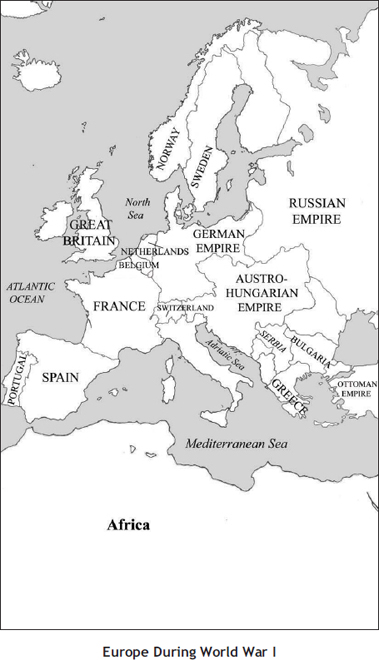
Russia had resigned from World War I. But the United States had just joined, on the side of Great Britain and the Allied forces.
The president of the United States, Woodrow Wilson, had once believed that the United States should stay neutral in the Great War. But he had changed his mind. Now he was sure that the United States had a duty to fight against Germany. If Germany, ruled by a kaiser (emperor), took over Europe, the democratic countries of Europe would lose their right to elect their own leaders. Woodrow Wilson announced that America had to join the war so that “the world may be made safe for democracy.”
American soldiers marched off to join the Allied troops in Europe. These American soldiers were nicknamed “doughboys.” No one is quite sure where this name came from. It might refer to a type of food that soldiers ate, a doughy mixture of flour and rice, cooked over a campfire. Or it might come from the old expression “dough-head,” which meant “stupid”!
But “doughboy” wasn’t an insult when it referred to American soldiers. Americans were proud that their soldiers were going overseas to help Great Britain and France fight against the German threat. Just as in Great Britain, women jumped in to help at home and do the jobs that men left behind when they went off to war. American women also joined the Navy and Marine Corps. They weren’t allowed to fight, but they served as nurses, clerks, telephone operators, electricians, and photographers. They also put together torpedoes and designed camouflage. Three Army nurses earned Distinguished Service Crosses, America’s second highest military award.
Four months after America entered the war, American soldiers won their first battle against soldiers of the Central Powers. In May, June, and July, Allied soldiers triumphed in three more important battles. After the last, the Second Battle of the Marne, a French general named Charles Mangin paid tribute to the American soldiers who had fought so courageously. “Shoulder to shoulder with your French comrades, you threw yourselves into the counter-offensive,” he told them. “You ran to it as if going to a feast. Your magnificent dash upset and surprised the enemy. … You have shown yourselves to be worthy sons of your great country and have gained the admiration of your brothers in arms. … American comrades, I am grateful to you for the blood you generously spilled on the soil of my country. I am proud of having commanded you during such splendid days and to have fought with you for the deliverance of the world.”
The new strength of the American soldiers, joining with the Allied forces that had fought for four long, weary years, finally tipped the balance of the war against the Central Powers. On November 11, 1918, Germany was forced to surrender. The power of the Second Reich was broken. All over the world, exhausted soldiers heard the great news: An armistice (an end to fighting) had been declared.
A few years later, an American soldier named Thomas Gowenlock, who had been on the front lines of World War I, described the soldiers’ response when they learned that Germany had surrendered. “All over the world on November 11, 1918, people were celebrating, dancing in the streets, drinking champagne, hailing the armistice that meant the end of the war,” he wrote. “But at the front there was no celebration. … The men … were trying to reassure themselves that there were no enemy batteries spying on them from the next hill and no German bombing planes approaching to blast them out of existence. They talked in low tones. They were nervous. After the long months of intense strain, of keying themselves up to the daily mortal danger, of thinking always in terms of war and the enemy, the abrupt release from it all was … agony. Some suffered a total nervous collapse. Some, of a steadier temperament, began to hope they would someday return to home and the embrace of loved ones. Some could think only of the crude little crosses that marked the graves of their comrades. … What was to come next? They did not know—and hardly cared. Their minds were numbed by the shock of peace.”
Although peace had finally arrived, as many as ten million soldiers and another ten million civilians had died, all around the world. In France, Great Britain, and Germany, almost every family had lost brothers, husbands, and fathers to the Great War.
But in England and America, the war helped to bring about at least one good thing. For the first time, women were allowed to vote.
For years, British and American women had been demanding the right to vote (also known as suffrage). Women who marched, protested, and spoke in public about their right to suffrage were called suffragettes. If you’ve ever seen the movie Mary Poppins, you might remember that Mrs. Banks is a suffragette. She wraps a banner around her, proclaiming that women should have the right to vote, and marches off singing:
We’re clearly soldiers in petticoats
And dauntless crusaders for women’s votes. …
Our daughter’s daughters will adore us
And they’ll sing in grateful chorus
“Well done, sister suffragette!”
After World War I ended, it seemed obvious that women should be allowed to vote. After all, while the men had gone off to fight, women had done the men’s jobs—and done them perfectly well. Why in the world shouldn’t they be given the same right to vote as the men?
In 1918, Great Britain passed a new law called the Reform Act. Because women had worked so hard to help win the war, every woman over the age of thirty could vote. (In 1928, Britain changed the law so that women twenty-one and older could vote, too.)
For women in America to vote, an amendment to the Constitution had to be passed. In 1918, Congress agreed to begin the process of changing the Constitution so that women could gain suffrage. One representative to the Congress, Frederick Hicks of New York, was sitting by his dying wife when it came time to pass the amendment. She told him to leave her deathbed and go help pass the amendment—so he did!
On the day that Congress would take its final vote on passing the amendment, “suffragists” crowded into the Senate to hear the outcome. The New York Times reported that “deafening applause” broke out when a senator stood up to announce that the amendment had passed Congress. The Great War was finally over. Now, in America and Great Britain, women could help pass the laws that would shape the world after the war.