Around the year 1900, the president of Mexico was a man named Porfirio Díaz. He had been president for over thirty years. This was odd—because Mexico’s constitution said that no one could be president for more than four.
Look between North and South America, and you’ll see a bridge of land that connects them. On this land, which we call Central America, lies the country of Mexico.
Like South America, this land was home to native American tribes before Spanish conquistadores arrived and settled down. Spain claimed Central America for its own and gave it the name “New Spain.” In 1821, “New Spain” declared its independence from Spain and became the country of Mexico, with its own constitution and its own elected president.
President Díaz had been elected again, and again, and again. He had been president for so long that his presidency had earned itself a name: “the Porfiriato.” Porfirio Díaz claimed that no one in Mexico wanted to end his presidency by running against him. The truth was that his supporters paid visits to anyone who might be thinking about running for president against Díaz, and scared them out of the idea.
This had worked for thirty years. But now many Mexicans were growing discontented with Porfirio Díaz’s government. Most of the decisions about how Mexico should be run were made by a small and powerful group of very rich men. Díaz had treated the native Central American tribes cruelly. He had ordered them rounded up and sent off to work as slaves on tobacco plantations; then, he took their land away and sold it to his friends and to foreign businessmen. The poor Mexicans who weren’t native Indians were just as bad off. Even though they worked hard to farm their land, they couldn’t sell the food they raised for enough money to feed themselves. When a dreadful famine swept across Mexico, thousands began to die of starvation.
Meanwhile, the powerful, wealthy men who owned large, modern farms were still watering their crops with artificial irrigation, raising healthy harvests—and then shipping the food out of the country for sale. People in other countries were ready to pay good money for their produce. Why should they waste it on starving peasants? These rich Mexicans didn’t seem to care if the poor people of their own country died. In fact, to the common people of Mexico, they seemed less and less like Mexicans, and more and more like Europeans. Many of them had gone to school in Europe. They dressed like Europeans and talked like Europeans. Some had even begun to speak French instead of Spanish, the language of Mexico.
Groups of rebels—like the Young Turks, the Young Italians, and the groups that had formed all over Europe a few years earlier—started to band together and protest. They pointed out that for years and years, no one had dared to run against Porfirio Díaz. He had only been reelected again and again because he had no opponent! Mexico needed presidents who would only serve for one term. Mexico needed presidents who would see that all Mexicans got a decent education, proper food, and enough pay to live on.
In 1910, President Díaz allowed another presidential candidate to run against him. Francisco Madero was from a rich family, and had a huge fortune of his own. But even though he was a wealthy man who owned large farms, he treated his workers well. He made sure that they had decent houses, good food, and clean water. He sent his own doctor to take care of the sick laborers. He even used his own money to build schools for the children of the men and women who worked for him. Madero wanted Mexico to become a true democracy—not a dictatorship, run by a president who never left office.
Madero’s kindness made him popular—and well loved. When Díaz saw that Madero might well beat him in an election, he had Francisco Madero arrested and thrown into jail. On the day of the election, Porfirio Díaz’s officials announced that Mexicans had once again elected Díaz president.
The day after this fake election, Madero escaped from jail. He left Mexico by dressing himself as a railroad worker and catching a train that took him across the Mexican border into the United States. In San Antonio, Texas, he set up headquarters for a revolutionary group that would fight against President Díaz’s government. He used his huge fortune to buy guns and send them into Mexico, for the use of rebel soldiers who banded together to fight against the Mexican army.
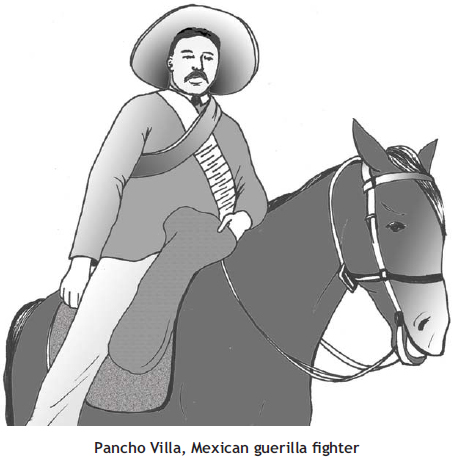
One of the most famous of these rebel soldiers was a man named Doroteo Arango. Arango was a cattle thief from the north of Mexico, a bandit who had survived through stealing and hiding. But now he became a guerilla warrior and earned the nickname Pancho Villa. Pancho Villa raised an army of about three hundred men, stole enough food and supplies to keep them alive, and began to mount raids and attacks on government forces. Other revolutionary leaders joined him. All over Mexico, rebels were fighting against government forces, taking over villages, and driving away government officials. The Mexican Revolution was in full swing.
Soon, Porfirio Díaz realized that he would not be able to hold on to power very much longer. He was eighty years old, and suffering horribly from an abscessed tooth and other illnesses. He could barely get out of bed.
Late one May night, less than a year after the Mexican Revolution began, Porfirio Díaz hobbled slowly through the dark, surrounded by his advisors. He had agreed to meet a group of rebels outside of the city of Ciudad Juárez. Automobiles had been pulled into a circle, their headlights shining on a table where a treaty sat. By signing the treaty, Díaz would promise to give up his power. He bent over the paper and signed it slowly, with a shaking hand. His helpers supported him as he walked away. The next day, Porfirio Díaz left his country and went to France. He died in Paris four years later.
Madero marched into Mexico City to the cheers of the people. The wife of an American diplomat who watched the victory parade wrote, “People came from far and near, in all sorts of conveyances or on foot, just to see him, to hear his voice, even to touch his garments for help and healing. … It is a curious experience to see a people at the moment of what they are convinced is their salvation, to see the man they hail as ‘Messiah’ enter their Jerusalem. … The only thing they didn’t shout was ‘Hosanna.’ ”
The people of Mexico hoped that Madero would bring a true democracy, with peace and prosperity, to Mexico. Unfortunately, Madero found himself with a big problem. All of the rebel leaders who had helped fight for Díaz’s removal had different ideas about how Mexico should be reformed. Some of them just wanted free elections. Others wanted the government to take the land owned by foreign businessmen away from them, and give it back to the people. And the rich men of Mexico, even those who had supported Madero’s presidency, wanted as little change as possible.
For two years, Madero struggled to make all of these different powers work together—and failed. Once again, rebellion broke out. This time, it was against the very man that the rebels had hoped to put into power! Madero found himself sending out the Mexican army to fight against the revolutionaries who had once been his allies.
By February of 1913, the rebels had invaded Mexico City itself, and had set up their headquarters in the government armory (the place where weapons were stored). Madero’s troops besieged them. For ten days, the two sides shot at each other. The shells set off fires all through the city, burning homes and stores. People who left their homes were likely to get caught in the crossfire. The people of Mexico City were too frightened to leave their homes. Some of them ended up cooking and eating their pet cats in order to stave off hunger!
These days became known as the Ten Tragic Days, or La Decena Trágica.
Finally, rebel forces charged into President Madero’s office and dragged him out. They put him under guard, and took control of the city. The leader of the rebels, a general named Victoriano Huerta, was now in charge of Mexico City.
Huerta and the other rebels promised that they would keep Madero safe. But late one night, Madero was murdered by Huerta’s officers. Huerta told the people of Mexico that the ex-president had been accidently killed while trying to escape.
Now, Mexico was under the rule of Huerta—who was as much of a dictator as Porfirio Díaz had ever been! But Huerta didn’t keep power for long. The rebel leader Pancho Villa, who had fought against Díaz, continued to fight against Huerta. Less than a year later, Huerta himself fled.
For the next thirty years, civil war, assassinations, struggle and rebellion continued in Mexico. The Mexican Revolution had gotten rid of a tyrannical president—but it had not brought peace to Mexico.
While Mexico was struggling with its own people, a great war was about to spread across the other half of the world. This war became so huge that for years, people in Europe simply called it “The Great War.” Today, we call it World War I.
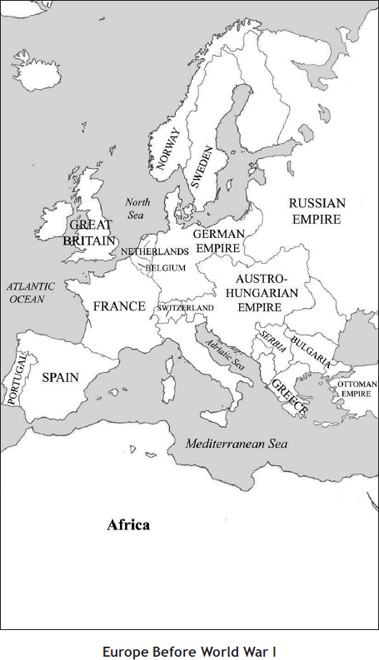
World War I began in the Balkans. Remember how Bulgaria attacked Serbia, back when the Balkan Peninsula was fighting for independence from the Ottoman Turks? Bulgaria, Serbia and Greece had been planning to divide up Macedonia, but Bulgaria didn’t think it was getting enough land. After the attack, Serbia and Bulgaria were enemies—and Bulgaria began to make an alliance with Austria (also called the “Austro-Hungarian Empire,” since Austria was really the two countries of Austria and Hungary, united under one Austrian ruler).
If Austria was a friend of Bulgaria, Serbia would be Austria’s enemy. The Serbs had another complaint against Austria as well. Austria had taken the little country of Bosnia and made it part of the Austro-Hungarian Empire. But the people who lived in Bosnia were from the same ancient race as the people who lived in Serbia. Both were “Slavic.” Many Serbians thought that all Slavs should be united together—and that no Slavs should be ruled by Austrians.
On June 28, 1914, a nineteen-year-old Serbian assassin named Gavrilo Princip shot Archduke Franz Ferdinand, the heir to the Austrian throne.
The assassination was a disaster. To start with, it almost didn’t work. Six teenagers, none of them older than nineteen, had planned to throw a bomb into the Archduke’s car as it passed by. But the boy given the job of throwing the bomb missed! The explosion went off behind the Archduke’s back fender. Immediately, police charged into the crowd and grabbed the bomb-thrower. He tried to swallow a capsule of cyanide to kill himself, but he couldn’t get it into his mouth properly. He was arrested at once and dragged off to jail.
At this, the other five boys fled. Gavrilo Princip went into a coffeehouse nearby to calm himself down by drinking a cup of coffee. When he finished his coffee, he stepped out onto the sidewalk and looked around. A car was coming towards him—the Archduke’s car, leaving the scene of the bombing to take the Archduke to safety. Princip, hardly able to believe his luck, drew his gun and shot into the car … killing both the Archduke and his wife.
The leaders of Austria insisted that the assassination attempt must have been planned by the Serbian government. Serb leaders denied it. But the denial did no good. On July 28th, the Austro-Hungarian Empire declared war on Serbia.
Two other countries immediately got involved. Russia, an ally of the Serbians, started to gather its troops together to attack Austria. So Germany, an ally of Austria, declared war on Russia. Two days later, Germany also declared war on France, and started to march towards the French border.
What did France have to do with the Balkans?
Not a lot. The truth was that most of the countries of Europe were ready to fight anyway. For decades, they had been arguing with each other about their borders, the size of their armies, and who got to control which colonies in Asia and Africa. Even though the bullet that killed the Archduke was often described as “the bullet that started World War I,” the Archduke’s assassination didn’t really cause World War I.
If you remember your ancient history, you know that the Trojan War started when a Trojan nobleman fell in love with the beautiful Helen and kidnapped her. The Greeks set out to take revenge on the Trojans—but the truth was that the Greeks and Trojans had hated each other for years, and were glad to find a reason for war. Helen was described as “the face that launched a thousand ships,” but, like “the bullet that started World War I,” Helen was a convenient excuse for a fight.
When the German army began to march towards France, it went through Belgium, which had already declared that the Belgians wouldn’t get involved in the Austrian-Serbian quarrel. Now, Germany was ignoring a declaration of “neutrality” (refusing to join either side) and invading yet another country. At this, the British began to worry. Remember, Germany had been building new oil-powered ships for its navy, and Great Britain was already nervous about this growing fleet of battleships. If Germany was left alone, German soldiers might take over all of Europe.
On August 4, 1914, Great Britain declared war on Germany. The war had truly begun.
Before long, most of Europe was in on the fight. On one side were the “Central Powers”—the Austro-Hungarian Empire, Bulgaria, and Germany, soon joined by the Ottoman Turks. On the other side were the “Allied Forces”—Great Britain, France, Russia, China, Greece, Japan, Serbia, and a collection of other countries (including Belgium, which wasn’t neutral any more).
No one believed this war would take very long. After all, the four countries of the Central Powers were defying the rest of the world. But it did. The fighting went on and on. Countries as far away as Australia and South Africa declared themselves ready to fight. Canadian soldiers marched off to fight in defense of Great Britain. The United States was one of the few powerful countries that refused to get involved.
Germany’s new, powerful ships sailed along the British coastline, attacking British vessels and merchant ships. On May 7, 1915, a German submarine fired a torpedo at a British ship called the Lusitania. The ship turned on end and sank, as the passengers scrambled frantically to get above decks. Almost twelve hundred people drowned.
The rest of the world was furious. The Lusitania wasn’t carrying soldiers; it was a passenger ship, filled with civilians. This broke all the rules of war. German submarines could torpedo British warships, but they were supposed to leave civilian ships alone.
The United States government was particularly angry, because over a hundred of the drowned passengers were American citizens. For the first time, Americans began to think that perhaps the U.S. should get involved in the Great War.
By the winter of 1916, it seemed that the war might never end. So Great Britain passed a new and frightening law. It declared that the British government could now order young men to join the army and go fight—even if they didn’t want to. This was called the draft. Never before had Great Britain forced its men to join in a war.
Young men bravely went when called. But the war was dangerous, exhausting, and brutal. At the front (the place where the fighting between enemies actually took place), British soldiers sang a song that went like this:
I don’t want to go in the trenches no more,
Where whizzbangs and shrapnel they whistle and roar.
Oh my, I don’t want to die, I want to go home.
The draft, of course, meant that even more men were away at war. Women had to begin working in factories and shops, driving trucks, and doing other “men’s jobs.” By 1918, almost a million women worked in British weapons factories. A seventeen-year-old girl named Lottie Wiggins, who drove a crane at one of the factories, described the long hours at her new job: “[We worked] twelve hours [a day] Monday to Saturday, then we changed to eighteen hours [a day], going on duty at 6 o’clock Saturday evening and working to 2 o’clock Sunday afternoon. … [Then on] Monday at 6:00 a.m. … we would resume normal twelve-hour shifts.”
Meanwhile, young men from France and Great Britain travelled to the front, fought bravely—and died. In a five-month battle fought at Verdun, in France, three hundred thousand German soldiers and almost half a million French soldiers died. In another attack called the Somme Offensive, four hundred thousand British soldiers died, trying to push back the German army. In the Great War, Great Britain lost almost an entire generation of young men, killed in the fighting. Those who survived were often crippled by wounds, or by the sheer horror of their years of fighting.
But the Allies refused to yield.
Three years after the Great War began, Germany came up with an idea to bring it to an end. The Germans sent a secret telegram, in code, to the German Ambassador in Mexico, telling him to make a deal with the Mexican government. If Mexico would fight on the side of the Germans, and Germany won, Germany would reward Mexico. It would take the land that America had claimed during the Mexican War and give it back to Mexico. That land included New Mexico, Texas, Utah, Nevada, Arizona, California, and part of Colorado!
Before the Germans could actually make this deal, British cryptographers (professional code-breakers) managed to get a copy of the telegram and decoded it. American newspapers published the contents of the telegram, so that American citizens all across the United States could read it. Both the British and the Americans were outraged by this sneaky attempt to pull the United States into the war.
On April 6, 1917, the United States declared war on Germany. Now American soldiers would join the British, Canadian, and French soldiers, along with the soldiers of a dozen other nations, in fighting against Germany and its allies.