China was filled with unhappiness. Its population had grown so quickly that the country couldn’t raise enough food to feed itself. China’s factories, farming machines, and weapons were all old-fashioned and shabby. China could no longer defend itself; instead, other countries fought wars over its cities. Forty million Chinese used the drug opium.
Worst of all, the Qing dynasty seemed to have no power at all. After the Boxer Rebellion, China had been forced to do whatever the British and French ordered. When Russia and Japan fought over Chinese land, the United States had to step in to make peace. One Chinese official exclaimed, “The Russians are spying on us from the north, the English are peeking at us from the west, the French are glaring at us from the south, and the Japanese stare at us from the east. We are in great danger!”
The last Qing emperor could do nothing to protect his country from this danger. He was only three years old.
The empress Cixi had died in 1908. Guangxu, the emperor that the Dragon Empress had removed from his throne, was still alive—but he died not long after. It was rumored in the palace that Cixi had left instructions for Guangxu to be poisoned, so that her chosen heir, the three-year-old Qing prince Puyi, would have no rival for his throne.
At three, Puyi couldn’t rule China. Instead, he lived in his palace inside the Forbidden City. Walls thirty-five feet high separated him from the common people of China. The roof of his palace was gold, the royal color. His blankets, dishes, clothes, and everything else he owned was also the color of gold.
Until he was seven years old, Puyi never even saw another child. Scores of servants followed him everywhere, carrying extra clothing in case he got cold or wanted to change, and food in case he got hungry. At each meal, he was given twenty-five different kinds of food, laid out on six tables, to choose from. A doctor, carrying medicines, followed him around in case he sneezed or coughed.
Puyi was treated like a little god, but the real rulers of China were his regents. These Qing noblemen were supposed to run China for Puyi. The truth was that the regents, like the empress who had just died, had to do whatever Russia, Japan, and the United States told them to do.
In 1911, the people of China finally rebelled against this foreign control.
The revolt began in the Sichuan Province, near China’s center. Officials in the Sichuan Province wanted to build their own railroad—a railroad that would belong to the Chinese, not to a foreign country like Russia. Many Sichuan merchants had contributed money to build the railroad. But they hadn’t raised quite enough money to start laying down the railroad ties.
Then the Qing regents announced that the government would take over the project of building the railroad.
This meant that the Sichuan railroad would no longer belong to China. To finish the railroad, the Qing government meant to make a deal with French, German, and English bankers to get enough money. So the railroad would actually belong to French, German, and English banks.
The Sichuan officials refused to hand over the railroad project. They announced that they would no longer obey the Qing regents or the Qing government. Instead, they would set up a new Chinese government—a Chinese republic. The capital of this new Chinese republic would be the city of Nanjing, far south of Beijing. The president of the republic would be a doctor named Sun Yixian.
Sun Yixian (also called Sun Yat-sen) had tried to lead a rebellion against the Qing dynasty in 1895, sixteen years before. When his plans to overthrow the Qing ruler were discovered, Sun Yixian had to run for his life. He went to Japan, and afterwards travelled in Europe. But now he had returned to China as the head of a group of revolutionaries who called themselves the “Kuomintang,” or the “Nationalist Party.”
The Sichuan rebellion spread all over China. The Qing regents knew that they could not fight against the will of the people, or against the armed members of the Nationalist Party. So in February of 1912, they announced that the little emperor would abdicate (leave his throne).
The Qing dynasty had ended. For the first time in thousands of years, China no longer had an emperor.
Now, Sun Yixian governed China. He told the Chinese people that, rather than following the rule of an emperor, they should live by the Three Principles of the People. The First Principle was “democracy”: The Chinese should be able to vote for their leaders. The Second Principle was “livelihood”: Everyone in China should be able to find a job and earn enough to buy food. And the Third Principle was “nationalism”: The Chinese, not foreigners, should run the country of China.
The little prince, barely eight years old, was allowed to keep on living in his palace. A British official visited him to give him English lessons. Puyi liked his English lessons, and asked his tutor whether he could have an English name. The tutor gave him a list of English kings. From this list, Puyi chose the name Henry. From then on, he was known as Henry Puyi.
When he was twenty years old, Henry Puyi finally left the Forbidden City, and Beijing, and his country. He went to live in Japan. The Forbidden Palace, which for so long had been closed to the common people of China, was opened up so that anyone could come and see it.
When he was fifty-two years old, Henry Puyi visited his home again—for the first time in thirty-two years. Few people noticed him, or knew who he was. Just like a tourist, he wandered through the palace where, so many years before, he had been treated like a god.
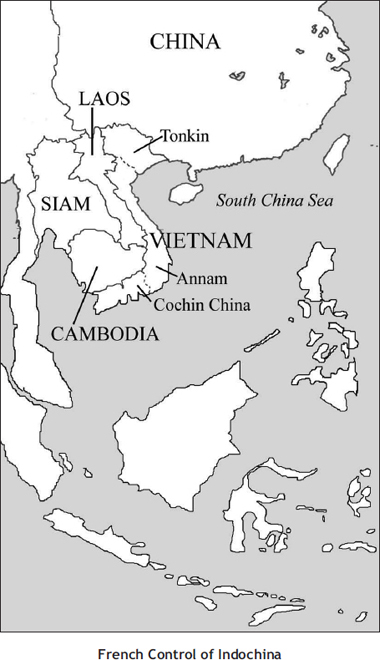
If you were to travel south, down from China, you would find yourself on a large peninsula that juts down from the Chinese mainland into the ocean. The northern edge of this peninsula touches China; the southern end of it almost touches the Dutch East Indies. Travel west from the peninsula, and you would go across the Indian Ocean and find yourself on the eastern shore of India. Sail due east from this peninsula, towards the rising sun, and you would make your way through another cluster of islands. If you kept on sailing, after many days you would see the western coast of the United States in front of you.
Because this peninsula lies close to both China and India, it was known as “Indochina.” Just as India had been taken over by Great Britain, and the East Indies by the Dutch, Indochina had been claimed by the French.
France, now ruled by the Third Republic, didn’t have much of an empire left. Long before the Third Republic, France had settled in Canada—but it had been forced to surrender those colonies to Great Britain. France had built trading posts in India—but had been forced out of India by the British East India Company.
But in Indochina, France had managed to hang onto a little empire of its own.
The left side of the peninsula, the country of Siam (which today we call Thailand), belonged partly to France and partly to Great Britain. But France claimed to rule all of the right side of Indochina—the lands that today are Vietnam, Laos, and Cambodia.
Along the eastern coast—the country of Vietnam—the French divided their territory into three colonies. They called the northern colony Tonkin. The middle colony was called Annam. And the colony the furthest to the south was known as Cochin China.
For a hundred years, the Nguyen dynasty of emperors had ruled in Vietnam. The French allowed the Nguyen emperor to stay on his throne. But the French, not the Nguyen emperor, made all of the decisions about Vietnam’s government. The French built railroads through the country and ports on its coast. The French owned rice plantations, groves of rubber trees, and coal mines. The Vietnamese worked in these plantations, groves, and mines—for very little pay. Almost all of the profit went to the French owners.
Under French rule, a very small group of rich Vietnamese who had allied themselves with the French overlords also made money from the plantations. But Vietnamese citizens, even wealthy ones, were not allowed to hold important jobs. It isn’t surprising that the Vietnamese wanted the French out of their country.
The very first revolutionary group that tried to fight for Vietnamese independence was led by a Vietnamese patriot named Phan Boi Chau. Phan Boi Chau was born in 1867. As he grew up, he saw the French gaining more and more power over his country. He hated the French occupiers. Because his family was rich, Phan Boi Chau was allowed to go to school, and was even offered a job in the Vietnamese government.
But this meant that Phan Boi Chau would be working for the French. He refused.
Instead, in 1903 he formed a group called the Restoration Society—in Vietnamese, Duy Tan Hoi. He convinced a Vietnamese prince from the Nguyen family to join the Restoration Society. But all of this rebellious activity was noticed by the French. Phan Boi Chau, afraid of arrest by French police, fled to Japan.
From Japan, Phan Boi Chau—like many other patriots in exile—wrote articles about the evils of French rule. He asked other Vietnamese patriots to come and join him in exile. He hoped that, one day, this group of exiles could attack the French.
But the Japanese didn’t want to anger France. So in 1908, they ordered Phan Boi Chau to leave Japan. Instead of returning to Vietnam, Phan Boi Chau went to China. He renamed his revolutionary group the “Vietnamese Restoration Society,” or Viet Nam Quang Phuc Hoi.
From China, the Vietnamese Restoration Society tried to organize rebellions against the French. But it was difficult for Phan Boi Chau to start a revolt while he was living in another country. None of the rebellions succeeded.
The Chinese noticed what Phan Boi Chau was doing, though. Like the Japanese, they didn’t want to anger the French. So in 1917, they arrested Phan Boi Chau and put him in jail. Before long, the Chinese agreed to set Phan Boi Chau free. But he had grown more and more discouraged by his long exile, and now by his imprisonment. He even wrote an article suggesting that, maybe, it would be better for the Vietnamese to try to get along with the French. He had begun to doubt that the Vietnamese would ever be able to get the French out of their country.
A few years later, Phan Boi Chau was in the Chinese city of Shanghai when French officials, visiting the city, recognized him. They ordered him to be arrested and taken back to Vietnam. There, Phan Boi Chau was tried for treason—and convicted. He was sentenced to spend the rest of his life in his house, guarded by French soldiers. He spent fifteen years under this “house arrest” before he died.
Phan Boi Chau had failed. But because of his work, other Vietnamese began to think more seriously about independence from France. Eventually, the seeds of revolution Phan Boi Chau planted would grow—and bloom. Because of this, Phan Boi Chau is remembered today as one of the greatest Vietnamese patriots.