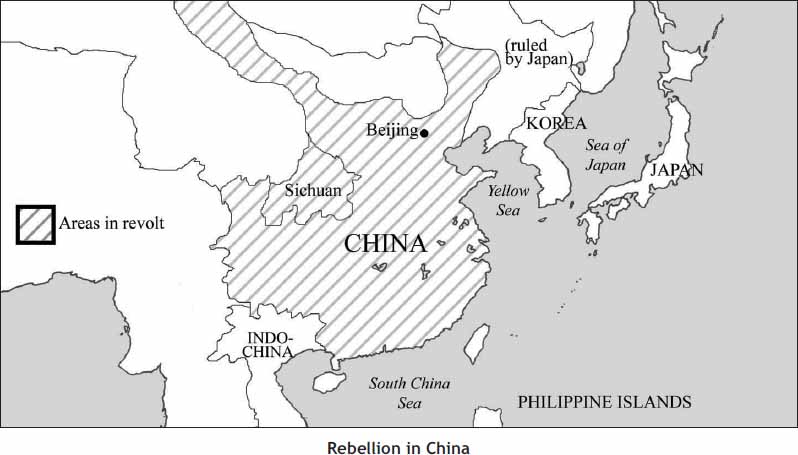
Russia had failed to extend its power over China. But the czar and his army would have better luck a little further to the west.
Just below the Caspian Sea lay the ancient empire of Persia, now shrunk down to the size of a small country. In an earlier chapter, we read about Persia’s attempts to invade Afghanistan. Persia and Russia made an alliance with each other, so that a Persian-Russian army could attack Afghanistan and bring it under Russian control. But when Great Britain threatened Persia, the Persian shah (king) decided that it would be wiser to withdraw and let the Russians and the British quarrel over Afghanistan.
Soon, the Russians and the British began to quarrel over Persia as well.
For years, the Russians had been trying to creep over Persia’s northern border and take away Persian land. Although the Persians fought back, they were forced to give some of their land to Russia. Meanwhile, the British tried to gain power in Persia too—not by fighting, but by diplomacy. Remember those polite messages that one country sends to another by way of an ambassador? Diplomacy looks courteous and well mannered, but usually one country agrees to the polite messages of another country only because both countries know that a war will start if it doesn’t.
Great Britain asked the shah, politely, to let British merchants sell and buy goods in Persia freely, and to let British citizens enter and leave Persia without any restrictions. The shah had to agree. He knew that British soldiers might invade unless Persia did as Great Britain asked, and Persia couldn’t fight both the Russians and the British.
Persia was trapped between these two great powers, Russia and Great Britain: powers that distrusted each other and were likely to fight. Persia also had to keep an eye on the Ottoman Empire, which lay on its western border. To the east lay the country of Afghanistan, which still hated Persia because Persian rulers had claimed to rule over Afghanistan for so many years. Persia was surrounded by enemies!
In 1896, the shah of Persia died. His son, the crown prince, Mozaffar od-Din Shah, inherited the throne of Persia. Mozaffar od-Din Shah was thirty-five years old, but he had very little idea about how to rule Persia. All his life, he had hated his father—and had spent as much time away from him as possible. So his father had never taught him how to run his country. And when Mozaffar od-Din became shah, Persia was not only surrounded by enemies, but was deep in debt. His father had spent far, far too much money!
In order to raise money for Persia, Mozaffar od-Din Shah sold permission to develop an oil field to an Englishman named William Knox D’Arcy. This permission meant that, in exchange for a large sum of money, D’Arcy could drill holes in the ground almost anywhere in Persia, looking for oil. Oil, or petroleum, is a thick liquid that burns quickly. It lies in huge pools beneath the earth’s surface, often under thick sheets of rock. Sometimes the pools are near the surface—but more often, they are hundreds of feet below the ground. To find oil, D’Arcy had to use a steel drill to dig down through the earth, hoping to find a pool (or reservoir) of oil. He might drill two hundred holes to find one reservoir. And if his drill finally went through rock into a pool of oil, the oil might explode out of the hole and spray into the air, like soda out of a soda bottle that’s been shaken up.
Besides selling permits to D’Arcy, Mozaffar od-Din Shah raised money by borrowing it from Russia and from Great Britain. He didn’t use this borrowed money wisely. Instead, he took three expensive trips through Europe, spent huge sums on decorating his palace and on lavish parties, and bought very expensive clothes and jewels for himself and his family. Meanwhile, Persia sank more deeply into debt.
The Persian people rebelled.
Like the people of many other countries, the Persians demanded a constitution. This constitution would put limits on what the shah could do, so that he couldn’t borrow or spend money without the approval of the Persian people. In the capital city of Persia, Tehran, armed rebels who wanted the shah to leave his throne set up their headquarters in a shrine. (Persian tradition said that the shah couldn’t send his soldiers into a shrine to arrest anyone who had taken refuge there, because a shrine was a religious building.) Other Persians rioted in the streets. Workers went on strike. Tehran was in chaos. By December of 1906, Mozaffar od-Din Shah realized that he would have to give in to the demands of the people.
The shah agreed to give Persia a constitution. He also agreed that Persia would have an assembly, like Parliament in England or Congress in the United States. This assembly, called the National Consultative Assembly or the “Majles,” would help rule the country. The constitution and the assembly would take much of the shah’s power away. Mozaffar od-Din Shah had been in poor health for some time. Now, he became so upset by the changes in his country that he had a heart attack and died.
After Mozaffar od-Din Shah’s death, both Russia and Great Britain claimed control over different parts of Persia. The British insisted that Great Britain had authority over the land along the Persian Gulf. The Russians announced that the northern part of Persia, close to the Russian border, was under their protection. And Russia also wanted to be able to send Russian ships to the Persian ports in the Caspian Sea. After all, Russia had lost Port Arthur, so its only port to the Pacific was still frozen every winter.
The new shah of Persia, Mohammad Ali Shah, had to figure out how to deal with these two empires who were quarrelling over his land. Unfortunately, Mohammad Ali Shah didn’t have much power to fight back. Persia owed Russia and Great Britain so much money that British and Russian banks had the right to print and issue Persia’s money. Even Persia’s banknotes came from the foreigners Mohammad Ali Shah wanted to get rid of! Worse, many of the commanding officers in the Persian army weren’t even Persian. They were British and Russian.
Mohammad Ali Shah thought that taking stronger control over his country might help him deal with the foreigners. So in 1908, he told his own personal band of bodyguards, the Persian Cossack Brigade, to dissolve the Majles. Mohammad Ali Shah intended to rule on his own.
But the Persian people were so angry over the shah’s actions that they drove him out of the country. Mohammad Ali Shah had to escape. He ran to Russia!
Mohammad Ali Shah left his eleven-year-old son Ahmad behind him. The young boy became the next shah, but because he was so young a regent ruled for him—along with the Majles, which re-formed as soon as Mohammad Ali Shah fled to Russia.
While Mohammad Ali Shah was running away, William D’Arcy was finally discovering oil. He had just drilled down into an enormous oil reservoir in the southwest of Persia. As soon as he found the oil, he sold his company to the British government and retired. Now the British government owned an oil company that had the official right to pump oil out of Persia’s land. This company, the Anglo-Persian Oil Company, could send this Persian oil back to Great Britain.
Why was oil so important to the British?
The British navy had two kinds of ships—ships with engines that burned coal, and ships with engines that burned oil. On a coal-burning ship, many of the sailors had to spend their time shoveling coal, which meant they couldn’t fight. An oil-burning ship, on the other hand, only needed a few men to run the engines. The rest of the men could be manning guns. Ships that ran on oil also could go faster, and had to refuel less often.
Great Britain’s ships were mostly coal-burning. But when the British government discovered that the Germans were building oil-burning ships, the British got worried. This new German navy would be stronger and faster than the British navy. Britain needed oil-burning ships too.
The future prime minister of England, Winston Churchill, knew that if Great Britain built oil-burning ships, the British Empire would have to find a good reliable source of oil. After all, Great Britain had “the finest supply of the best steam coal in the world, safe in our mines under our own land.” But Great Britain had no oil. “We must carry it by sea,” Churchill warned, “in peace or war from distant countries.” Unless Great Britain could gain control of a country where oil was found, the British oil-burning ships might end up sitting at anchor, empty of fuel.
Now that oil had been discovered in Persia, Great Britain had two reasons to take control of Persia. If the British controlled Persia, it would keep Russia’s power in the east from growing. And Great Britain would also be able to use Persian oil to fuel the British navy.
Meanwhile, the Majles (the Persian assembly) decided that it was time to ask for help from another country. It sent a message to the American president, William Taft, asking for the United States to lend Persia enough money to pay off both the British and the Russians. The president sent over a whole team of American bankers to figure out whether this could be done.
Great Britain wasn’t happy about the American bankers in Persia, but Russia was furious. Russia sent the Majles a diplomatic message: “Send those Americans home right away!”
The Majles ignored the message. So Russian soldiers marched down from Russia, over the border into Persia, towards the city of Tehran. As the soldiers got closer and closer, the American bankers fled the country. The Majles dissolved, and its members left Tehran. Now the young shah of Persia would rule—under the supervision of the czar of Russia.
Persia would stay under Russian control for another decade. But the Russians allowed the Anglo-Persian Oil Company to keep on piping oil out of the ground and shipping it out of the country. Eventually, the Anglo-Persian Oil Company, which became known as British Petroleum, would become one of the largest oil companies in the entire world.
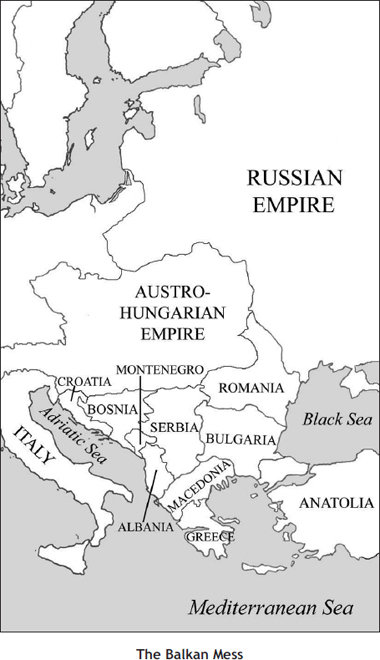
If you look at a map of the Mediterranean Sea, you’ll see the boot of Italy jutting down into the water. Just across a little stretch of sea, another peninsula also juts down into the Mediterranean, surrounded by little islands and laced through with rivers and inlets.
If you’ve studied ancient history, you know that the country of Greece sits on the south end of this peninsula. But the whole peninsula is not known as “Greece.” Instead, it is called “the Balkan Peninsula.” North of Greece lies a handful of other little countries called “the Balkans.”
Until the year 1878, much of the Balkan Peninsula belonged to the Ottoman Empire. If you look at your map again, you’ll see Macedonia (the homeland of Alexander the Great) just above Greece. The Ottoman Turks claimed Macedonia as theirs. Above Macedonia, Albania (also part of the Ottoman Empire) sits on the western side of the peninsula, with the tiny country of Montenegro just above it. For many years, Montenegro had managed to remain independent from Austria, the Ottomans, and the other powerful countries of Europe and the East.
Beside these two countries, in the middle of the peninsula, is the country of Serbia, which the Turks also ruled; and to the east, on the top of the peninsula, stretching overtop of the Aegean Sea, lies the country of Bulgaria. And just north of the peninsula, along the Adriatic Sea, are two more little countries: Bosnia and Croatia. Croatia had been folded into the eastern half of Austria, years before, but Bosnia belonged to the Turks. The Turks also ruled over the country of Romania, which lay above Bulgaria and just below the Russian border.
If you’re confused, don’t worry too much. Most people in Europe and the Americas didn’t really have a good idea of who was ruling what on the Balkan Peninsula! This little patchwork of countries kept getting claimed by the larger countries around them. But the Ottoman Empire claimed more of the Balkans than any other country.
After the war between the Turks and the Russians in 1878, the Ottoman Turks had lost some of their land on the Balkan Peninsula. If you think back to Chapter Nine, you’ll remember that the Russians marched down to attack the Ottomans in revenge for the sultan’s cruelty to Bulgaria. When the Russians won, the Ottoman Empire had to give Romania and most of Asia Minor (called “Anatolia” at that time) to Russia. It also had to agree to give Bulgaria its freedom.
This arrangement made the rest of Europe nervous. It made Russia much larger, and it also turned Bulgaria into a big independent country that would always be a loyal ally of the Russians. Russia was getting far too powerful.
So the great powers of Europe—France, Germany, Great Britain, and Austria—told Russia that it could keep Romania, but it had to give Anatolia back to the Turks. They also decided that since Bulgaria would always fight on Russia’s side in any war, Bulgaria would have to be smaller. So they forced the newly freed Bulgarians to give the whole southern part of their new country back to the Turks as well. The new, much smaller country of Bulgaria would be ruled by a Russian prince named Alexander of Battenberg, the nephew of the Russian czar.
The Bulgarians in the south of country—the part that had been given back to the Turks—were furious. They didn’t want to be part of the Ottoman Empire. They wanted to be free to join the north.
Together, the northern and southern parts of Bulgaria decided to reunite. The Ottoman Turks, worn out by war, didn’t try to stop them. But Russia became angry over this decision, because Alexander of Battenberg and the northern Bulgarians hadn’t asked Russia for permission. All Russian army officers in Bulgaria and all Russian diplomats were ordered to come home.
Now that Bulgaria was no longer friendly with Russia, the rest of Europe wasn’t quite so worried about it. Bulgaria was allowed to stay one country.
Now the Balkan Peninsula had changed. Bulgaria was independent, and no longer an ally of Russia. The Ottoman Empire still controlled Anatolia (Asia Minor). Montenegro was still free. Serbia, which had been part of the Ottoman Empire, was set free as well. Austria took Bosnia for itself (so now Bosnia and Croatia were both part of Austria). The Ottomans got to keep Albania and Macedonia.
Just a couple of years later, Macedonia tried to break free from the Ottoman Turks. On August 2, 1903, Macedonian rebels joined together in the city of Krusevo and declared themselves independent of Turkish rule. This became known as the St. Elijah’s Day Uprising.
Apparently the Turks hadn’t learned anything from the Bulgarian rebellion. When the Bulgarians had revolted, the Turks had killed thousands—and had brought a devastating war down on themselves. But when the Macedonians revolted, the Turks did exactly the same thing. The sultan Abdulhamid ordered Turkish soldiers to march into Macedonia and kill the rebels.
This violence disgusted many Ottoman Turks—and gave the Young Turks a chance to finally get rid of the sultan. Remember, the Young Turks had already tried to start a rebellion against Abdulhamid. They had been forced to flee from their country, but they had gathered together in other cities, such as Geneva and Paris. In these cities, exiled Turks had been planning a takeover of their own country.
Now Abdulhamid had grown unpopular not just with his people, but with the Ottoman army. The Young Turks convinced the army to join them in demanding that Abdulhamid bring back the Turkish constitution. Faced with his own soldiers, Abdulhamid had to agree. He also had to reassemble the Turkish parliament. And then he left the country.
The Young Turks, now in power, issued a “Proclamation for the Ottoman Empire.” The government, they announced, would now obey the “predominance of the national will.” In other words, it would do what the people wanted. All Ottomans older than twenty would be allowed to vote. All Ottomans, whether Christians or Muslims, would have the same rights. And the Young Turks had even bigger plans for the Ottoman Empire. They wanted to get rid of the Islamic laws (laws based on the Muslim religion) that had always been part of the empire’s government. Instead, they wanted to have secular laws (laws not based on any particular religion). They sent messengers to other European countries, asking for advice about how to make Turkish farms and factories more modern. They tried to force everyone in the empire to speak Turkish. They hoped that in this new “Ottoman nation,” everyone—whether Christian or Muslim—would follow the same laws, speak the same language, and be loyal to the same government.
This didn’t work very well.
Macedonia and Albania, where most of the people were Christians, still didn’t want to be part of the Ottoman Empire, even if it claimed to be an “Ottoman nation” where Christians and Muslims were treated the same. But even though the Young Turks claimed that their government was ready to listen to the wishes of the people, when the people wanted to be independent, the Young Turks stopped listening. They were ready to send the Turkish army to keep the Ottoman nation together by force.
It became clear to the people of the Balkan Peninsula that the Young Turks were not going to allow them to leave the empire any more than the sultan had. So after only four years of Young Turk rule, the Balkan countries began to fight for their independence. Serbia, Bulgaria, Greece and Montenegro joined together, with the help of the Russian government, and tried to free Macedonia from Turkish rule. Together, the countries managed to put together an army of seven hundred and fifty thousand men to march against the Turks.
This “First Balkan War” began in 1912. In less than two months, the weak, disorganized Ottoman army realized that it would have to surrender the rest of its Balkan land.
Albania was finally independent. A prince descended from a good German family became the head of the Albanian government, and the countries of Europe agreed to recognize Albania as a free nation.
But Macedonia never did get its freedom. Instead, the “Second Balkan War” began between Serbia, Bulgaria, and Greece. These three countries, which had been allies against the Turks, started to argue with each other about how they would divide up Macedonia. In 1913, Bulgarian soldiers attacked their own allies, trying to take away a larger part of Macedonia by force.
The attack failed. Greece and Serbia divided Macedonia up between themselves. Bulgaria only got a tiny bit of land.
Now all of the Balkans were free of the Ottoman Turks. But the countries on the Balkan Peninsula were furious with each other. Bulgaria began to make an alliance with the country of Austria, in order to increase its own power. Serbia, which had been attacked by Bulgaria over the division of Macedonia, grew more and more hostile to Bulgaria—and to Austria, Bulgaria’s new friend.
On June 28, 1914, a Serbian would show how much Serbia hated both Bulgaria and Austria. He would kill the heir to the throne of Austria. But this wouldn’t begin a “Third Balkan War.” Instead, it would start the first World War.