Imagine that you and your family live in Pennsylvania, in the eastern United States, not long before the Spanish-American War. You’ve always lived in Pennsylvania. It’s the only home you know. But your father is having trouble finding work, and your parents have heard that out in the vast western territories of the United States, settlers can begin a new life.
So they decide to pack up and head out to Oregon, all the way on the other side of North America.
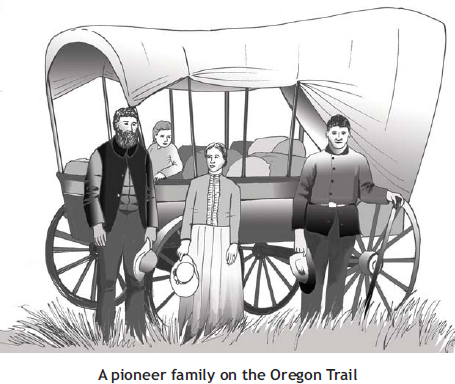
You’ll travel to Oregon in a wagon pulled by oxen. Horses can’t live on the prairie grass out west, but oxen can. That way, you won’t have to take as much food for the animals. Most of the wagon will be filled with food for your family instead. In order for you, your parents, and your older brother to reach Oregon safely, you’ll need to take a thousand pounds of food with you—more than will fit in the back of a large pick-up truck today.
If you’re like most families heading to Oregon, you’ll soon discover that you’ve brought too much stuff. The more belongings you pack into your wagon, the heavier the wagon is, and the slower your oxen walk. As you ride along, you see that the families travelling ahead of you have begun to toss things out of the wagons as they go: clothes, toys, books, pieces of furniture, even cast-iron stoves.
So many families took the wagon route to Oregon to begin a new life that the path west became known as the Oregon Trail. Today, you can still see marks in the ground where thousands of wagon wheels rattled through the trail. The trip was hard. In large families, not everyone could fit into the wagon, so family members took turns walking beside the oxen. Often, they walked barefoot, on scraped and blistered feet, in the rain. Some pioneers (people travelling west in the 1800s) died when they were struck by lightning! Others got bruised by giant pieces of hail, the size of grapefruits. Many got sick. If they caught the mysterious, deadly illness called cholera, they might die in just a few short hours. Their families would bury the dead by the side of the trail—and move on.
Every night, the pioneers camped by the side of the trail. Every morning, they got up before sunrise and made a fire. Without a fire, there would be no hot breakfast. But by the time the wagons reached the vast western plains, there were few trees and branches to make a fire with. Sometimes, pioneers might find a chair or table that another wagon had tossed out, and build a fire with the furniture. But more often, they had to collect dried buffalo dung, which the settlers called “buffalo chips.” The dung burned almost as well as wood.
Sometimes even buffalo chips couldn’t be found. Then, settlers ate their food raw. A minister named Samuel Parker, who followed the Oregon Trail out west, wrote, “Dry bread and bacon consisted our breakfast, dinner and supper. The bacon we cooked when we could obtain wood for fire; but when nothing but green grass could be seen, we ate our bacon without cooking.”
The trip out west took six months. But despite the long, hard journey, thousands and thousands of Americans decided to take the Oregon Trail. The eastern cities and states, from Atlanta, Georgia, to Boston, Massachusetts, were filling up. In many cities, it was hard for workers to find jobs. And in the countryside, it was hard for young farmers to find land to buy. People from Boston, New York, Philadelphia, Richmond, Charleston and a dozen other cities began to move west.
The U.S. government wanted these American settlers to claim the west for the United States. So, as people went west, government officials went with them and divided the huge western lands into areas called territories. When sixty thousand people had settled down in a particular territory, they could send a message to Congress and ask that their territory become a state. Once a territory became a state, the settlers who lived there could elect representatives to Congress and have a voice in their own government. After Texas (which had been claimed by the United States from the Spanish), the first western territory to become a state was Iowa, in 1846—long before the Civil War! The last was Arizona, which became a state in February of 1912.
But there was a problem. The western territories to which the settlers were travelling weren’t empty. Native Americans, nicknamed “Indians,” had been living there for centuries. As a matter of fact, many of the names of western states and towns come from Indian words. “Nebraska,” for example, comes from a word used by the Oto tribe, meaning “flat water.” “Minnesota” comes from a word used by the Dakota tribe that means “sky-tinted water.”
At first, Native Americans were mostly friendly to the settlers. But as more and more pioneers arrived, the Native Americans began to see that this huge invasion would deprive them of their land. They began to defend their villages and their hunting grounds against the newcomers.
In response, the U.S. government sent an army—soldiers with guns to fight against the Native American tribes with their horses, bows and arrows. Skirmishes and battles were fought all over the west. But the sheer size of the U.S. army eventually drove the Native Americans out of the lands where they had always lived. Instead, the United States marked off certain areas of land called “reservations” and told the Native American tribes that they could only live in these “reserved places.”
Even after the reservations were set up, Native Americans continued to resist. In the territory that is now Montana, the Native American leader Crazy Horse, head of the Lakota “Indians,” refused to allow his people to be driven into the reservations. Instead, he called his warriors to join him near the Little Bighorn River and fight back. The U.S. soldiers who were sent to attack Crazy Horse and his men were commanded by a famous soldier named George Custer. Custer had fought in the Civil War. He was the youngest man to ever be made a general in the United States Army. But he had fewer than seven hundred men under his command—and he did not know that almost four thousand Native American warriors had answered Crazy Horse’s call. When Custer led his men into the Battle of Little Bighorn, he was killed, along with hundreds of his men.
Another famous Native American warrior, an Apache chief named Geronimo, actually led a band of Apaches in an escape from their reservation. “I was born on the prairies where the wind blew free and there was nothing to break the light of the sun,” he told his followers. “I was born where there were no enclosures.” Instead of accepting imprisonment on a reservation, Geronimo and his band broke out. For a whole year, they fought a guerilla war against the U.S. soldiers in the territories that now belong to the states of New Mexico and Arizona. But finally Geronimo was taken prisoner. He died twenty-three years later without ever returning to his home.
The western part of the United States no longer belonged to the Native Americans. Instead, the new western states became home not only to Americans from the east, but also to people who came from all over the world. People from Sweden moved to North and South Dakota. People from Ireland moved to Montana. People from China came to California.
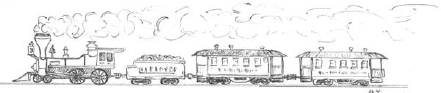
America was now a huge country, spreading over a vast continent. Farmers and cattle ranchers who raised grain and cows on the western plains needed a way to get their wheat, corn, and meat to hungry city-dwellers in the East. So American businessmen built large railroads. Soon, the railroad tracks crossed the continent. The buffalo that had once roamed through the plains began to disappear. Western settlers killed thousands of them—sometimes shooting buffalo from railroad cars as the trains puffed by the herds. Buffalo Bill Cody, a famous outlaw and soldier, earned his nickname because he shot more than four thousand buffalo in a little over a year. The buffalo became an endangered species—a kind of animal that is in danger of disappearing from the earth.
The American West had changed forever.
Imagine for a minute that you are very, very good at making chocolate candy. Every morning you get up and start work. You mix cocoa powder, sugar, butter, and milk. You stir the mixture over the stove until it is thick and creamy. Then you pour the warm chocolate mixture into candy molds. You add marshmallow centers to some of the candies, peanuts to others, butterscotch pieces to yet another tray. When the candies cool, you dip some of them in a white chocolate coating, and drizzle caramel over others. Then you take your chocolate candies out in a tray and walk through your neighborhood, shouting, “Candy for sale!” Your neighbors come out and buy the candies for twenty-five cents each. When all the candy is gone, you walk home, counting your money. You have enough money to buy ingredients for the next day’s candy—and enough extra to buy yourself food for the day and a new pair of shoes.
Now imagine that someone else builds a chocolate factory down the street. Ten workers measure and dump the ingredients into ten vats, where machines stir until the chocolate is thick. The vats dump the chocolate out into molds, where ten more workers add peanuts, marshmallows, and butterscotch pieces. As soon as the chocolate cools, the molds turn over automatically and the chocolates fall out onto a conveyor belt. Two more factory workers pick the broken chocolates out, and put the others into fancy boxes.
The factory owner makes so many chocolates that he can buy huge amounts of cocoa, sugar, butter, and milk. Because he buys huge amounts, he gets a special deal and pays less for each ingredient than you do. And because machines do some of the work, he can make many more chocolates than you can, without having to pay too many helpers. As a matter of fact, his factory makes so many chocolate candies that he can sell them for ten cents each and still make a profit.
When you walk down the road with your candies, you find out that all of your neighbors have already bought cheap candy from the factory. You can’t sell a single piece of chocolate! And if you lower your price to ten cents a piece, you won’t make enough money to buy food and shoes for yourself.
What can you do?
You give up your chocolate making and go work in the factory. All day long, you add peanuts to candies. No matter how many candies you fill with peanuts, you earn the same amount of money for every hour that you work. By the end of the year, the factory has made seven thousand dollars in profit. But all of the profit for making extra candy goes to the factory owner, not to you!
But then something else happens.
The factory owner thinks to himself, “If I could buy ten more vats and ten more conveyer belts, I could make even more candy. It would cost me three thousand dollars. But as soon as the vats and conveyer belts were working, I could make so much more candy that I would soon earn back much more than three thousand dollars in extra profit! Where can I get three thousand dollars?”
The factory owner decides to go talk to three rich friends. He tells the rich friends that if each one of them will give him a thousand dollars, he will give them one-tenth of the factory in exchange. Of course, he can’t chop off one-tenth of his factory! But he offers to give each friend one-tenth of the factory’s profit at the end of the year.
The three friends agree. Each hands over a thousand dollars. At the end of the year, the factory has made fifteen thousand dollars in profit! Each friend gets one tenth of this—fifteen hundred dollars. The factory owner gets $10,500. He’s richer because the factory is bigger—and his friends have gotten fifteen hundred dollars in exchange for the thousand dollars they invested at the beginning of the year.
Everyone is happy!
Except, maybe, for you. You’re still making exactly the same salary as you did back when the factory only made seven thousand dollars in profit.
This is what began to happen in the United States as the year 1900 approached. Two hundred years before, most people made money by working in their homes and selling what they made. But when factories came along, they made the same goods—lace, cloth, plows, hammers, bread—more cheaply than home workers could. The home workers were forced out of business and had to go work in the factories.
Then the factory owners wanted more machines, more workers, and bigger buildings. So they asked rich men, called “investors,” to give them money to make improvements in exchange for part of the profits at the end of the year. This share in the profits was called “stock,” and the rich men became “stockholders.”
In our story, the rich friends who gave the chocolate-factory owner money each “bought stock” in the factory. Because they were now “stockholders,” they got part of the profits at the end of the year. And the chocolate factory was no longer a business owned by a single businessman. It was a “corporation”—a business in which more than one person had the right to share in the profits.
The practice of “buying stock” grew more and more common. An investor could make a tremendous amount of money, if he were both smart and lucky. If he spent $100 buying stock in a business that was about to make a huge amount of money, he might get back $1,000 at the end of the year. But if he invested $100 in a business that wasn’t very well run, he might only get $10 from the tiny profits at the year’s end. He would lose $90 instead of making $900!
Stockholders who owned part of the profits in six or seven different businesses could become incredibly wealthy. Some of these rich stockholders used their money to buy yachts, marble bathrooms with gold faucets, and diamond necklaces. But others believed that it was important for those who had profited from buying stock (the “stock market”) to give money to those who were less wealthy.
One of the most famous of these rich men was named Andrew Carnegie. Andrew Carnegie was born in Scotland, but his parents brought him to settle in Pennsylvania when he was thirteen years old. Andrew started working in a cotton factory right away! But he was determined to become more than a factory hand. He went to night school and worked hard at every job he had. By the time he was in his thirties, Andrew Carnegie owned the largest steel company in the United States. In the year 1900, the Carnegie Steel Company made forty million dollars in profit. And since Andrew Carnegie owned more stock in the company than anyone else, he got over half of the profit—twenty five million dollars for one year’s salary!
Andrew Carnegie believed that he should give away as much of this money as possible. He wrote that it was actually good for society for some men to become unbelievably wealthy—because then they could do good for others. “This, then, is held to be the duty of the man of Wealth,” he wrote, “ … [to become] sole agent and trustee for his poorer brethren, bringing to their service his superior wisdom, experience, and ability to administer—doing for them better than they would or could do for themselves.”
In other words, Carnegie believed that an average man who got rich would just squander his money. But a man who was smart enough to earn enormous wealth was also smart enough to use that money for the good of mankind. So it was really much better for the country that some people were poor (because that meant they really didn’t have the ability to spend money wisely anyway). The very rich would spend that money on their behalf!
Andrew Carnegie practiced what he preached. He gave away 350 million dollars for college scholarships, libraries, scientific research, and many other good causes. He made a name for himself as a philanthropist (a person who gives away money for the good of others).
But this did not make him popular with everyone. Many people objected to Andrew Carnegie’s idea that the poor have less wisdom and ability than the rich. Others pointed out that Andrew Carnegie was rich only because he had spent years and years paying the men and women who worked in his steel factories a tiny salary—while he took most of the profit at the end of the year. Carnegie, they claimed, was no better than an outlaw. Like many wealthy stockholders, Andrew Carnegie had stolen the work of others and taken it for himself.