While the Boers and the British were fighting in South Africa, the South American country of Brazil was kicking out its emperor.
Brazil had been ruled by only two emperors in its short history. The first emperor of Brazil, Pedro I, was the son of the king of Portugal. When Pedro was a little boy, Brazil wasn’t even a country. It was a Portuguese colony.
Pedro grew up in the colony of Brazil. When he was twenty-three, his father (the king of Portugal) gave him the job of governing Brazil. A year later, Pedro led Brazil in declaring independence from Portugal—and from his father. He became Pedro I, the first emperor of an independent Brazil.
The new country of Brazil was filled with rich slave-holders, powerful plantation owners, Portuguese noblemen, ambitious military officers, and politicians who wanted more power for themselves and less for the emperor. No matter what Pedro did, someone criticized him. Pedro I managed to rule this restless country for only nine years before riots broke out in the streets of Brazil’s capital city, Rio de Janeiro. Unhappy Brazilians yelled that Pedro I was still too loyal to Portugal, and that he wasn’t giving his people enough freedom. Pedro I collected his money, his belongings, and most of his family, caught a British warship in the port, and sailed away. Brazilians said afterwards that Pedro I had left only one silver spoon in the whole palace!
But Pedro I had left more than a silver spoon behind. He had left his ministers of state—and also his five-year-old son. The little boy had a name bigger than he was: Pedro de Alcontâra Joso Carlos Leopoldo Salvador Bibiano Francisco Xavier de Paula Leoc dio Miguel Rafael Gabriel Gonzaga, By the Grace of God and Unanimous Acclamation of the People, Constitutional Emperor and Perpetual Defender of Brazil. For short, Pedro II.
At five, Pedro II wasn’t exactly ready to be the Constitutional Emperor and Perpetual Defender of Brazil. So three of his father’s ministers formed a committee to help him rule until he was older. They made sure that he was properly looked after and educated. Little Pedro II worked hard at his studies. He learned French, Hebrew, Arabic, and other languages. He loved to read and write. And he was particularly fond of studying science.
In 1841, at the age of fifteen, Pedro II took control of his country.
Like his father, Pedro II found that Brazil was a very difficult country to rule. Brazil had five different kinds of people living in it. Most of the land and most of the money was owned by families who were descended from Portuguese settlers. The South American Indian tribes who had lived in Brazil before the Portuguese arrived had lost most of their land; most of them worked as poor laborers for the rich Portuguese. And because slavery was still legal in Brazil, the hardest work was done by thousands of African slaves.
These three groups of people had been joined by a fourth group: immigrants from Europe. Poor Europeans had been coming to the New World for years, looking for a better life. Many of them went to North America and settled in the United States. But many others went to South America. German, Italian, and Polish settlers had moved into Brazil and settled down—and more were coming every year.
After the American Civil War ended, a fifth group of settlers arrived in Brazil—American cotton planters who had lost their plantations. They travelled down from the American South to try their luck at growing cotton in Brazil. Even today, you can still visit the town of Americana in Brazil. Americana was founded by an Alabama cotton planter who took his family down to Brazil to start a new life. Today, you can find Brazilians in Americana who have American last names like Norris and Jones. In June, they have a huge festival called Junino in which a Brazilian band plays Brazilian music with Southern banjos, while young Brazilian men and women square dance.
Pedro II believed that Brazil could only prosper if all five groups of people had the opportunity to work, to earn a good living, and to get an education. He encouraged Brazilian companies to build modern factories and railroads. He started new schools. He begged skilled workers from other countries to come and settle in Brazil. He travelled to other European countries to see their scientific inventions and their factories. He even came to the United States. In Philadelphia, he went to see the new telephone invented by Alexander Graham Bell. When Bell invited him to use the telephone, Pedro II picked up the receiver and said into the mouthpiece, “To be, or not to be.” He was probably the first citizen of Brazil to ever use a telephone! He was so pleased with the new invention that, when he went home, he had a telephone put into his summer house.
But most importantly of all, Pedro II set out to get rid of slavery.
Pedro’s father had hated slavery, calling it a “cancer” on Brazil. Pedro II was a great admirer of the American president Abraham Lincoln, and he agreed with Pedro I. Slavery would have to go.
But many of the powerful plantation owners in Brazil used slaves to run their farms and harvest their crops. They weren’t willing to give up their free help. Pedro II had to get rid of slavery very slowly. Nine years into his reign, Pedro II and his government made slave trade to Brazil illegal, so that no more slaves could be brought to Brazil from Africa. Twenty-one years later, the Brazilian government began to declare the slaves of Brazil free. Seventeen years after that, in the year 1888, Pedro’s government signed a law making slavery illegal.
By 1888, Pedro II had been the emperor of Brazil for forty-seven long years. During most of his reign, he had been a popular ruler. The people of Brazil were more prosperous than when he had first taken the throne. Pedro’s new schools had also done their job. More men and women had learned how to read and write in Brazil than in any other country.
But now more and more Brazilians began to complain about their emperor. The plantation owners didn’t like giving up their slaves. The soldiers in the Brazilian army thought that they weren’t being paid enough. And the prosperous farmers, merchants, and shopkeepers of Brazil had begun to believe that no modern country should have a king. Instead, Brazil should be a republic, with a constitution of its own.
In 1889, the year after slavery was made illegal, Pedro II realized that he would not be able to keep his throne any longer. He was now sixty-two years old. He had spent his life working to make Brazil a rich, free, well-educated, modern country—a modern country that no longer wanted to be ruled by an old-fashioned emperor.
Late one evening, Pedro II called his Council of State together. He told them that he was going to bed. In the morning, he wanted to hear their final decision: Should he stay in Brazil, and keep his crown?
When Pedro got up the next morning, the Council of State had made up its mind. It was time for Brazil to become a republic. The emperor and his family should leave the country, but they could have twenty-four hours to get their possessions together.
“I am leaving,” Pedro II answered, “and I am leaving now.” Immediately he collected his family and sailed away from Brazil, heading for the city of Paris.
Two years later, the old emperor caught the flu. He died a few days before Christmas, in the year 1891. Brazil had just finished writing its new constitution when Pedro II was buried in Portugal.
In 1971, Pedro II’s body was brought back to Brazil and buried in a place of honor. Brazil was finally ready to praise the second emperor for all of the years he had spent serving his country. He had become a Brazilian hero—even though the age of emperors was gone.
The last time we visited the Ottoman Empire, in the year 1878, the sultan Abdulhamid II sat on the throne. The empire had just lost over half its territory. The officials who were supposed to run the empire were more interested in living comfortable, luxurious lives than in doing their jobs. Once the most powerful empire in the East, the Ottoman Empire was now known as the “Sick Man of Europe.”
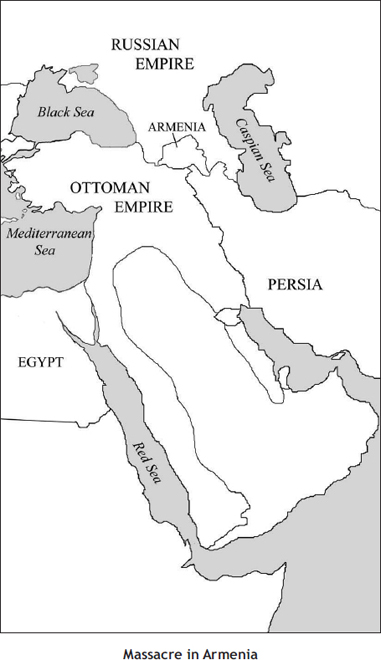
Although it was sick, the Ottoman Empire still covered all of Asia Minor, stretched over the ancient land of Mesopotamia and down along the Persian Gulf, and controlled the entire eastern coast of the Red Sea. It was still an empire, and Abdulhamid II wanted to make it a great empire once more.
But Abdulhamid had a problem. With half of his mind, he agreed with the new, modern ideas about the people of a country having the right to rule themselves. But with the other half of his mind, he liked the idea of the sultan as the unquestioned ruler of the Ottoman Empire, a powerful man who could decree what the empire would do—without opposition.
When we read about Abdulhamid before, we read about his willingness to allow the Turks to have a constitution and an assembly like a Western parliament. But the Turkish constitution did not last very long. There were two problems with the constitution. First, Abdulhamid insisted that the constitution include a paragraph called “Article 113.” This said that the sultan could deport (send out of the empire) anyone he thought “harmful to the state.” This meant that Abdulhamid could send anyone who disagreed with him to another country and forbid him from coming back. Second, for centuries, the Ottoman sultan had been honored and obeyed as the ultimate power on earth. Even though many Ottoman Turks wanted a more Western government, when their Sultan made a decree, it was very hard for them to ignore it!
The Ottoman constitution lasted for exactly one year. Then Abdulhamid ordered it dissolved. Now he would rule like an old-fashioned sultan, with no constitution or parliament to limit his power.
At first, Abdulhamid used his old-fashioned power to make many Western-style improvements to the empire. He ordered railroads laid down, and had lines strung so that the Ottomans could use the new Western invention, the telegraph. He improved the great university of Istanbul. He changed some of the laws of the empire to make them more modern.
But Abdulhamid also ruled with an iron fist. He organized a huge spy network that listened for any talk of rebellion or revolt; anyone who criticized the sultan could expect a visit from the dreaded secret police. He ordered his soldiers to march in and attack rebels against the sultan in several different places within the Empire—particularly to the east.
One of these rebellions broke out in the country of Armenia.
Armenia lay up north of Asia Minor, between the Caspian Sea and the Black Sea, just south of the Russian border. Several hundred years before, the country of Armenia had been captured and divided between the Ottoman Empire and the Persian Empire. Then the Russians took away the Persian section of the country. That meant that people who called themselves Armenians lived partly under Russian rule, and partly under the rule of the Ottoman sultan. But the Armenians who lived in the Ottoman Empire were not always treated well. They were Christians, not Muslims. The laws of the Ottoman Empire meant that they had to pay more taxes than Muslims. They didn’t have the same rights as Muslims. And the Ottoman officials in charge of Armenia often treated Armenians badly, driving them from their homes and seizing their land. The Armenians hated this treatment. In 1894, they picked up weapons to fight back.
Russia wanted Abdulhamid to respond to the rebellion by giving the Armenians better protection and more rights. But Abdulhamid didn’t like Russia telling him what to do. He believed that Russia was scheming with Great Britain and other European countries to encourage rebellions against him. The countries of Europe, he fumed, had already managed to “cut off the feet and hands” of the Ottoman Empire. Now, if they encouraged the rebellion in Armenia, they would “cut out the country’s insides.”
He wasn’t about to let this happen.
So Abdulhamid sent his soldiers into Armenia and ordered them to fight against the rebels. He also ordered them to put an end to the revolt by killing Armenians not just in Armenia, but wherever they were, all through the empire. In his mind, Armenians were traitors. They were more likely to be loyal to Russia than to the Turks. Their disloyalty was like an illness that would infect the rest of the Ottoman Empire.
Many Armenians were killed by Abdulhamid’s soldiers. Others were forced to march out of the Turkish territory, and died of starvation and weariness on the long walk. The killing went on for three years. No one knows exactly how many Armenians were killed, but at least a hundred thousand men, women, and children died.
Abdulhamid had not learned from the fate of Abdul Aziz! Once again, he made the countries of Europe certain that the Turks were savages, unwilling to enter into the modern age. A few years before, the British ambassador had praised Abdulhamid for his “kindliness of disposition and enlightened views.” No one in Great Britain would agree with that now!
Abdulhamid had agreed with some Western views—but the Armenian massacre made it very clear that he still held onto the ideas of the past. He was determined to keep hold of his territory, and to rule it with absolute authority.
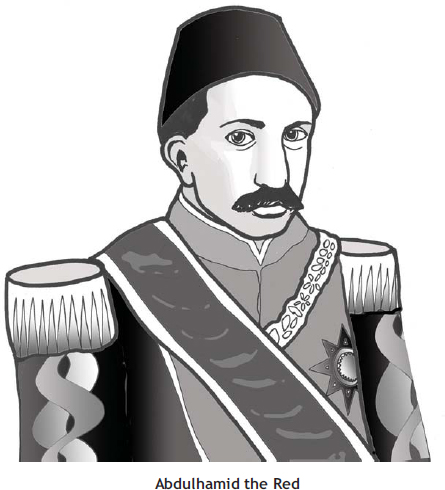
Although he wanted to keep the Sick Man of Europe from getting any sicker, his harsh methods not only made the empire sicker, but came close to killing it. Abdulhamid’s iron fist and his reliance on fear and spying to keep his power had already made him unpopular with Turks who wanted their country to be more modern—particularly with university students who were learning about the ideas of the West. And when Abdulhamid ordered the Armenian massacre, he became even more unpopular with these forward thinkers. Many Turks called Abdulhamid “Abdulhamid the Red,” because he had shed so much blood.
In 1889, medical students began to form a plot to get rid of Abdulhamid. They wanted to change the laws of the Ottoman Empire so that, instead of being a country under the power of an Islamic sultan who ruled by Muslim law, the empire of the Ottoman Turks would instead become a country called “Turkey.” This country would be ruled by secular laws (laws not based in religious belief). The people of Turkey would be loyal to their country, not a sultan. Their slogan was “Liberty, Justice, Equality, Fraternity”—ideas they had learned from the French and American revolutions. Soon, they recruited other students at Istanbul University and other colleges to join them. They called themselves the “Committee of Union and Progress.” But others called them the “Young Turks.”
Abdulhamid wasn’t going to put up with the revolt of the Young Turks any more than he had put up with the rebellion in Armenia. Soon, his secret police were planning to arrest the leaders of the movement. The leaders of the Young Turks had to flee from their country.
But they went to Geneva and Paris, cities where other Ottoman Turks who had been exiled from their country by Article 113 lived. They organized the Turks who no longer lived in the Ottoman Empire into a movement that wanted to change the empire—and get rid of Abdulhamid, the Red Sultan.