On a stifling hot June evening, five men were putting on home-made armor. They buckled on breastplates made from plow parts, and pulled on helmets made from buckets with holes cut for eyes. They looked as though they were pretending to be knights in armor for a costume party.
But the five men weren’t getting ready for a party. They were about to fight a desperate battle with the Australian police. At the end of it, four of them would be dead—and one would be dragged away to be hanged for murder.
Australia was part of the British Empire. But in those days, people in Great Britain thought of Australia as the bottom of the world—so far away that most of them would never visit it. And many of the people who lived in Australia were either condemned criminals or the children of criminals. Decades earlier, Great Britain had decided that British prisons were too crowded for any more prisoners. Instead, the British prisoners were put onto ships and sent far, far southeast, to the continent of Australia. There, watched over by British guards and British governors, the prisoners planted fields, built houses, and grew food.
At first, the prisoners struggled to survive under the scorching Australian sun. But as time went on, they learned what crops would grow in the cracked, dry ground. Many earned their freedom, settled down on land of their own, and raised families. Free men and women sailed from Great Britain to join them. In England, a poor man had no chance to grow rich. But in Australia, he might be able to own a farm of his own.
When gold was discovered in Australia, thousands of gold miners came from all over the world to dig in the red Australian earth. Many of the miners grew even poorer as they desperately searched for gold, but others found unbelievable wealth. They loaded gold nuggets into their shotguns and fired them off for fun. They sprinkled gold dust in their Christmas dinners! One gold nugget dug up in Victoria weighed a hundred and fifty pounds—as much as a man.
Two years after the gold rush began, the British government decided that it would no longer send convicts to Australia. Australia was growing richer—and stronger. Instead, the settlements of Australia would become regular British colonies.
But the Australian colonies were filled with trouble. Rich men with gold and power took the best land of Australia and pastured their sheep on it. Poor working farmers often had to survive on tiny, dry patches of ground. And many Australians believed that government officials and policemen didn’t care about the rights of the poorest sheep-farmers and cattle-herders.
Desperate men hid along the roads, holding up the wagons that took gold from the mines into the towns. Some of these bandits, called “bushrangers,” became as famous in Australia as Robin Hood was in England. Martin Cash was called the Gentleman Bushranger because he was so polite to the men he robbed at gunpoint. “Captain Thunderbolt” stole money from inns. “Captain Moonlite” robbed banks.
But the most famous bushranger of all was Ned Kelly.
Ned Kelly’s father was a prisoner who had served his time and earned his freedom. But when Ned was eleven, his father died. His mother Ellen had to raise her seven children and farm eighty acres of wild Australian land alone.
Ned Kelly started getting in trouble at a very young age. But it isn’t always clear whether he had really done all of the things the police accused him of. When he was only fourteen, he was arrested for robbing a traveller, but there wasn’t enough evidence to convict him. A year later, he was arrested again for helping a bushranger. This time, he was sent to jail for six months. Just a few weeks after he was released from jail, he was arrested again—this time, for accepting a stolen horse from a friend. Ned protested, “I didn’t know the horse was stolen!” But the judge sent him back to jail, this time for three years.
Not too long after Ned Kelly got back out of jail, a policeman arrived at the Kelly farm late one warm afternoon. The policeman announced that he was there to arrest Ned’s little brother, Dan, for stealing horses.
Nobody knows exactly what happened next. The policeman went back to the police station and said that Ned had shot at him, and that Ned’s mother Ellen had attacked him with a shovel. But neighbors of the Kellys said that Ned was miles away at the time. And Ellen Kelly said that she hadn’t attacked the policeman with a shovel at all. In fact, she had offered to feed him dinner!
But the police decided to arrest Ned and Dan Kelly and charge them with attempted murder. The two boys ran away from home and hid in the wild bush lands of Australia. So the police arrested Ellen Kelly instead—and sent her to jail for three years.
Ned Kelly, out in the bush, was furious. He believed that poor farmers such as himself could never be treated fairly by the police. He believed that the government would always be on the side of the rich.
When a band of four policemen came after Ned and Dan Kelly, the two Kellys fought back. In a gun battle fought at Stringybark Creek, three of the policemen were killed.
Ned claimed that he had shot the policemen in self-defense. “I was compelled to shoot them,” he wrote in a letter defending himself, “or lie down and let them shoot me!” But the government said that Ned and Dan, along with two friends who had joined them in the wilderness, were guilty of “wilful murder.” There was a reward of 800 pounds for the capture of these four outlaws! And anyone who saw them could shoot them on sight without asking questions first.
For almost two years, Ned Kelly, his brother, and his two friends roamed through southeastern Australia with a gang of followers. They robbed banks and hid from the police. But to many poor Australians, Ned Kelly and his gang were heroes because they had fought back against cruel and unjust police and government officials.
In June of 1880, Ned Kelly and his gang planned to blow up the railroad tracks near the little town of Glenrowan. They captured a hotel in Glenrowan and set up their headquarters there. Before they could plant dynamite beneath the track, police surrounded the hotel.
Ned Kelly and his gang were prepared for a shootout. They had made themselves iron armor out of plow parts! Each suit of armor weighed fifty pounds or more and would stop a bullet. Ned, his brother Dan, and three other gang members armed themselves in iron before the police attacked.
But Ned Kelly didn’t have any armor on his legs! During the gun battle, he was shot in the legs. He collapsed while he was trying to save his brother and the rest of his gang. The outlaws were killed—except for Ned. He was captured by police and taken to the city of Melbourne. There, Ned Kelly was put on trial for murder.
During his trial, Ned Kelly claimed that he had always fought only to defend himself. He told the judge, “I am the last man in the world who would take a man’s life!” When the judge said, “You are accusing the witnesses against you of lying!” Ned Kelly answered, “I dare say. But a day will come, at a bigger Court than this, when we shall see which is right and which is wrong.”
Ned Kelly was sentenced to be hanged. Thirty thousand Australians signed a petition, asking the governor of Melbourne to save Ned Kelly from death. But the governor refused. In 1880, Ned Kelly was executed.
For a hundred years, Australians wrote stories and poems about Ned Kelly. Some Australians insisted that Ned Kelly was just a common criminal. But others believed that Kelly was a brave man, fighting against unjust laws that Great Britain forced Australians to obey.
Twenty-one years after Ned Kelly’s death, Australia became the Commonwealth of Australia. Like Canada, Australia would remain part of the British Empire—but the Australians would have the right to make their own laws and elect their own leaders.
Australia was far away—but the mysterious jungles and plains of Africa seemed just as distant. As far as Great Britain, Germany, France, and the other countries of Europe were concerned, Africa was a wild, mysterious, distant land.
After David Livingstone, other explorers had followed his tracks. They had travelled down the Nile River to its source and sailed across the wide Congo into Africa’s unknown center. They found hundreds of miles of wealth: elephants with ivory tusks, ground filled with gold and silver to be mined, limestone waiting to be quarried, rubber plants, wide fields perfect for cotton, coffee, and tea. No European had ever laid claim to this land. So, as far as the explorers were concerned, no one owned it.
France, Germany, and Great Britain—not to mention Spain, Portugal, and Russia—all built more and more trading posts around the coasts of Africa. By the end of the 1870s, there were plenty of European traders and missionaries in Africa. But most of the African continent itself was still under the control of African chiefs and kings.
Then, two countries began to push for more.
Leopold, the king of Belgium, seized the most land. Even before he inherited the throne of Belgium, Prince Leopold wanted his tiny country to grow larger by claiming colonies all around the world. Five years before becoming king, he told his people, “I believe that the moment is come for us to extend our territories. I think that we must lose no time, under penalty of seeing the few remaining good positions seized upon by more enterprising nations than our own.” And, just one year later, he told his countrymen, “Imitate your neighbours; extend beyond the sea whenever an opportunity is offered. You will there find precious outlets for your products, food for your commerce, … and a still better position in the great European family.”
When Prince Leopold became King Leopold II, he tried to convince the Belgian Parliament to claim the center of Africa, the “Congo Basin,” for its own. Parliament refused. So Leopold announced that he was going to found a new charity, the “International African Association,” which would bring modern science and trade into Africa. He hired Henry Stanley, the explorer who had gone into Africa and looked for Livingstone, to help him map out trade routes into the Congo. Henry Stanley mapped out a route a thousand miles long! Leopold II built trading posts and little medical offices all along this route, in the name of the International African Association. And then he announced that all unclaimed land along the route was actually his own, private, personal colony in Africa.
The German states were not far behind. In 1880, only nine years after the German states had reluctantly agreed to recognize Wilhelm as the “German emperor,” the Second Reich was claiming lands in both the east and the west of Africa for “Germany.”
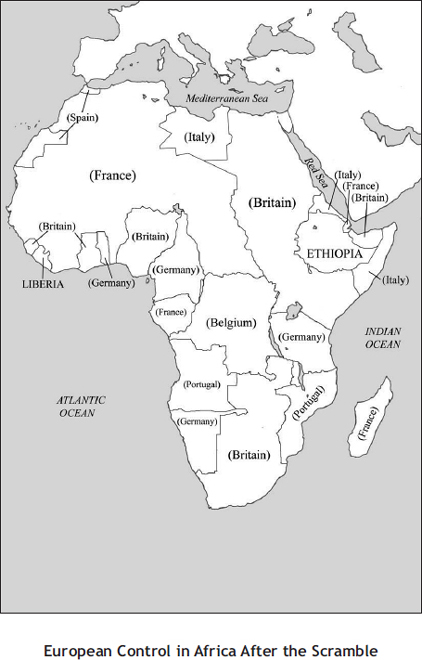
The other countries of Europe didn’t intend to be left behind, while Belgium and Germany took the riches of Africa for their own. Portugal claimed the southeastern African coast. The French took control of lands in the west, southwest, and north, and also convinced chiefs in the Upper Congo to sign treaties of peace, in exchange for bolts of cloth and barrels of alcohol. Italy signed a treaty of alliance with Ethiopia, in the northeast of Africa. And Great Britain claimed pieces of the southeastern coast, the southern tip of Africa, and a few scattered kingdoms along Africa’s western coast.
All of these countries wanted still more. The years after 1880 became known as “The Scramble” because so many countries were elbowing each other to gain control of African land. Every country in Europe believed that whatever country held the most foreign territory could claim to be the greatest.
In 1884, Germany invited the rest of Europe to a conference in the German city of Berlin. At this “Berlin Conference,” representatives from a dozen different countries decided that it would be best for everyone if France, Germany, Portugal, Italy, and all the other countries of Europe didn’t fight over Africa. After all, wars were expensive. It would be simpler to just agree on some way to divide the land fairly. After all, there was a lot of Africa to go around.
So at the Berlin Conference, the countries of Europe agreed that, if any country built trading posts and missionary stations in any area of Africa, that country had “occupied” the area and could claim it. No other country would try to claim, or attack, that territory.
Everyone signed the agreement and went home, pleased with their civilized and peaceful solution. But this very civilized and peaceful solution ignored the African tribes who had lived in these occupied countries for thousands of years. Most Europeans thought that the Africans who lived in the plains and jungles of their continent weren’t fully human—certainly not smart enough to control their own land. For Europeans, Africans were like children who had to be watched over, guided, and controlled.
Although the Berlin Conference was supposed to prevent war, it actually caused a hundred years of unhappiness and unrest in Africa. When a European country “occupied” part of Africa, it drew lines around its new “colony” and gave it a name, like “British Somalia” or “Rhodesia.” But long before Europeans started drawing lines around colonies, African tribes had been making alliances and fighting wars with each other. When European countries started laying out new borders for new countries, they often drew lines that divided friendly tribes from each other and locked hostile tribes together inside the same country borders.
By 1900, every mile of Africa—except for Ethiopia, on the eastern coast, and the little country of Liberia, on the western coast—had been claimed by a European country. The enormous continent of Africa had been divided: Germany, Italy, Britain, Portugal, Spain, and France had taken every square inch.
An African-American writer named W. E. B. Du Bois was in his teens when the Berlin Conference ended. He watched the changes that Europeans brought to Africa, as they built trading posts and missionary stations and took Africa for their own. As a grown man, he wrote, “The invading investors who wanted cheap labor at the gold mines, the diamond mines, the copper and tin mines, the oil forests and cocoa fields, followed the missionaries. The authority of the family was broken up; the authority and tradition of the clan disappeared; the power of the chief was transmuted into the rule of the white district commissioner. … By the end of the nineteenth century, the degradation of Africa was as complete as organized human means could make it.”