Down in South America, a five-year war was about to start—a war fought because two countries quarreled over the driest place on earth.
In Chapter Six, we read about the War of the Triple Alliance, between the three-way partnership of Brazil, Argentina, and Uruguay, fighting against the country of Paraguay. In 1879, fourteen years after the War of the Triple Alliance began, another war broke out, between three more South American countries.
This time, the three countries were on the other side of South America, along the western coast. The country of Peru was the farthest to the north. It lies just below the equator (the imaginary line that runs around the center of the earth). On the west side of Peru, the Pacific Ocean laps up against hundreds of miles of beaches. But not far inland, the ground rises suddenly up into mountains. The Andes Mountains, rocky and covered with snow, run right down the middle of Peru like a backbone.
Just below Peru is the shorter, rounder country of Bolivia. Like Peru, Bolivia had a coastline along the Pacific Ocean. But Bolivia stretches into the middle of South America. Farmland, valleys, and even tropical jungles are inside its borders.
Just below Bolivia lies Chile, a long, skinny country running all the way down the coast. Bolivia is shaped like an orange, but Chile is shaped like a noodle! The country of Chile is ten times as long as it is wide. If you laid Chile sideways on top of a map of the United States, it would stretch from the East Coast all the way over to California. But it would only be as tall as the state of Pennsylvania.
The war started with a quarrel between Chile and Bolivia over the Atacama Desert—a bleak, empty stretch of sand that covered the southern part of Bolivia and the northern edge of Chile. The two countries had never really decided on a boundary that ran across the desert. Why would they bother? The ground of the Atacama Desert is made of salt, sand, and hardened lava. It is fifty times drier than Death Valley. The Atacama Desert is the driest place in the whole world!
This South American desert is so dry because it lies in a “rain shadow.” A rain shadow is a stretch of earth behind a mountain, shielded from the wind. When a storm blows towards a rain shadow, it hits the mountain first. The air of the storm rises up higher and higher, trying to get over the mountain. As it rises, the air grows cooler. All of the water in the air condenses and falls out. By the time the air reaches the other side of the mountain, all the water has fallen out of it. There is no rain left to fall in the rain shadow. Scientists who have tested the soil of the Atacama Desert say that it is as barren and lifeless as the soil on Mars!
The Atacama Desert may not have water or life. But it does have chemicals and minerals in it. Copper lies below the sand. So does saltpeter, used to make gunpowder. And so does a chemical called sodium nitrate. Sodium nitrate comes from a disgusting place; it often forms when bat and seabird droppings decay. But it is very useful for making fertilizer—and for making bombs.
Miners from Chile went into the Atacama Desert to dig for copper and for sodium nitrate. But Bolivia claimed that, since part of the desert belonged to Bolivia, the miners should pay taxes to Bolivia when they sold the copper and sodium nitrate that they found.
The two countries quarreled about the desert. They quarreled about the taxes. They quarreled about where the boundary line between Chile and Bolivia should be drawn. Finally, Bolivia got so exasperated with the quarrelling that Bolivian officials seized all of the buildings, tools, and minerals of a Chilean mining company that was working in the Atacama Desert. Bolivia announced that everything the mining company owned would be sold at auction.
On the day that the auction was supposed to be held, Chilean soldiers marched up to the city of Antofagasta and took control of it. Antofagasta was a Bolivian city on the coast of the desert. Merchants who wanted to load up on the copper or sodium nitrate being mined in the desert could dock their ships at Antofagasta and fill their holds. By claiming the port city, Chile was claiming the right to control the Atacama Desert—and everything dug out of its sands.
Two weeks later, Bolivia declared war on Chile!
But Bolivia wasn’t alone in its fight against Chile. Six years earlier, Bolivia and the country of Peru had signed a treaty with each other. This treaty promised that the two countries would always be each other’s allies—especially against Chile. Now, Bolivia called Peru to come help in the desert war.
But it is very hard to fight in a desert so dry that not even snakes can survive. Instead, the three countries fought their war in the waters of the Pacific, just off the coast. And even though Bolivia and Chile had started the war by quarrelling over the Atacama Desert, the war at sea—the War of the Pacific—ended up being mostly between Chile and Peru.
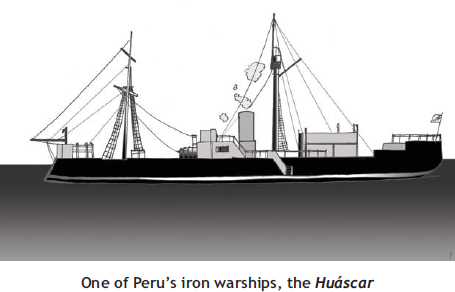
Chile, which had so many miles of coastline, had one of the strongest navies in South America. But Bolivia had no navy at all, while Peru had a navy with two iron warships in it, the Huáscar and the Independencia.
Right at the beginning of the war, the commander of the Independencia was chasing a smaller wooden ship from the Chilean navy. He chased the smaller ship right over the top of a sharp reef—and tore the bottom of his iron ship right off! In one stroke, Peru had lost half of its iron battleships.
The commander of the Huáscar, Admiral Miguel Grau, was more successful. For six months, Miguel Grau sailed up and down the coast of Chile, attacking Chilean ships and keeping merchants away from Chilean ports. But finally the Chilean navy managed to corner the Huáscar in a violent sea battle. Miguel Grau was killed. His men tried to open the drains in the Huáscar to sink it, but Chilean sailors swarmed on board in time to save the Huáscar and take it for Chile.
Now Chile’s path to Peru was clear. The Chilean army invaded Peru. The War of the Pacific had moved onto land!
Peru’s president fled from the country. Chilean soldiers invaded Lima, Peru’s capital, and burned the southern part of the city to the ground.
But Peru refused to surrender for three more long, destructive years of war. Finally, Peru had to agree to sign a peace treaty that gave the southern part of its coastline to Chile. Bolivia also had to give up land—its entire coastline! From that day on, Bolivia was “landlocked.” It had no way to get to the sea. And Chile had won the rights to the Atacama Desert and all of its mines. In years to come, Chile would make a great deal of money by selling sodium nitrate to countries who needed to make explosives for war.
Peru had suffered terribly from the War of the Pacific. The country was deep in debt and had lost thousands and thousands of soldiers during the fighting. After the treaty was signed, the people of Peru were so angry and unhappy that civil war broke out, and went on for seven years.
And Bolivia was angry that it had lost its land along the Pacific Ocean. In the year 2004—more than a hundred years after the War of the Pacific had ended—the president of Bolivia was still insisting that Chile and Bolivia should talk about who really owned the land along the sea.
In the same year that the War of the Pacific began, the ruler of Egypt lost his throne.
When you think about Egypt, you probably picture mummies, buried deep beneath the sloping sides of pyramids. You imagine hieroglyphs written on temple walls, reed boats sailing down the Nile River, and pharaohs wearing their cobra crowns.
But it had been hundreds of years since a pharaoh ruled over Egypt. The country of Egypt had become part of the Islamic empire in the Middle Ages. By the middle of the 1500s, the Ottoman Turks had taken over the Islamic empire. Egypt became a far-away part of the Ottoman Empire—a part that no one really paid very much attention to.
In 1805, an officer in the Ottoman army seized the throne of Egypt. This officer, Muhammad Ali, claimed that he was ruling in the name of the Ottoman sultan. But the Ottoman sultan was so weak that Muhammad Ali could pretty well do whatever he wanted. And what he wanted was to make Egypt a little more like the countries of Europe. He brought university professors from Europe into Egypt, to teach Egyptian students about the West. He tried to make Egypt bigger, by taking over part of the Sudan (the country that lay just south of Egypt). He hired French soldiers to come down to Egypt and train the Egyptian army.
Egypt was growing stronger, more modern—and more like the West.
After Muhammad Ali died, his son Said Pasha became the ruler of Egypt. Like Muhammad Ali, Said Pasha claimed to be loyal to the Ottoman Empire. Again the Ottoman Empire paid very little attention to him.
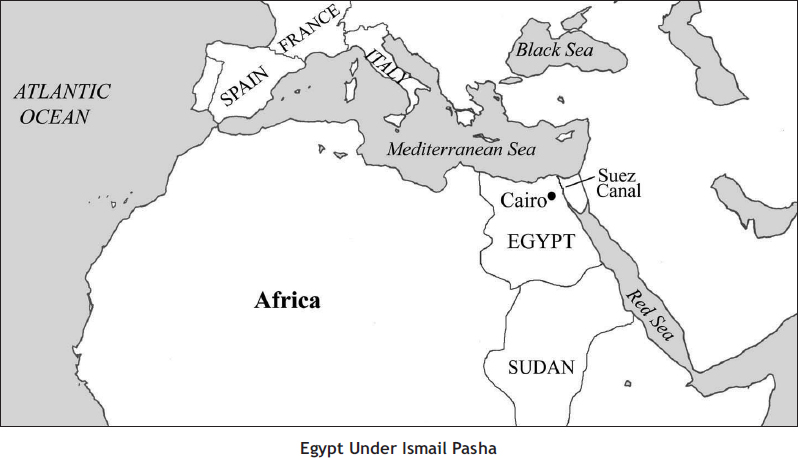
But Said Pasha made a decision that would soon attract attention to Egypt from all over Europe. He gave a French company permission to start digging a canal (a man-made river leading from one body of water to another) from the southern banks of the Mediterranean Sea, down to the left-hand tip of the Red Sea.
Naturally, the countries of Europe were very interested in this canal—the Suez Canal. The canal could change the way that European countries traded with China, Japan, and the other countries of the Far East. Instead of travelling all the way down the coast of Africa, around the tip of that enormous continent, and then heading east, European ships could sail from the Mediterranean Sea straight down into the Red Sea and then turn east. When the canal was finished, it would be a hundred miles long, about twenty-six feet deep, and it would make the trip from Europe to the East six thousand miles shorter!
The Suez Canal took ten years to finish. By the time it was opened, Said Pasha had died. His nephew, Ismail Pasha, had taken control of Egypt.
Ismail’s reign started out well. In 1867, four years after he became the ruler of Egypt, the sultan of the Ottoman Empire (which still claimed to own Egypt, even though the Ottomans didn’t have very much power over Egypt) gave him the title of khedive. This title came from the ancient Persian word for lord; in Turkish it meant “king” or “sovereign ruler.” For Ismail to be called the khedive of Egypt was a great honor!
Two years later, Khedive Ismail invited leaders from all over the world to come celebrate the official opening of the Suez Canal. The Empress of France, the Crown Prince of Prussia, the Emperor of Austria, and dozens of other rulers and ambassadors arrived to watch the first ship sail through the canal. “It was a gorgeous and glittering scene,” wrote a British nobleman who saw the opening with his own eyes. “There were fifty men-of-war [warships] flying the flags of all nations of Europe, firing salutes, playing their bands, whilst the sandy [land near the canal] was covered with tented Arabs and Bedouin from far and near who had come with their families, on horseback and camel, to join in the greatest festival that Egypt had seen since [ancient] days.” There were fireworks and speeches, blessings from Christian priests and Muslim leaders, fireworks and feasts. Ismail Pasha even planned to have an opera performed for the distinguished guests. The Italian composer Giuseppe Verdi was writing an opera called Aida, about a heroic soldier of ancient Egypt. It would have been perfect for the celebration of the Suez Canal, but Verdi didn’t finish it in time. Instead, the guests got to hear his opera about an Italian clown—Rigoletto.
The rule of Ismail Pasha, the khedive of Egypt, seemed to be flourishing. He had great plans to make Egypt even stronger. He wanted to make the schools better, so he opened new classrooms for girls. He built new roads and railroads. He oversaw the building of new factories and cotton mills; since the Civil War had destroyed the cotton plantations of the United States, Egyptian cotton was in great demand. He marched down into the Sudan, south of Egypt, and took over even more of it, so that Egypt’s borders stretched down along the coast of the Red Sea.
But Ismail Pasha spent too much money on his projects. He had to start borrowing money from France and Great Britain. Under his rule, Egypt borrowed over ten million dollars! Finally, Ismail had to sell control of the Suez Canal to the British to raise extra money.
But even this money didn’t pay off Egypt’s debts. France and Great Britain demanded control over Egypt’s treasury so that they could get their money back. That was the beginning of the end for Ismail Pasha. Now that he had lost control of Egypt’s money, he had lost control of Egypt’s government.
Four years later, the British and French told the Ottoman sultan that Ismail Pasha would have to go.
The Ottoman sultan had just lost his war with Russia. He wasn’t strong enough to defy France and Great Britain. He ordered Ismail to leave his position. Ismail couldn’t resist the sultan, the French, or the British. In 1879, he left his home, his palace, and his country, and went to live in exile in Italy.
Ismail’s son Tawfiq became the khedive—a khedive who had to obey British orders. The Egyptian army grew more and more unhappy with the British control over their country. Egyptian army officers tried to lead a rebellion—but the British marched into Egypt with an army and captured Cairo, Egypt’s capital city. Now Egypt was an occupied territory. And soon Britain extended its rule down over the Sudan as well.
Like India, Egypt had now become British. The empire where the sun never set had grown a little bit larger.