Summer had come to England. The sun poured down on the hot, soot-covered roofs and cluttered streets of London. The Thames River shone in the morning light. In an open green space at the center of the city, a huge glass box sat like a glittering toy on the grass.
Beneath the glass roof of the box, an army troop was marching in circles, beating a path on the grass. The youngest soldier looked up at the glass ceiling nervously.
“It’s going to collapse any minute!” he whispered to the soldier in front of him.
“Quiet!” bellowed the sergeant at the troop’s head. “Left! Right! Left, right, left! Stamp your feet! March until it falls down on your head!”
The young soldier hunched his shoulders and tramped harder. The ceiling shook—but the walls stood firm. Finally, the sergeant called his men to a halt. They had marched for an hour, and failed to shake the glass building down. Queen Victoria and her husband, Prince Albert, would be delighted!
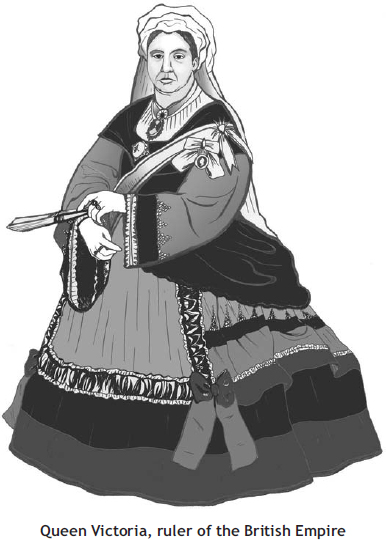
Victoria was queen of Great Britain, a country made up of four smaller countries (England, Scotland, Ireland, and Wales) all allied together. In less than a year, Victoria and Albert planned to invite the entire world to Great Britain’s capital city, London, for the biggest fair ever held: “The Great Exhibition of the Works of Industry of All Nations.” Countries from all across the globe would bring their inventions, their machines, and their goods to this fair. But such a huge fair needed an enormous building to hold all those exhibits.
Prince Albert had looked at 245 different plans for buildings—and had rejected all of them. Finally, he found the perfect exhibition hall: a glass building made out of almost a million feet of glass, attached to four thousand tons of iron columns and beams. This glass building had been designed by a man named Joseph Paxton, a gardener who had spent years building greenhouses. It was bigger than any building in England, and it would shine in the sun like a jewel.
But when the people of London heard about the glass building, they objected. If huge crowds milled around underneath the glass ceiling, shaking the ground with their feet, the building might collapse and kill everyone beneath.
So Joseph Paxton made a smaller model of his glass building and asked the troop of soldiers to jump and stamp around underneath it, shaking the ground. The model remained standing. Plans to build the giant greenhouse could go ahead!
There was no time to waste. The Great Exhibition was due to open in less than nine months. Every glassmaker in England was called upon to help. Thousands of sheets of glass and hundreds of iron bars and columns were brought to an open green space in the center of London called Hyde Park. There, the iron and glass were put together into a huge greenhouse that covered nineteen acres—the same space as seventeen football fields. A huge dome rose from it, big enough so that the towering elm trees in the park could fit right into the building. Paxton’s building, the Crystal Palace, was ready for the fair.
Countries from all over the world brought thirteen thousand different exhibits. Vases and hats from Russia, furniture from Austria, farming tools from the United States, rich clothing and embroidery made in Prussia, fine cloth and weapons from France, and Swiss watches filled the halls. There were statues and pictures, a life-sized lead mine, the first gigantic models of dinosaurs, cuneiform tablets just discovered in the ancient land of Assyria, and a fountain hundreds of feet high.
On May 1, 1851, Queen Victoria and Prince Albert arrived in their state carriage to open the very first day of the Great Exhibition. The Crystal Palace shone in the sun. Flags waved from the roof. Sunshine flooded through the glass walls and illuminated the queen as she walked into the central dome. As she entered, a huge choir began to sing the Hallelujah Chorus.
Victoria and Albert walked through the Crystal Palace, admiring the beautiful clothing and furniture and the ingenious inventions from other countries. Later, Queen Victoria wrote in her diary, “We were quite dazzled by the most splendid [Indian] shawls and tissues … [and] charming Turkish stuffs, including very fine silks. … [And] there were ‘Bowie’ knives in profusion, made entirely for Americans, who never move without one.”
But Albert and Victoria were the most pleased by exhibits from all parts of the British Empire—an empire that stretched around the world. Australian convicts from the British colony of Australia had sent bonnets made out of palm leaves. British New Zealand sent carved wood. British-run factories in India sent beautiful silks and cottons. The British colony of Canada sent a brand-new kind of fire engine. Throughout the Crystal Palace, visitors marveled at British machines: a huge locomotive engine, a diving bell, models of steamships, cranes, pumps, plows and reapers, and architects’ models of bridges and buildings.
The real reason for the Great Exhibition was to show the entire world how powerful and modern the British Empire was. Britain itself was just a tiny island off the coast of Europe. But British governors were in charge of British colonies and territories in Canada, Australia, New Zealand, India, South Africa, and many more places. Victoria’s empire was so big that the British said, “The sun never sets on the British Empire!” No matter where the sun’s light fell as the Earth travelled around it, the rays would warm land governed by the British.
British colonies sent coal, silk, furs, and other valuable goods back to Britain itself. But the British didn’t spread their empire just for money. They were sure that they could improve every part of the world—if they could just take control of it. Englishman Cecil Rhodes wrote, “We are the first [best] race in the world, and … the more of the world we inhabit, the better it is for the human race.”
The Great Exhibition made this clear! Only half of the Crystal Palace was given over to exhibits from the rest of the world. The other half was filled entirely with British goods. The six million visitors who came to the Great Exhibition could see exactly what the British thought of themselves: Britain was as powerful as the rest of the world, put together. The British historian and writer Thomas Babington Macaulay exclaimed, “[The Great Exhibition was] a most gorgeous sight. … I cannot think that the Caesars ever exhibited a more splendid spectacle.” Just like the Caesars of the Roman Empire, the kings and queens of Britain had spread their laws, their customs, and their language across the world.
But just like the Romans of old, the British would soon have to fight to keep their empire together.
Not long after the close of the Great Exhibition, Britain found itself fighting a war in India—a war in which the eighty-two-year-old emperor of India, Bahadur Shah, would be forced to hide in a tomb while fighting raged outside.
Long before Bahadur Shah was born, English merchants who wanted to buy rare silks, cotton, and tea from India asked the emperor of India, Jahangir, for permission to build little settlements called trading posts along the Indian coast. These settlements would be safe places for their ships to land.
Jahangir agreed. So the merchants, joining together into a group called the East India Company, began to build their trading posts. For a hundred years, the East India Company went on building trading posts throughout India. More and more Englishmen and women settled around the trading posts. The trading posts put guns on their walls to defend the settlers. The trading posts began to look more like English cities!
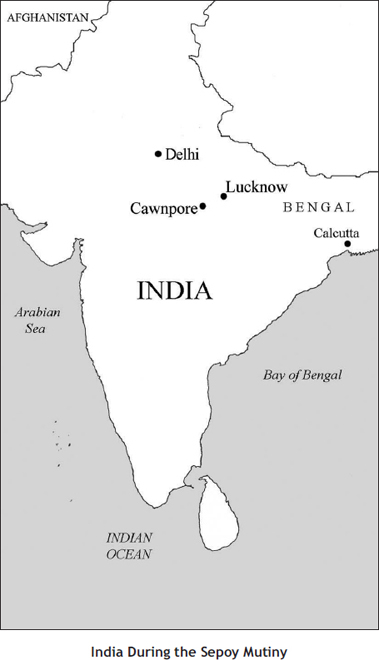
One of the largest of these “English cities,” Calcutta, lay on India’s northeast coast, in the province of Bengal. The governor of Bengal began to grow nervous about this large settlement of Englishmen with guns, right in the middle of his country. He decided that it was time for the English to leave—so he assembled an army and marched out to fight against them.
But the merchants of the East India Company didn’t want to leave Calcutta. They hired an army of English soldiers and an English general and fought back. When they defeated the Indian army, the East India Company took control of the government of Bengal.
The merchants had become governors.
By the time Bahadur Shah was born, the East India Company had seized control of more and more parts of India. In some places, British officials actually ran the government of India. In others, they allowed local rulers to control their courts and their ceremonies—but British “advisors” told the rulers what to do. And the taxes paid by Indians on their land went to the British.
Many Indians were displeased by life under British rule. They could see that British soldiers and officers treated Indians with scorn. The British tore down Indian temples to make room for British railroad tracks. Sometimes they forced Indian Muslims to shave their beards, which symbolized their faith. And both Hindus and Muslims in India were afraid that the British were out to convert them, by force, to Christianity.
When Bahadur Shah’s father finally died, as a very old man, Bahadur Shah became the emperor of India. He was already sixty years old. Even though he was emperor, he had to do exactly as the East India Company told him. The Company even paid his salary!
In 1856, when Bahadur Shah was eighty-one years old and had “ruled” India for twenty-one years, the East India Company made a very big mistake.
The Company had three large armies to help control the three hundred million people of India. The army officers were all British, but many of the soldiers were native Indians, both Hindu and Muslims, who had agreed to work for the East India Company. These native soldiers were called sepoys.
In 1856, the British passed a law declaring that any soldier who belonged to the British army in India could be put on a ship and sent to fight in another country. The Hindu soldiers were appalled. A devout Hindu could only keep himself ceremonially clean if he could cook his own food and draw his own water for bathing—and this was impossible on board a ship. A Hindu soldier who went on a British ship and then came home often found that his relatives and friends refused even to eat with him.
Then something even more disturbing happened. The East India Company bought a new, modern kind of rifle called the Enfield rifle, and announced that the army would begin using it. Soon, word spread through the ranks of the sepoys: “Don’t use the rifle! They are trying to make us into Christians once more!”
To understand this, you have to know that in those days, when a soldier loaded a rifle, he first had to load the powder, and then the bullets. This took time! But in an Enfield rifle, the bullets and powder were folded up together in a greased-paper package called a cartridge. All the soldier had to do was bite off the end of the cartridge, pour the powder into the rifle, and slide the bullet in.
Now, the sepoys whispered to each other that the grease used to coat the cartridges had been made out of animal fat. Devout Hindus were horrified by the thought that the fat of cows might touch their lips. Cows were sacred animals, never to be eaten. The Muslims were just as sickened by the idea that they might have to put pig fat into their mouths. In Islam, hogs were unclean.
At once, the British government announced that Hindu and Muslim soldiers could make their own grease out of vegetable oil. But it was too late. The sepoys were already angry at their British superiors, who called them “pigs” and other demeaning names. Now they were convinced that the cartridges were a deliberate attempt to destroy their Hindu and Muslim faith.
The sepoys began to rebel all over the northwest of India. They announced that Bahadur Shah, now eighty-two, was their commander in chief. Bahadur Shah was too old to fight—but he watched as the rebels took control of Delhi, drove the British out of the city of Cawnpore, and then laid siege to the city of Lucknow.
But the British had no intention of losing India. The East India Company marched new divisions of well-trained British soldiers into India, and laid siege to Delhi. The rebels fought desperately to keep their city. One out of every three British soldiers who besieged Delhi was killed. But finally the British flooded over the walls. They found Bahadur Shah hiding in the tomb of his great ancestor Humayan and dragged him out to stand trial for treason. Bahadur Shah was found guilty and sent away to live, under guard, in a distant city—where he died, five years later, at the age of eighty-seven.
The British government declared that India would no longer have an emperor. But the East India Company wouldn’t govern India anymore, either. Britain was fed up with the incompetent rule of the East India Company. If the Company had not treated the sepoys so poorly, perhaps the Sepoy Mutiny would never have happened.
So Queen Victoria took India away from the East India Company and announced that India was now a colony of Britain, governed directly by the Queen and Parliament with the help of a head official called the Viceroy of India. Queen Victoria promised that all the British would work to make India a better place for the Indians.
But India didn’t belong to the Indians any more. It had become British. All over India, Indians went on hoping for the day when they would get their own country back.