MasteryTM
Printer-Friendly Version. Click Here
for the Mastery page.
A Game of Skill for Two Players by S. John Ross. Copyright
© 1998, 2002, 2006.
All Rights Reserved. "Mastery", "Draume" and "Draume
Crown" are trademarks of S. John Ross.
Board and Pieces
The Mastery playing field is an ordinary checkerboard (an 8x8 grid).
Each side consists of thirteen pieces: three Masters, four Officers, and
six Pawns. Each side's pieces should be easily distinguishable by color.
A Mastery set can be built easily by scavenging the pieces from two identical
chess sets, using Rooks for Masters, Knights for Officers, and Pawns for
Pawns.
|
Imperial Board
|
Setup
|
Draume Crown Board
|
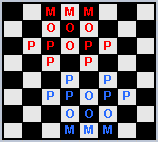 |
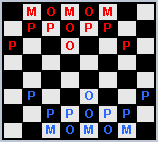
There are two possible setups, shown in these diagrams. The first setup
is traditional - the "lock" or "imperial" board, with
both sides closely tangled and ready to fight. The second setup is the
"Draume Crown" board, which provides a less immediate conflict,
and a more subtle opening game.
|
 |
The Game's Object
- There are two ways to win. If either player ever loses (A) all three
of its Masters, or (B) all of it's Officers and Pawns, leaving nothing
but one or more Masters, that player has lost, and the game is over. Either
side may also resign the game to his opponent.
- There are no conditions for a draw in Mastery according to the game's
formal laws, but many "house rules" exist for determining draw
conditions.
The Turn
Each player acts in turn, with the darker-colored side moving first.
On his turn, a player must do one of three things: Move, Capture, or Control.
Movement
All pieces must move in straight, unobstructed lines to their destination.
No piece can jump over another.
| Masters
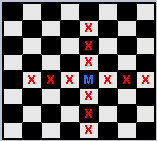
may move in any single orthogonal direction (up, down,
left, right), up to three squares. See the diagram to the right.. The Master
M may move to
any X shown, provided
that the path is unobstructed. Masters may never move diagonally. |
|
|
|
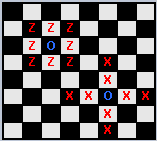
Officers may
move in any single orthogonal direction as well, up to two squares. See
the diagram to the left, in the lower right corner. The Officer O
may move to any X
shown, provided the path is unobstructed. Officers may never move diagonally.
(for the bit about Z,
keep reading).
|
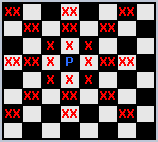
| Pawns may move
only one square, but it can be to any unoccupied adjacent square, including
diagonally adjacent ones. Pawns are the only piece capable of diagonal
movement. See the diagram to the right. The Pawn P
may move to any X
shown, provided the square is unoccupied.
The double-x squares XX
represent the movement treacherous pawns are capable of (see below).
|
|
Capture
- Capture in Mastery is comparable to capture in Chess. That is to say,
it's identical to a Move, except that the destination square contains an
enemy piece, which is removed from the board. The path toward the enemy
piece must still be unobstructed.
- Rank plays no part in capture. Any ally piece can capture any enemy
piece, and vice versa.
Ally pieces may not be captured by one another, except by Masters. Masters
may "devour" ally Officers or Pawns if desired.
- Whenever an enemy Officer or Master is captured, the capturing player
may immediately return one of his own captured pieces to play. The
"resurrected" piece may be placed in any unoccupied space
on the board. The resurrected piece must be of a lower rank than the piece
that was captured: capturing a Master will allow the resurrection of an
Officer or Pawn (player's choice); capturing an Officer will allow the
resurrection of a Pawn only. If no eligible captured pieces are available,
this benefit is lost. Masters, once captured, may never be resurrected
by any means.
- Masters "devouring" ally pieces do not trigger resurrections
at all.
Control
When making a Move or Capture, players must move one of their own pieces.
When making a Control play, however, players must move one of the enemy's
pieces. When a piece is moved by an enemy, it is referred to as a treacherous
piece. For the duration of a Control move, the treacherous piece is considered
to be of it's opposite color, and follows the normal rules for movement
and/or capture. Thus, a Control play will be either a Move or a Capture,
using an enemy piece as if it were your own.
Controllable Pieces
Only those enemy pieces sitting in the Zone of Control of one of your
ally pieces may be controlled. Furthermore, pieces only exert control over
pieces of lower rank: Masters may exert control over Officers and Pawns;
Officers may exert control over Pawns only, and Pawns exert no control
at all.
|
|
The Zone of Control Z for
an Officer O extends
to all adjacent squares, both orthogonally and diagonally. Any enemy Pawn
in the Officer's ZOC may be controlled. See the diagram to the left, in
the upper left corner. |
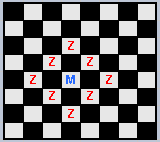
| The Zone of Control Z for
Masters M is a
diamond shaped pattern surrounding the Master. See the diagram to the right.
Any enemy Pawn or Officer in the Master's ZOC may be controlled. Note that
the four orthogonally adjacent squares are not part of the Master's
ZOC! An enemy piece may sit in these "blind spots" without any
risk of being controlled. |
|
|
|
Treacherous Pawns
Officers under enemy control gain no special powers: they're just Officers,
with no additional rules. Pawns, on the other hand, are more powerful in
the hands of the enemy! A treacherous pawn may move up to three
squares in any single direction, instead of just one, to either move or
capture.
|
The Reflection Rule
- The reflection rule is as follows: No piece may be moved to the square
that it occupied on the turn immediately previous.
- This means that if the Blue player moves a pawn on his turn (Turn 1),
and the pawn lands in the Zone of Control of an enemy officer, the Red
player may NOT, on his turn (Turn 2) make a Control move to return the
blue pawn to the square it came from. On Blue's next turn, however (Turn
3), that pawn may be moved anywhere, since Turn 1 is no longer "the
turn immediately previous." Also, on Turn 2, red may opt to make a
Control move to move the offending pawn elsewhere - just not to
the square it occupied at the beginning of Turn 1.
- The rule works in both directions. Had Red begun by controlling the
Blue pawn, the Blue player could not immediately "reflect it back."
He could move it someplace else, or wait another turn to return it to the
spot where he wanted it (assuming it survives that long).
The Lost Power Rule
Whenever either side loses either all six Pawns, or all four Officers,
it loses the power to make Control moves. This remains in effect for as
long as that side is completely without either Pawns or Officers.