Previous Chapter ... ... Next Chapter
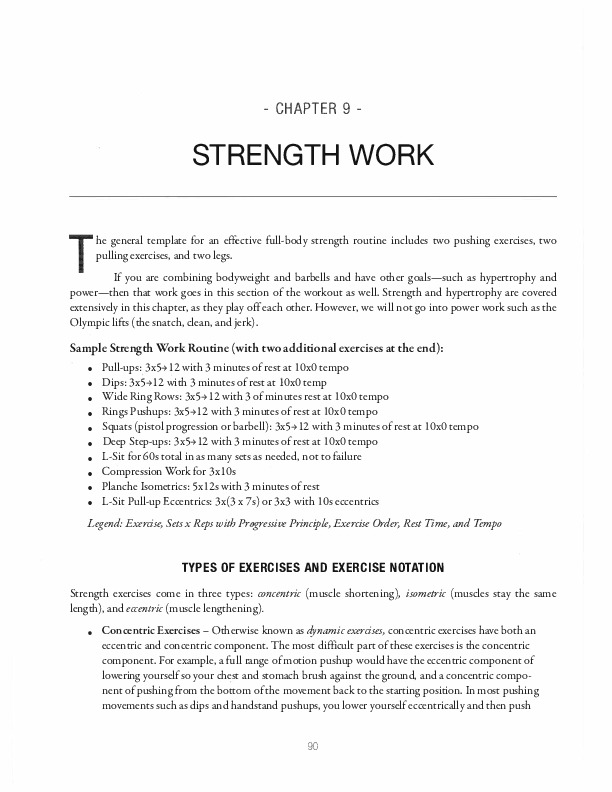
The general template for an effective full-body strength routine includes two pushing exercises, two pulling exercises, and two legs.
If you are combining bodyweight and barbells and have other goals-such as hypertrophy and power-then that work goes in this section of the workout as well. Strength and hypertrophy are covered extensively in this chapter, as they play off each other. However, we will not go into power work such as the Olympic lifts (the snatch, clean, and jerk).
Sample Strength Work Routine (with two additional exercises at the end):
Legend: Exercise, Sets x Reps with Progressive Principle, Exercise Order, Rest Time, and Tempo
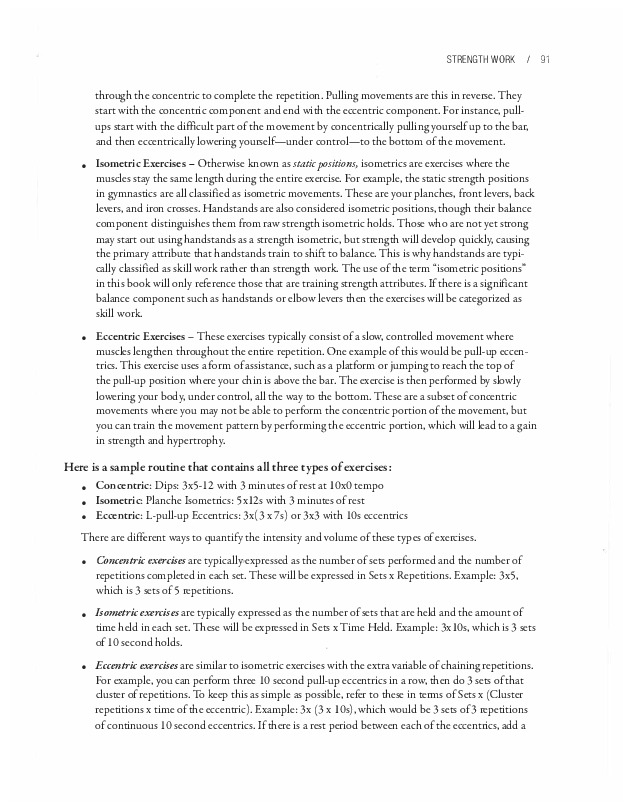
Strength exercises come in three types: concentric (muscle shortening), isometric (muscles stay the same length), and eccentric (muscle lengthening).
Isometric Exercises - Otherwise known as staticpositions, isometrics are exercises where the muscles stay the same length during the entire exercise. For example, the static strength positions in gymnastics are all classified as isometric movements. These are your planches, front levers, back levers, and iron crosses. Handstands are also considered isometric positions, though their balance component distinguishes them from raw strength isometric holds. Those who are not yet strong may start out using handstands as a strength isometric, but strength will develop quickly, causing the primary attribute that handstands train to shift to balance. This is why handstands are typically classified as skill work rather than strength work. The use of the term "isometric positions" in this book will only reference those that are training strength attributes. If there is a significant balance component such as handstands or elbow levers then the exercises will be categorized as skill work.
Eccentric Exercises - These exercises typically consist of a slow, controlled movement where muscles lengthen throughout the entire repetition. One example of this would be pull-up eccentrics. This exercise uses a form of assistance, such as a platform or jumping to reach the top of the pull-up position where your chin is above the bar. The exercise is then performed by slowly lowering your body, under control, all the way to the bottom. These are a subset of concentric movements where you may not be able to perform the concentric portion of the movement, but you can train the movement pattern by performing the eccentric portion, which will lead to a gain in strength and hypertrophy.
Here is a sample routine that contains all three types of exercises:
There are different ways to quantify the intensity and volume of these types of exercises.
For example, you can perform three 10 second pull-up eccentrics in a row, then do 3 sets of that cluster of repetitions. To keep this as simple as possible, refer to these in terms of Sets x (Cluster repetitions x time of the eccentric). Example: 3x (3 x 10s), which would be 3 sets of 3 repetitions of continuous 10 second eccentrics. If there is a rest period between each of the eccentrics, add a
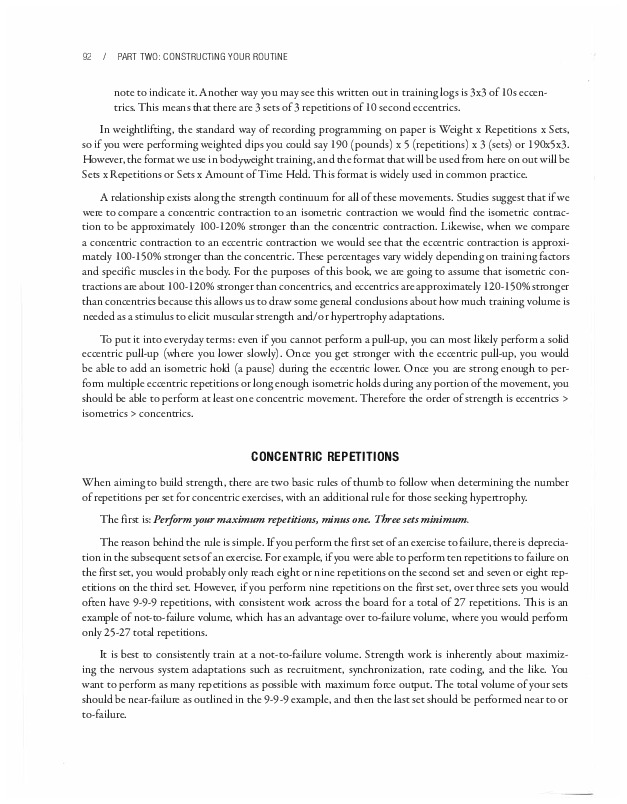
note to indicate it. Another way you may see this written out in training logs is 3x3 of 10s eccentrics. This means that there are 3 sets of 3 repetitions of 10 second eccentrics.
In weightlifting, the standard way of recording programming on paper is Weight x Repetitions x Sets, so if you were performing weighted dips you could say 190 (pounds) x 5 (repetitions) x 3 (sets) or 190x5x3. However, the format we use in bodyweight training, and the format that will be used from here on out will be Sets x Repetitions or Sets x Amount of Time Held. This format is widely used in common practice. A relationship exists along the strength continuum for all of these movements. Studies suggest that if we were to compare a concentric contraction to an isometric contraction we would find the isometric contraction to be approximately 100-120% stronger than the concentric contraction. Likewise, when we compare a concentric contraction to an eccentric contraction we would see that the eccentric contraction is approximately 100-150% stronger than the concentric. These percentages vary widely depending on training factors and specific muscles in the body. For the purposes of this book, we are going to assume that isometric contractions are about 100-120% stronger than concentrics, and eccentrics are approximately 120-150% stronger than concentrics because this allows us to draw some general conclusions about how much training volume is needed as a stimulus to elicit muscular strength and/or hypertrophy adaptations.
To put it into everyday terms: even if you cannot perform a pull-up, you can most likely perform a solid eccentric pull-up (where you lower slowly). Once you get stronger with the eccentric pull-up, you would be able to add an isometric hold (a pause) during the eccentric lower. Once you are strong enough to perform multiple eccentric repetitions or long enough isometric holds during any portion of the movement, you should be able to perform at least one concentric movement. Therefore the order of strength is eccentrics > isometrics > concentrics.
When aiming to build strength, there are two basic rules of thumb to follow when determining the number of repetitions per set for concentric exercises, with an additional rule for those seeking hypertrophy. The first is: Performyour maximum repetitions, minus one. Three sets minimum.
The reason behind the rule is simple. If you perform the first set of an exercise to failure, there is depreciation in the subsequent sets of an exercise. For example, if you were able to perform ten repetitions to failure on the first set, you would probably only reach eight or nine repetitions on the second set and seven or eight repetitions on the third set. However, if you perform nine repetitions on the first set, over three sets you would often have 9-9-9 repetitions, with consistent work across the board for a total of 27 repetitions. This is an example of not-to-failure volume, which has an advantage over to-failure volume, where you would perform only 25-27 total repetitions.
It is best to consistently train at a not-to-failure volume. Strength work is inherently about maximizing the nervous system adaptations such as recruitment, synchronization, rate coding, and the like. You want to perform as many repetitions as possible with maximum force output. The total volume of your sets should be near-failure as outlined in the 9-9-9 example, and then the last set should be performed near to or to-failure.
Studies suggest that if your primary goal is hypertrophy rather than strength you can perform your sets to failure. The same is true if your primary goal is endurance. The stresses placed on muscles in to-failure volume will fatigue your muscle fibers, do mechanical damage, and stress the metabolic processes within them to stimulate an overall increase in hypertrophy and endurance that not-to-failure training does not provide.
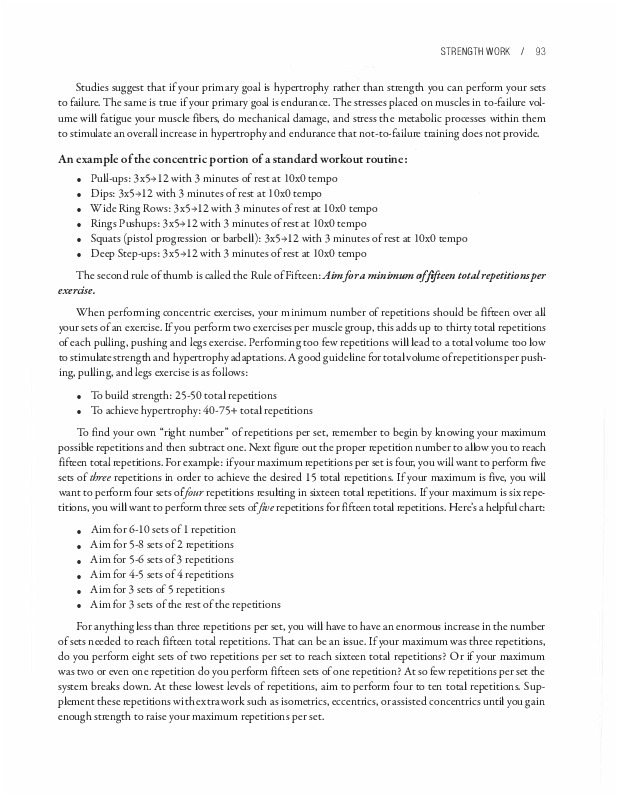
An example of the concentric portion of a standard workout routine:
The second rule of thumb is called the Rule of Fifteen: Aimfar a minimum of fifteen totalrepetitions per exercise.
When performing concentric exercises, your minimum number of repetitions should be fifteen over all your sets of an exercise. If you perform two exercises per muscle group, this adds up to thirty total repetitions of each pulling, pushing and legs exercise. Performing too few repetitions will lead to a total volume too low to stimulate strength and hypertrophy adaptations. A good guideline for total volume of repetitions per pushing, pulling, and legs exercise is as follows:
To find your own "right number" of repetitions per set, remember to begin by knowing your maximum possible repetitions and then subtract one. Next figure out the proper repetition number to allow you to reach fifteen total repetitions. Far example: if your maximum repetitions per set is four, you will want to perform five sets of three repetitions in order to achieve the desired 15 total repetitions. If your maximum is five, you will want to perform four sets of Jour repetitions resulting in sixteen total repetitions. If your maximum is six repetitions, you will want to perform three sets of jive repetitions far fifteen total repetitions. Here's a helpful chart:
Far anything less than three repetitions per set, you will have to have an enormous increase in the number of sets needed to reach fifteen total repetitions. That can be an issue. If your maximum was three repetitions, do you perform eight sets of two repetitions per set to reach sixteen total repetitions? Or if your maximum was two or even one repetition do you do fifteen sets of one repetition? At so few repetitions per set the system breaks down. At these lowest levels of repetitions, aim to do four to ten total repetitions. Supplement these repetitions with extra work such as isometrics, eccentrics, or assisted concentrics until you gain enough strength to raise your maximum repetitions per set.
Assisted concentric exercises involve using a partner, pulley system, band, or machine system to make the exercise easier. For intermediate progression, you can perform the assisted concentric method of an exercise instead of four to ten repetitions.
Take the example of pushups. If you elevate your upper body on a box or stairs, this makes the pushup easier. In an advanced exercise like diamond pushups, you could make them somewhat easier by spacing your hands closer together than a normal pushup, but not as close as a full diamond pushup. It would be much easier as a beginner to place a band underneath your chest and around something higher or to simply have a partner assist you.
The optional rule of thumb (for hypertrophy only): Beginners should aimfar ten sets of exercises per muscle group.
The third rule for concentric exercises applies only to pure hypertrophy work. If this is your goal, aim for ten sets for each category-pushing, pulling, legs, and core-no matter what the repetition range. If you are performing five repetitions to failure of both pull-ups and rows, aim for 5x5 on each of these exercises, adding up to about fifty repetitions. If you are performing a pushup variation and dips at a volume of 3x8 each, you want to perform 5x8 for each, which would equate to 40 repetitions times two exercises for a total of eighty repetitions.
This system allows for a potential maximum hypertrophy response for beginners. A side benefit is that this rule allows you to perform ten sets of anyching. You may want to work three different pushing exercises, such as pushups, dips, and handstand pushups. Simply split up the ten total sets between each of these exercises. Beginners are advised to focus on the fundamentals, rather than attempting a large number of different types of exercises all at once.
The easiest way to progress with concentric exercises is to remember these three rules when establishing your routine. There may be some cases when modifications outside of the suggested ranges are necessary, such as with prehabilitation, rehabilitation, or too few repetitions per set, but for the most pare, these strategies will work for nearly all beginners and intermediates.
Isometric holds are exercises in which the muscles neither lengthen nor contract. An example of isometric exercises as part of a workout routine:
| Max Hold | Hold Time | Total Sets | Total Time | Sweet Spot (Sets x Hold) |
|---|---|---|---|---|
| 1 | 1 | 7-10 | 7-10s | 8x1s |
| 2 | 2 | 6-8 | 12-16s | 7x2s |
| 3 | 3 | 6-8 | 18-248 | 7x3s |
| 4 | 3 | 6-8 | 18-24s | 7x3s |
| 5 | 4 | 5-7 | 20-28s | 6x4s |
| 6 | 5 | 5-6 | 25-30s | 6x5s |
| 7 | 5 | 6-6 | 26-30s | 6x5s |
| 8 | 6 | 5-6 | 30-36s | 6x6s |
| 9 | 6 | 5-6 | 30-36s | 6x6s |
| 10 | 7 | 5-6 | 35-42s | 5x7s |
| 11 | 8 | 5-6 | 40-488 | 5x8s |
| 12 | 8 | 6-6 | 40-48s | 5x8s |
| 13 | 9 | 6 | 46s | 5x9s |
| 14 | 10 | 5 | 50s | 5x10s |
| 15 | 10 | 5 | 50s | 5x10s |
| 16 | 11 | 6 | 66s | 5x11s |
| 17 | 12 | 6 | 60s | 5x12s |
| 18 | 13 | 5 | 65s | 5x13s |
| 19 | 13 | 5 | 65s | 5x13s |
| 20 | 14 | 4 | 56s | 4x14s |
| 21 | 14 | 4 | 56s | 4x14s |
| 22 | 15 | 4 | 60s | 4x15s |
| 23 | 16 | 4 | 64s | 4x16s |
| 24 | 16 | 4 | 64s | 4x16s |
| 25 | 17 | 4 | 68s | 4x17s |
| 26 | 17 | 4 | 68s | 4x17s |
| 27 | 18 | 3 | 64s | 3x18s |
| 28 | 19 | 3 | 67s | 3x19s |
| 29 | 20 | 3 | 60s | 3x20s |
| 30 | 20 | 3 | 60s | 3x20s |
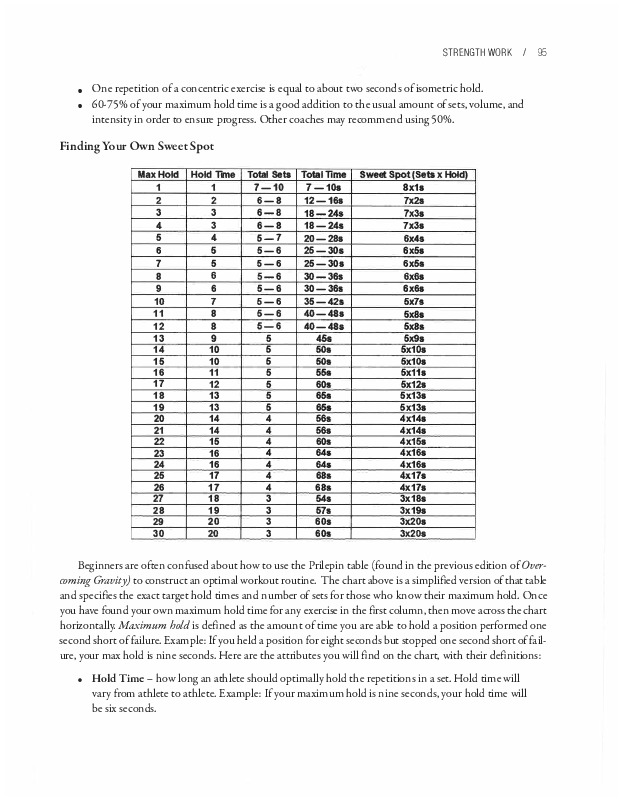
Beginners are often confused about how to use the Prilepin table (found in the previous edition of Overcoming Gravity) to construct an optimal workout routine. The chart above is a simplified version of that table and specifies the exact target hold times and number of sets for those who know their maximum hold. Once you have found your own maximum hold time for any exercise in the first column, then move across the chart horizontally. Maximum hold is defined as the amount of time you are able to hold a position performed one second short of failure. Example: If you held a position for eight seconds but stopped one second short of failure, your max hold is nine seconds. Here are the attributes you will find on the chart, with their definitions:
Total Sets - the optimal number of total sets of each exercise an athlete should perform in a workout. Example: If your maximum hold is nine seconds and your hold time is six seconds, your total sets will be five to six. As you can see, total sets could be a range and you can then choose how many you want to perform.
Total Time - total time allows you to track important improvements once you move beyond the beginner's phase; at first too much attention need not be spent on this column. This will illustrate why: If you were able to perform six sets of six-second holds, you have thirty-six seconds of total hold time. If you improved your maximum hold time during your next session but were able to perform only five sets of these seven-second holds then you know that you performed at a slightly less overall volume of thirty-five seconds compared to thirty-six seconds. Do not lose heart: you performed a similar amount of volume in one less set and gained one second of hold time; this is an overall improvement. Total time will feel more significant when you move beyond the beginner's phase.
Sweet Spot - Finally, the sweet spot represents the arbitrary amount of sets and repetitions for the maximum hold time that work best for the general training population. Most athletes fall in this range. If you are in the sweet spot range and are able to make solid improvements in your workouts, great! If you are failing to make improvements and tend to be exhausted, remove a set. If you feel you are undertraining, add a set. The "sweet spot" recommendation will give you a place to begin if you do not want to experiment with different sets and hold times. Reminder: To determine your maximum hold time, go to failure or stop one second short of failure.
There are other methods for programming hold times, sets, and total volume for isometric sets. One alternative is the "sixty-second method;' where all of your holds and sets add up to sixty seconds. This method uses 50% of your maximum hold time as the volume.
This method has both pros and cons. One advantage is that when you are able to move toward three sets of twenty seconds with a maximum hold of forty seconds, you are also already most likely ready to move on to the next progression. This method might also be better at preventing overuse injuries since 50% of the maximum hold time is a slow progression aimed at extensively preparing the connective tissue for the movements. However, due to the significantly shorter hold times, an athlete might have to perform as many as ten to twenty sets to reach a total volume of sixty seconds. This will appreciably extend the length of the workout. The recommended 60-75% hold time range has an excellent tradeoff between sets, volume, and intensity to set you up to progress well. For example, it allows a significant decrease in the number of sets performed at
lower hold times. This will decrease the propensity for overuse injuries. To compare the two formulas when an athlete has a ten-second maximum hold time, you would have:
One should aim for 25-50 total repetitions for strength and 40-75+ total repetitions for hypertrophy. Therefore, if you are aiming for hypertrophy, any additional exercises that work the same muscle groups should go from 30 repetitions to the 40-75 total or 18 repetitions to the 40-75 total. This type of relative comparison should make it easier to program each of the pushing, pulling, leg, and core exercises into a routine to give you the volume needed to progress toward your goals.
This mechad has worked in coaching athletes to successfully achieve back levers, front levers, planches, iron crosses, and other advanced isometric holds, but of course, individual impact will vary. If you use the chart and do not make progress, reduce the volume first. This allows additional recovery time, which can allow you to progress. If your progress still plateaus, add volume.
This mechad of troubleshooting works for all routines, not just isometric holds. If you are not improving, first try reducing volume to determine whether the issue is recovery time. This also lowers the strain on your connective tissues and central nervous system pool.
Eccentric exercises typically consist of slow, controlled movements where muscles lengthen throughout the entire exercise. An example of eccentric exercises as part of a workout routine:
Studies do not show any direct comparisons of the strength and hypertrophy potential of eccentric to concentric exercises. However, based on observations of various athletes, this formula works well in practice:
Studies do show that an eccentric exercise will preferentially activate fast-twitch fibers the faster it is performed. In other words, a quick, one-second repetition over a full range of motion will stimulate a greater hypertrophy response than a six-second repetition. The issue that arises when utilizing one-second eccentric repetitions is that the athlete has to perform an excessive number of sets in order to accumulate enough volume for strength and hypertrophy progression. At the other end of the spectrum, performing an eccentric movement for too long (for example, twenty or thirty seconds) is physiologically difficult due to the metabolic acidosis-colloquially "the burn"-and will not optimally improve either strength or hypertrophy.
For a good balance, aim for eccentric movements that are between three to ten seconds. This is where clustering repetitions aka "chaining" comes in. The way to group your exercises was mentioned previously on exercise notation, but here it is again for your convenience:
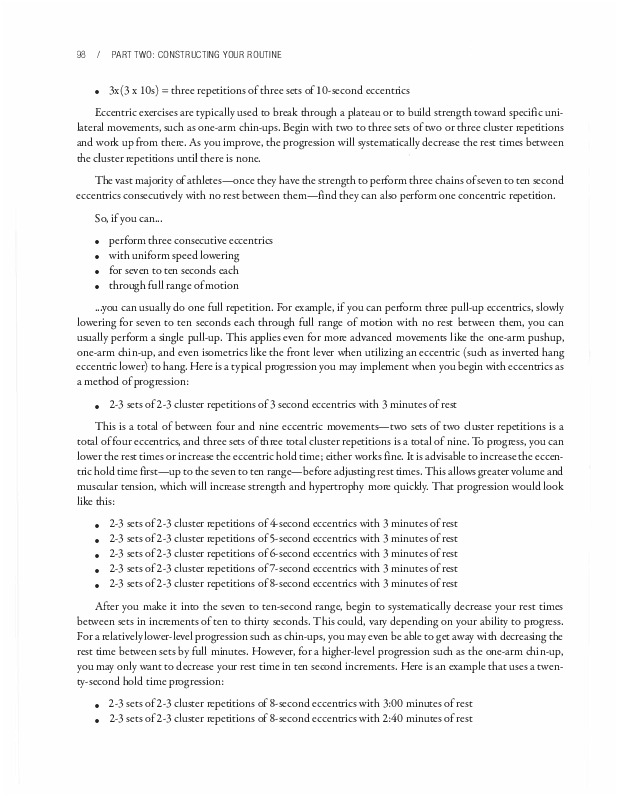
So, if you can...
...you can usually do one full repetition. For example, if you can perform three pull-up eccentrics, slowly lowering for seven to ten seconds each through full range of motion with no rest between them, you can usually perform a single pull-up. This applies even for more advanced movements like the one-arm pushup, one-arm chin-up, and even isometrics like the front lever when utilizing an eccentric (such as inverted hang eccentric lower) to hang. Here is a typical progression you may implement when you begin with eccentrics as a method of progression:
This is a total of between four and nine eccentric movements-two sets of two cluster repeticions is a total of four eccentrics, and three sets of three total cluster repetitions is a total of nine. To progress, you can lower the rest times or increase the eccentric hold time; either works fine. It is advisable to increase the eccentric hold time first-up to the seven to ten range-before adjusting rest times. This allows greater volume and muscular tension, which will increase strength and hypertrophy more quickly. That progression would look like this:
after you make it into the seven to ten-second range, begin to systematically decrease your resc times between sets in increments often to thirty seconds. This could, vary depending on your abilicy to progress. For a relatively lower-level progression such as chin-ups, you may even be able to get away with decreasing the rest time between sets by full minutes. However, for a higher-level progression such as the one-arm chin-up, you may only want to decrease your rest time in ten second increments. Here is an example that uses a twenty-second hold time progression:
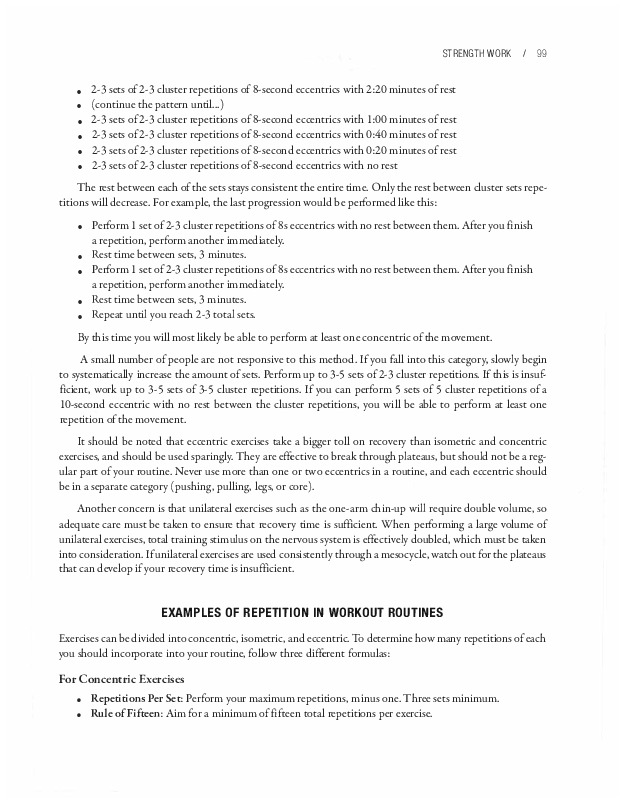
The rest between each of the sets stays consistent the entire time. Only the rest between cluster sets repetitions will decrease. For example, the last progression would be performed like this:
By this time you will most likely be able to perform at least one concentric of the movement. A small number of people are not responsive to this method. If you fall into this category, slowly begin to systematically increase the amount of sets. Perform up to 3-5 sets of 2-3 cluster repetitions. If this is insufficient, work up to 3-5 sets of 3-5 cluster repetitions. If you can perform 5 sets of 5 cluster repetitions of a 10-second eccentric with no rest between the cluster repetitions, you will be able to perform at least one repetition of the movement.
It should be noted that eccentric exercises take a bigger toll on recovery than isometric and concentric exercises, and should be used sparingly. They are effective to break through plateaus, but should not be a regular part of your routine. Never use more than one or two eccentrics in a routine, and each eccentric should be in a separare category (pushing, pulling, legs, or core).
Another concern is that unilateral exercises such as the one-arm chin-up will require double volume, so adequate care must be taken to ensure that recovery time is sufficient. When performing a large volume of unilateral exercises, total training stimulus on the nervous system is effectively doubled, which must be taken into consideration. If unilateral exercises are used consistently through a mesocycle, watch out for the plateaus that can develop if your recovery time is insufficient.
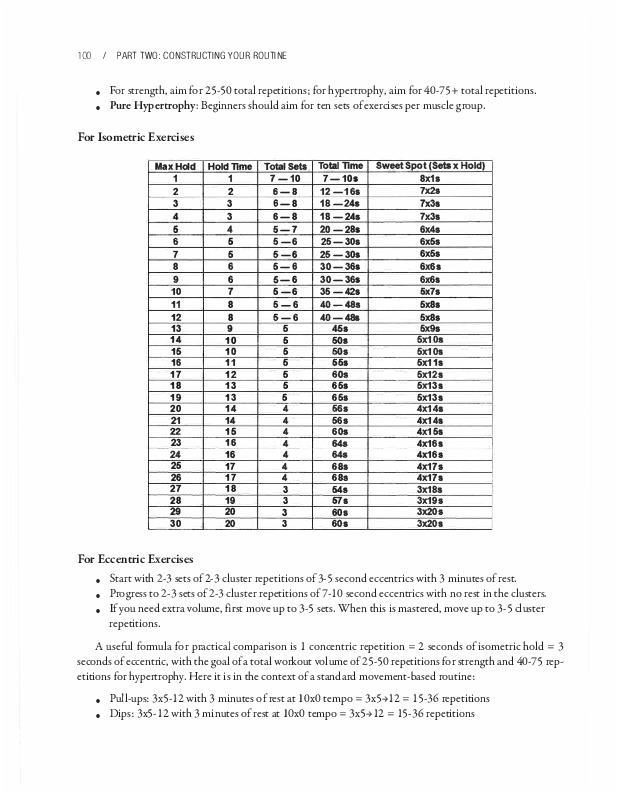
Exercises can be divided into concentric, isometric, and eccentric. To determine how many repetitions of each you should incorporare into your routine, follow three different formulas:
For Concentric Exercises
For Isometric Exercises
| Max Hold | Hold Time | Total Sets | Total Time | Sweet Spot (Sets x Hold) |
|---|---|---|---|---|
| 1 | 1 | 7-10 | 7-10s | 8x1s |
| 2 | 2 | 6-8 | 12-16s | 7x2s |
| 3 | 3 | 6-8 | 18-248 | 7x3s |
| 4 | 3 | 6-8 | 18-24s | 7x3s |
| 5 | 4 | 5-7 | 20-28s | 6x4s |
| 6 | 5 | 5-6 | 25-30s | 6x5s |
| 7 | 5 | 6-6 | 26-30s | 6x5s |
| 8 | 6 | 5-6 | 30-36s | 6x6s |
| 9 | 6 | 5-6 | 30-36s | 6x6s |
| 10 | 7 | 5-6 | 35-42s | 5x7s |
| 11 | 8 | 5-6 | 40-488 | 5x8s |
| 12 | 8 | 6-6 | 40-48s | 5x8s |
| 13 | 9 | 6 | 46s | 5x9s |
| 14 | 10 | 5 | 50s | 5x10s |
| 15 | 10 | 5 | 50s | 5x10s |
| 16 | 11 | 6 | 66s | 5x11s |
| 17 | 12 | 6 | 60s | 5x12s |
| 18 | 13 | 5 | 65s | 5x13s |
| 19 | 13 | 5 | 65s | 5x13s |
| 20 | 14 | 4 | 56s | 4x14s |
| 21 | 14 | 4 | 56s | 4x14s |
| 22 | 15 | 4 | 60s | 4x15s |
| 23 | 16 | 4 | 64s | 4x16s |
| 24 | 16 | 4 | 64s | 4x16s |
| 25 | 17 | 4 | 68s | 4x17s |
| 26 | 17 | 4 | 68s | 4x17s |
| 27 | 18 | 3 | 64s | 3x18s |
| 28 | 19 | 3 | 67s | 3x19s |
| 29 | 20 | 3 | 60s | 3x20s |
| 30 | 20 | 3 | 60s | 3x20s |
For Eccentric Exercises
A useful formula for practical comparison is 1 concentric repetition= 2 seconds of isometric hold= 3 seconds of eccentric, with the goal of a total workout volume of 25-50 repetitions for strength and 40-75 repetitions for hypertrophy. Here it is in the context of a standard movement-based routine:
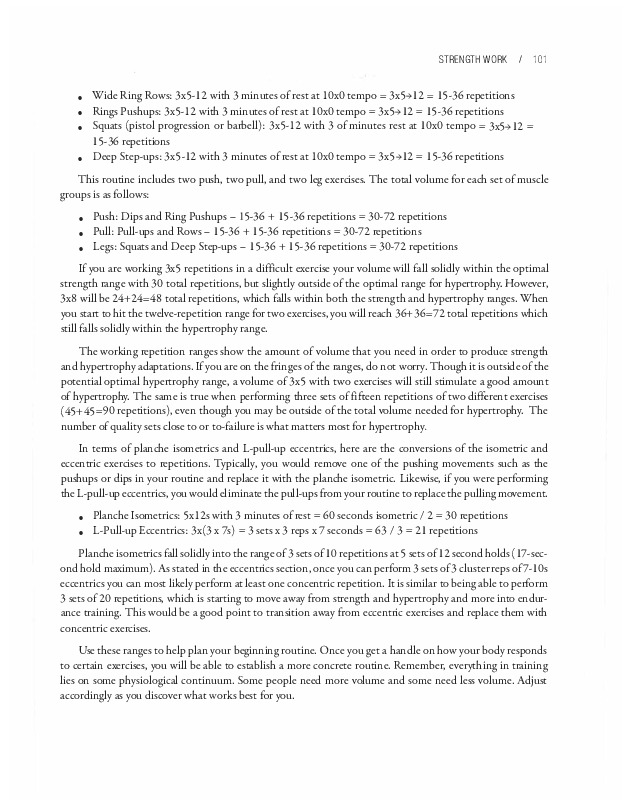
If you are working 3x5 repetitions in a difficult exercise your volume will fall solidly within the optimal strength range with 30 total repetitions, but slightly outside of the optimal range for hypertrophy. However, 3x8 will be 24+24=48 total repetitions, which falls within both the strength and hypertrophy ranges. When you start to hit the twelve-repetition range for two exercises, you will reach 36+36=72 total repetitions which still falls solidly within the hypertrophy range.
The working repetition ranges show the amount of volume that you need in order to produce strength and hypertrophy adaptations. If you are on the fringes of the ranges, do not worry. Though it is outside of the potential optimal hypertrophy range, a volume of 3x5 with two exercises will still stimulate a good amount of hypertrophy. The same is true when performing three sets of fifteen repetitions of two different exercises (45+45=90 repetitions), even though you may be outside of the total volume needed for hypertrophy. The number of quality sets close to or to-failure is what matters most for hypertrophy.
In terms of planche isometrics and L-pull-up eccentrics, here are the conversions of the isometric and eccentric exercises to repetitions. Typically, you would remove one of the pushing movements such as the pushups or dips in your routine and replace it with the planche isometric. Likewise, if you were performing the L-pull-up eccentrics, you would eliminate the pull-ups from your routine to replace the pullingmovement.
Planche isometrics fall solidly into the range of 3 sets of 10 repetitions at 5 sets of 12 second holds (17-secondhold maximum). As stated in the eccentrics section, once you can perform 3 sets of 3cluster reps of 7-10s eccentrics you can most likely perform at least one concentric repetition. It is similar to being able to perform 3 sets of 20 repetitions, which is starting to move away from strength and hypertrophy and more into endurance training. This would be a good point to transicion away from eccentric exercises and replace them with concentric exercises.
Use these ranges to help plan your beginning routine. Once you get a handle on how your body responds to certain exercises, you will be able to establish a more concrete routine. Remember, everyching in training lies on some physiological continuum. Some people need more volume and some need less volume. Adjusc accordingly as you discover whac works best for you.
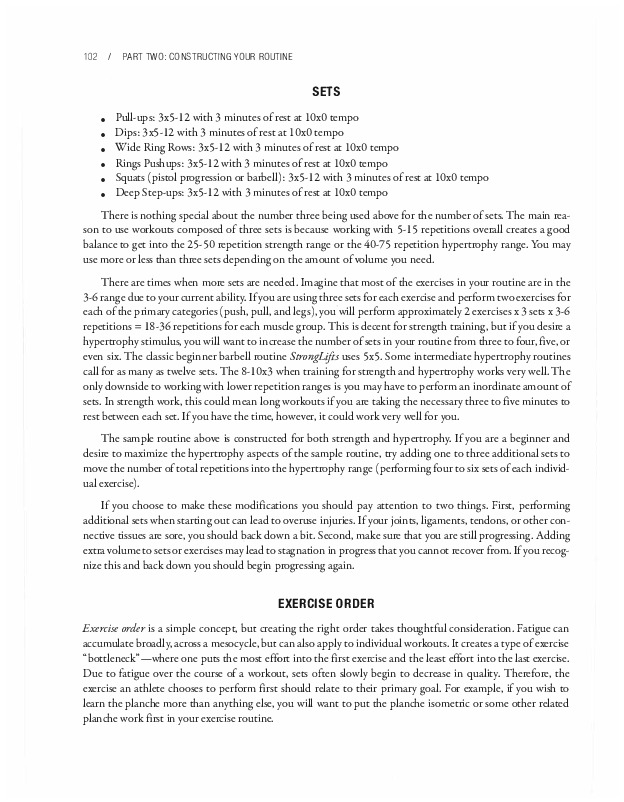
There is nothing special about the number three being used above for the number of sets. The main reason to use workouts composed of three sets is because working with 5-15 repetitions overall creares a good balance to get into the 25-50 repetition strength range or the 40-75 repetition hypertrophy range. You may use more or less than three sets depending on the amount of volume you need.
There are times when more sets are needed. Imagine that most of the exercises in your routine are in the 3-6 range due to your current ability. If you are using three sets for each exercise and perform two exercises for each of the primary categories (push, pull, and legs), you will perform approximately 2 exercises x 3 sets x 3-6 repetitions = 18-36 repetitions for each muscle group. This is decent for strength training, but if you desire a hypertrophy stimulus, you will want to increase the number of sets in your routine from three to four, five, or even six. The classic beginner barbell routine StrongLifts uses 5x5. Some intermediate hypertrophy routines call for as many as twelve sets. The 8-10x3 when training for strength and hypertrophy works very well. The only downside to working with lower repetition ranges is you may have to perform an inordinate amount of sets. In strength work, this could mean long workouts if you are taking the necessary three to five minutes to rest between each set. If you have the time, however, it could work very well for you.
The sample routine above is constructed for both strength and hypertrophy. If you are a beginner and desire to maximize the hypertrophy aspects of the sample routine, try adding one to three additional sets to move the number of total repetitions into the hypertrophy range (performing four to six sets of each individual exercise).
If you choose to make these modifications you should pay attention to two things. First, performing additional sets when starting out can lead to overuse injuries. If your joints, ligamenes, tendons, or other connective tissues are sore, you should back down a bit. Second, make sure that you are still progressing. Adding extra volume to sets or exercises may lead to stagnation in progress that you cannot recover from. If you recognize this and back down you should begin progressing again.
Exercise order is a simple concept, but creating the righc order takes thoughcful consideration. Fatigue can accumulate broadly, across a mesocycle, but can also apply to individual workouts. It creares a type of exercise "bottleneck"-where one puts the most effort into the first exercise and the least effort into the last exercise.
Due to fatigue over the course of a workout, sets afeen slowly begin to decrease in quality. Therefore, the exercise an athlete chooses to perform first should relate to their primary goal. For example, if you wish to learn the planche more than anything else, you will want to put the planche isometric or some other related planche work first in your exercise routine.

This can even occur within a single exercise. Most bodyweight trainers are familiar with degradation in exercise performance over the course of a workout. In a 3x5-repetition, you should typically be able to complete the first set one repetition short of failure. However, you may be struggling to complete the flfth repetition by your third set. If you extended the sets indeflnitely, you likely would not be able to complete five repetitions by the fourth, flfth, or sixth set. This accumulated fatigue applies to all exercises that follow your first exercise. If the second exercise in your routine is the front lever, the quality of your work will slowly decrease as the number of overall sets increases over the course of the workout.
The percentages of maximal possible effort drop off by a couple of points with every additional set of exercises you perform. By the time you do fifteen total sets of exercises-or three sets of five exercises-you will likely only be operating at 90-95% of your capacity level. You will not notice this unless you constandy vary your exercise order.
In light of all of this, you should prioritize the exercises you perform to align with your goals. If you have goals for pushing, pulling, and legs, respectively, you should prioritize the goals you wish to reach first and prioritize those exercises accordingly. Take a look at the order in this sample bodyweight routine:
If your primary goal is improving planche and L-pull-up progressions, then you will order these first. From there, you might choose leg exercises to be your next priority. Finally, the rest of your upper-body workout may be prioritized last, because you have no particular preference here. In that instance, the order of exercises would look like this:
If you want to improve on dips and rows more quickly, simply move them to the top of the routine. You will notice that the quality of work for the dips and rows will increase. This is the best way to structure your routine according to your goals. It is impossible to operate at 100% capacity over the duration of every workout. Additionally, changing and modifying your exercise order can be a good way to break out of monotony while still working toward your specific goals.
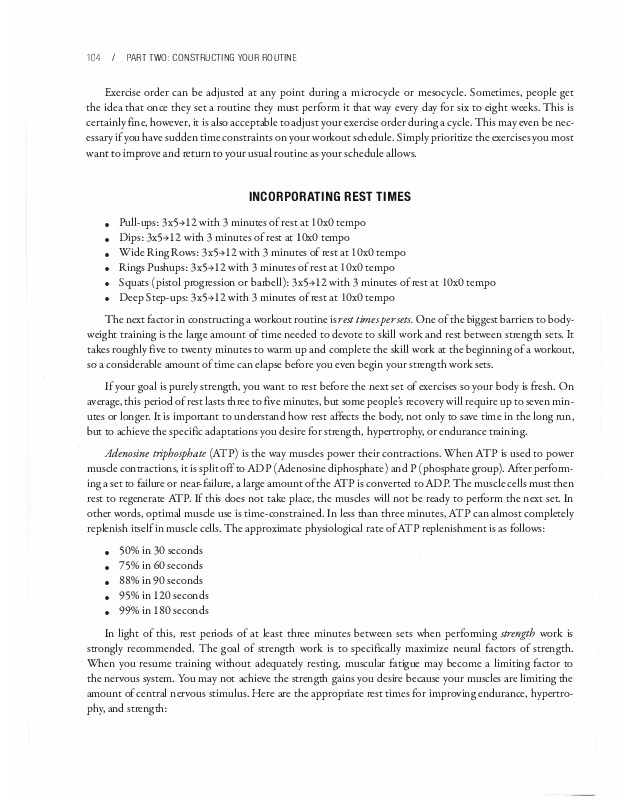
Exercise order can be adjusted at any point during a microcycle or mesocycle. Sometimes, people get the idea that once they set a routine they must perform it that way every day for six to eight weeks. This is certainly fine, however, it is also acceptable to adjust your exercise order during a cycle. This may even be necessary if you havesudden time constraints on your workout schedule. Simply prioritize the exercises you most want to improve and return to your usual routine as your schedule allows.
The next factor in constructing a workout routine is rest times per sets. One of the biggest barriers to bodyweight training is the large amount of time needed to devote to skill work and rest between strength sets. 1t takes roughly five to twenty minutes to warm up and complete the skill work at the beginning of a workout, so a considerable amount of time can elapse before you even begin your strength work sets.
If your goal is purely strength, you want to rest before the next set of exercises so your body is fresh. On average, this period of rest lasts three to five minutes, but some people's recovery will require up to seven minutes or longer. It is important to understand how rest affects the body, not only to save time in the long run, but to achieve the specific adaptations you desire for strength, hypertrophy, or endurance training.
Adenosine triphosphaté (ATP) is the way muscles power their contractions. When ATP is used to power muscle contractions, it is split off to ADP (Adenosine diphosphate) and P (phosphate group). After performing a set to failure or near-failure, a large amount of the ATP is converted to ADP. The muscle cells must then rest to regenerate ATP. If this does not take place, the muscles will not be ready to perform the next set. In other words, optimal muscle use is time-constrained. In less than three minutes, ATP can almost completely replenish itselfin muscle cells. The approximate physiological rate of ATP replenishment is as follows:
In light of this, rest periods of at least three minutes between sets when performing strength work is strongly recommended. The goal of strength work is to specifically maximize neural factors of strength. When you resume training without adequately resting, muscular fatigue may become a limiting factor to the nervous system. You may not achieve the strength gains you desire because your muscles are limiting the amount of central nervous stimulus. Here are the appropriate rest times for improving endurance, hypertrophy, and strength:
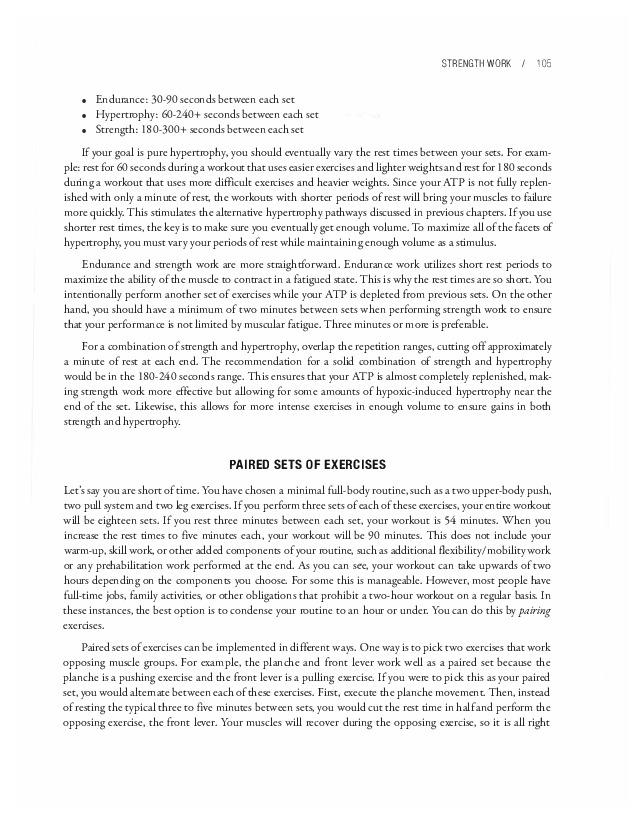
If your goal is pure hypertrophy, you should eventually vary the rest times between your sets. For example: rest for 60 seconds during a workout that uses easier exercises and lighter weights and rest for 180 seconds during a workout that uses more difficult exercises and heavier weights. Since your ATP is not fully replenished with only a minute of rest, the workouts with shorter periods of rest will bring your muscles to failure more quickly. This stimulates the alternative hypertrophy pathways discussed in previous chapters. If you use shorter rest times, the key is to make sure you eventually get enough volume. To maximize all of the facets of hypertrophy, you muse vary your periods of rest while maintaining enough volume as a stimulus.
Endurance and strength work are more straightforward. Endurance work utilizes short rest periods to maximize the ability of the muscle to contract in a fatigued state. This is why the rest times are so short. You intentionally perform another set of exercises while your ATP is depleted from previous sets. On the other hand, you should have a minimum of two minutes between sets when performing strength work to ensure that your performance is not limited by muscular fatigue. Three minutes or more is preferable.
For a combination of strength and hypertrophy, overlap the repetition ranges, cutting off approximately a minute of rest at each end. The recommendation for a solid combination of strength and hypertrophy would be in the 180-240 seconds range. This ensures that your ATP is almost completely replenished, making strength work more effective but allowing for some amounts of hypoxic-induced hypertrophy near the end of the set. Likewise, this allows for more intense exercises in enough volume to ensure gains in both strength and hypertrophy.
Let's say you are short of time. You have chosen a minimal full-body routine, such as a two upper-body push, two pull system and two leg exercises. If you perform three sets of each of these exercises, your entire workout will be eighteen sets. If you rest three minutes between each set, your workout is 54 minutes. When you increase the rest times to five minutes each, your workout will be 90 minutes. This does not include your warm-up, skill work, or other added components of your routine, such as additional flexibility/mobility work or any prehabilitation work performed at the end. As you can se'e, your workout can take upwards of two hours depending on the components you choose. For some this is manageable. However, most people have full-time jobs, family activities, or other obligations that prohibit a two-hour workout on a regular basis. In these instances, the best option is to condense your routine to an hour or under. You can do this bypairing exercises.
Paired sets of exercises can be implemented in different ways. One way is to pick two exercises that work opposing muscle groups. For example, the planche and front lever work well as a paired set because the planche is a pushing exercise and the front lever is a pulling exercise. If you were to pick this as your paired set, you would alternate between each of these exercises. First, execute the planche movement. Then, instead of resting the cypical three to five minutes between sets, you would cut the rest time in half and perform the opposing exercise, the front lever. Your muscles will recover during the opposing exercise, so it is all right
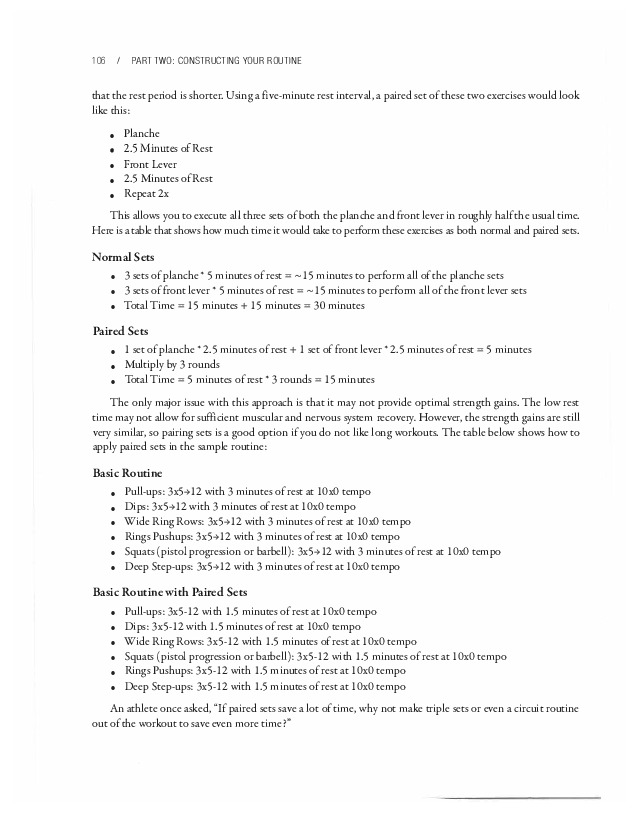
that the rest period is shorter. Using a five-minute rest interval, a paired set of these two exercises would look like this:
This allows you to execute all three sets of both the planche and front lever in roughly halfthe usual time. Here is a table that shows how much time it would take to perform these exercises as both normal and paired sets.
Normal Sets
Paired Sets
The only major issue with this approach is that it may not provide optimal strength gains. The low rest time may not allow for sufficient muscular and nervous system recovery. However, the strength gains are still very similar, so pairing sets is a good option if you do not like long workouts. The table below shows how to apply paired sets in the sample routine:
Basic Routine
Basic Routine with Paired Sets
An athlete once asked, "If paired sets save a lot of time, why not make triple sets or even a circuir routine out of the workout to save even more time?"
The answer is that performing three couplecs of two exercises is the same as performing two triplets of three exercises. The rest time between each of the sets does not change from couplecs to triplets, it nonetheless taxes the body more and cycling through a greater number of exercises is not beneficial for chose who desire strength and hypertrophy. For hypertrophy especially, this is a poor solution.
Another time-saving alcernacive is a push/pull or upper/lower splic. They work if you have serious time constraincs. This approach is not recommended unless you are also involved in another sport or have significant skill work that necessitates extra rest time from performing exercises three times per week. The reason for this is the decreased frequency of exercises. One last note is that paired sets should not be confused with super sets or drop sets.
Though they have similar names, they are actually three totally different techniques.
There are many different viewpoints on how to utilize tempo during training. Primarily we will focus on how tempo is used in strength and hypertrophy training. We will also take a look at how it can be used in rehabilitation.
Tempo is essentially how quickly you move in the concentric (up) and eccentric (down) portion of your repetitions and whether you rest between the repetitions. The preferred nomenclature of tempo is a fourplace format. For instance, 10x0 is the standard tempo. Here is an example of tempo for a pushup:
You will notice that tempo for pulling exercises (such as pull-ups) is reversed, as you start with the concentric. However, they are still notated in the same way:
The standard 10x0 tempo is recommended when training for strength and hypertrophy because it maximizes strength adaptations. This plays off Henneman's size principle. Discussed at length in Chapter 2, this principle states that low-threshold motor units (LTMUs) are recruited before medium-threshold motor units (MTMUs) and high-threshold motor units (HTMUs), in increasing order. Slow-twitch fibers are always recruited before fast-twitch fibers, ensuring the body conserves energy, as LTMUs are more resistant to fatigue.
The acceleration of the body, with good technique, at 10x0 tempo maximizes strength training because it will recruit all of the muscle fibers during the repetition. This increases the neural factors of strength, such as recruitment, synchronization, and rate coding. Studies have shown that fast repetitions are superior for strength and power in non-trained subjects. For hypertrophy, there may be a slight bias toward fast-twitch fibers over slow-twitch fibers, but this difference is not significant. The accelerating X tempo may also have a slight-and insignificant-increased hypertrophy effect due to recruitment of HTMUs earlier in the set. This gives them time to recover, be used again, and become a bit more fatigued over the course of performing a set to failure. Even so, beginners should use fast repetitions.
Hypertrophy is relatively similar for all tempos if the total time under tension or volume is the same. Whether you go slowly or fast with a weight, your muscle fibers are going to be fatigued at the end of the set if you perform it to failure. This is true if you do ten repetitions with a 10x0 tempo or five repetitions with a 5050 tempo, because you are still going to failure. Damaged muscles will repair and grow bigger according to the stress that is exerted on them. Beginners may find similar hypertrophy results with 40% 1 RM intensity and 85-90% 1 RM intensity.
The main question that is raised with a 10x0 tempo is what if the movement occurs very slowly, such as when the exercise is intense. Even if the repetitions do not move fast, it is the intent to move quickly that recruits your fast-twitch muscle fibers. Therefore, movements close to 1-4 RM are sufficient even if you are moving slowly.
This is not to say that slow repetitions are useless. You may choose to work with slower repetitions for a multitude of reasons including:
When first teaching someone a movement, utilizing a slower tempo such as 2020 or 2121 can have particularly good results. The two-second concentric and eccentric components allow time toconsider and focuson technique while performing the exercise, and the pause allows the student to catch their breath and re-focus.
If you are injured or undergoing rehabilitation, an initial slower tempo such as 4040 or 4141 may be utilized because you want to focus on good movement patterns rather than pursuing strength or hypertrophy. In this case, a slow movement allows an injured athlete to focus on properly contracting all of their musele groups in a timing sequence. This is particularly effective with shoulder injuries, where various muscle compensations often occur. Likewise, if you are trying to prevent muscle strains, you may find it beneficial to utilize a slower eccentric phase such as 5120 in order to teach your body to maintain control during the movement. A slower eccentric phase also helps build up muscle resistance to prevent future injuries. If you have muscle strains that occur solely during the eccentric portion of an exercise, it is essential that eccentrics be a part of your rehabilitation work. Slower eccentrics can also be used for those experiencing tendonitis. Determine the tempo of your exercises based on your overall training needs. For all of the exercises we will construct in subsequent routines throughout this book, we will use a 10x0 tempo. As you get more experienced, you can play around to see how you respond.
An alternative to consider is choosing a routine with little or no isometric work. Some people, including this author, favor movement-based routines over strict isometric work. You do not have to perform isometric exercises to obtain isometric skills. It is possible to build up to crosses, straddle planche, full front lever, and other isometric exercises without performing much isometric work in training.
Some of the benefits of this style of training include a more balanced and overall better strength development for all ranges of motion. In short, this practice contributes to faster progression. It also leads to developing the ability to navigate unexpected movements, such as those that occur in parkour or martial arts, by training in primarily movement-based strength work. If your sport of hobby requires you to perform unexpected movements or quickly adapt to a new situation, it may be advantageous to eliminate isometric exercises from your routine.
Studies have indicated that isometric movements only confer strength within thirty degrees of the range of motion that is being worked. For the shoulder (which is the lynchpin of upper-body strength), thirty degrees is approximately one-tenth of the overall rotary movement it possesses. This is another reason not to focus in on solely perform isometric exercises on a regular basis.
Programming a routine based on the elimination of isometrics is simple. Instead of putting isometric movements such as the planche, front lever, and back lever into your routine; simply replace them with additional concentric exercises. For instance, you can replace the planche with a horizontal pushing movement such as planche progression pushups, pseudo planche pushups, other rings pushup variations, or dips and HSPUs. Eliminating planche isometrics does not mean you have to eliminate planche-focused work. The same is true for front lever, back lever, and other isometric holds. The front lever can be replaced with front lever rows progression, rowing movements, or even barbell and dumbbell work with bent-over rows or onearm dumbbell rows.
For those of you considering bodyweight strength training for isometrics like the planche, front lever, and back lever, it is strongly recommended that you keep isometric exercises in your routines.
There are three frequent goals in bodyweight training: 1) developing specific skills, such as the planche, 2) achieving specific isometric goals, while also developing all-around straight-arm and bent-arm strength, and 3) building a large amount of strength across a wide variety of exercises.
Those who focus on a specific exercise-in this case, the planche-will realize the most success if they base the majority of their pushing exercises on their specific goal. To achieve the planche, far example, you need to develop the specific isometric strength position in the shoulder, as well as the muscle mass and neurological strength to make it happen. In this particular instance, you would want to train the planche isometric hold as well as some of the alternative planche movement exercises suggested above: planche progression pushups, pseudo planche pushups, other rings pushup variations, or some other variation of movement like dips and HSPUs. In the exercise technique section of the book the most effective accessory movements to help develop certain isometric holds are covered, including suggested alternative routes far athletes who hit a plateau and are unsure of how to progress.
If you have goals far overall straight and bent-arm strength, begin with isometric holds in order to build up your connective tissues. Once you achieve this, place these isometric holds in either the warm-up or cooldown sections of your routine in order to maintain them. This will free up more space far isometrics and new movements.
Finally, those who simply want overall strength need not concern themselves with isometric holds. You will achieve most of them just by getting stronger. One example is achieving the straddle planche on rings solely by working pseudo planche pushups, ring dips progressions, and rings handstand pushups. The strength developed from these movements transfers fairly effectively.
For beginners, the recommendation is: support work, positioning drills, German hangs, and other straight-arm work as part of a warm-up, fallowed by handstands as skill work. This will build up your connective tissue strength before you begin working isometrics. It is important far beginners to create a strong base by gaining proficiency with dips, rows, pull-ups, and pushups variations (typically to level five or six) before transitioning their routines away from pull-ups and pushups to the back lever and the planche.
Core work is now included in the strength portion of the Overcoming Gravity basic routine, closer to the end. Pairing handstands and manna as opposing shoulder movements is still encouraged; however, they do not need to be paired at the same time in a routine. Having them coupled at the beginning of the workout led to a large amount of unnecessary fatigue, which interfered with the rest of the workout. Pushups, dips, and handstand pushup sets in particular suffered from this fatigue. A solid faundation with these exercises is particularly important, as the technique and strength developed from them lead to nearly every pushing progression in one way or another.
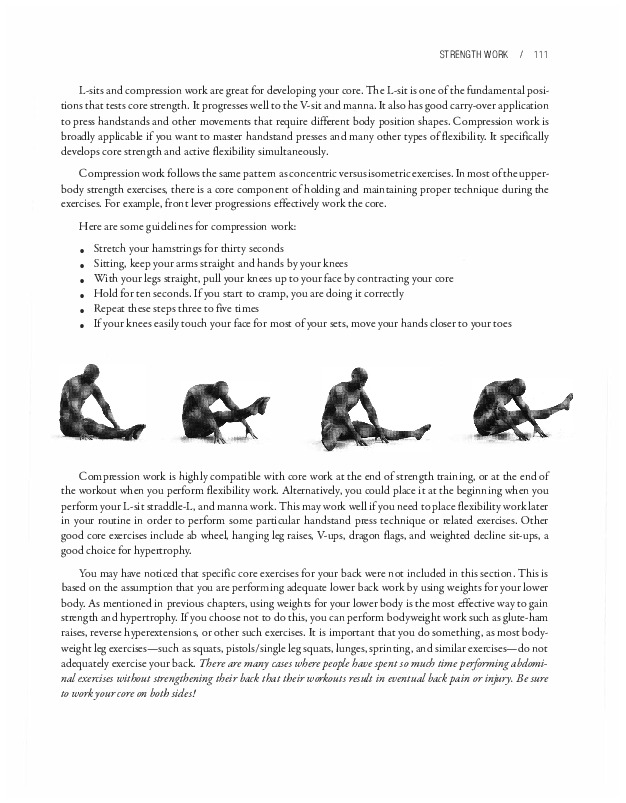
L-sits and compression work are great for developing your core. The L-sit is one of the fundamental positions that tests core strength. It progresses well to the V-sit and manna. It also has good carry-over application to press handstands and other movements that require different body position shapes. Compression work is broadly applicable if you want to master handstand presses and many other types of flexibility. It specifically develops core strength and active flexibility simultaneously.
Compression work follows the same pattern as concentric versus isometric exercises. In most of the upperbody strength exercises, there is a core component of holding and maintaining proper technique during the exercises. For example, front lever progressions effectively work the core.
Here are some guidelines for compression work:
Compression work is highly compatible with core work at the end of strength training, or at the end of the workout when you perform flexibility work. Alternatively, you could place it at the beginning when you perform your L-sit straddle-L, and manna work. This may work well if you need to place flexibility work later in your routine in order to perform some particular handstand press technique or related exercises. Other good core exercises include ab wheel, hanging leg raises, V-ups, dragon flags, and weighted decline sit-ups, a good choice for hypertrophy.
You may have noticed that specific core exercises for your back were not included in this section. This is based on the assumption that you are performing adequate lower back work by using weights for your lower body. As mentioned in previous chapters, using weights for your lower body is the most effective way to gain strength and hypertrophy. If you choose not to do this, you can perform bodyweight work such as glute-ham raises, reverse hyperextensions, or other such exercises. It is important that you do something, as most bodyweight leg exercises-such as squats, pistols/single leg squats, lunges, sprinting, and similar exercises-do not adequately exercise your back. There are many cases where people have spent so much time doing abdominal exercises without strengthening their back that their workouts result in eventual back pain or injury. Be sure to work your core on both sides!
Beginners initially become bigger and stronger by actually performing workouts. This is also where you learn and reinforce correct techniques. It is rarely a good idea to terminate a workout before finishing it. You will have days where you feel terrible as you start your workout. You may have thoughts along the lines of what's the point? I'm not very good at this, and I really don't feel up for trying today. However, beginners are often more capable than they believe. Pushing yourself through a workout builds a solid work ethic and helps you become more consistent. Cultivating good habits can result in the pleasant surprise of your body performing above and beyond your expectations. You may even set personal records if you follow through with a workout when you don't feel like it!
As you begin to progress toward higher skill levels, the fatigue you accumulate from stress or other factors may make you want to terminate a workout early or entirely. Most of the time, it is better for your body and psyche to finish the routine and work out your stress. However, there are times when it is better to call it quits for the day-particularly if your technique is terrible.
How do you determine if you should terminate your workout? Well, if the quality of your skill work is terrible, at least attempt another exercise or two before calling it a day. If you do not improve, don't feel bad about ending your routine early and taking some time to relax. If you are in the intermediate range, it's important that the quality of your workouts be high, so you may want to consider terminating your workout at this point. It's your calll
Once you reach the advanced skill level, you have a lot more flexibility. By this point you have learned how your body responds to a workout when you are tired and when you are fresh. You have the experience to discern if you will do poorly with certain exercises or skills, perhaps before you even begin your routine. In this instance, you may want to terminate a workout before beginning it. This is along the lines of instinctive or autoregulatory training. You need experience to use it effectively, but it can work very well if you adapt your workouts. Some people have the ability to do this without any training, but most people would rather do what they want and not listen to what their body needs. This is why beginners shouldpush throughfatigue and why intermediate, advanced, and elite athletes should make their own judgment calls.
There are infinite factors that can get you off-track: family life, a new baby, college exams, work demands, or just stress in your life in general. Ir is important to have a plan to keep life and fitness balanced. Remember why you are training and keep your eye on your goals. Hopefully you'll enjoy the process and exercise will not become a chore.
These are guidelines to assist you in using your own expertise as an athlete to make good judgment calls if a workout is not going as expected. Here are three scenarios where it is recommended that you terminate a workout:
The first two scenarios are obvious indicators that your workout will not be very high quality and could potentially worsen your condition. Be smart with your body and ensure it gets proper rest. Younger people often do not value rest, but rest is vital to make good progress toward your goals. Get rest when you need it and you'll be amazed at how much better you perform.
In the third scenario, you will generally want to terminate only the parts of your routine that aggravate your soreness or pain. You can switch to rehabilitation exercises for these parts of your routine and continue performing the rest as you usually would.
Total elimination of a workout in this scenario is a bad idea because it can get you in the habit of skipping workouts, when you should be rehabilitating your injury. Skipping workouts is especially prevalent in recreational sports and it can creare a negative cascade from not playing the sport, to not working out at all, to sitting around at home "resting." At this point, you are not actually rehabilitating your injury: you are becoming an inactive couch potato! This is why it is extremely important to not skip a workout when injured. Instead, modify it!
Previous Chapter ... ... Next Chapter